Bible study / Biblical figures / Aaron

Old Testament

Aaron

Exodus period (c. 1446 or 1250 BC)

priesthoodintercessionweaknessidolatryatonement

The Story of Aaron

Aaron, a central figure in the Exodus period, stands out as the brother of Moses and the first high priest of Israel. This era, traditionally dated to around 1446 or 1250 BC, unfolds in the harsh terrain of the Sinai Peninsula as the Israelites transition from Egyptian bondage to becoming a covenant nation under Yahweh. Aaron’s journey begins when God appoints him as Moses' spokesman. Moses, reluctant to speak due to a speech impediment, relies on Aaron’s eloquence to convey God’s messages to Pharaoh and the Israelites (Exodus 4:14-16). This partnership underscores Aaron’s initial role as a supportive figure, setting the stage for his future leadership.

However, Aaron’s path takes a startling detour with the incident of the golden calf. While Moses communes with God atop Mount Sinai, Aaron succumbs to the people's demands for a tangible deity. He collects their gold, melts it down, and fashions a golden calf, proclaiming it as the god who led them out of Egypt (Exodus 32:2-4). This act of idolatry, starkly contrasting with his sacred role, reveals a profound weakness. In the absence of Moses, Aaron’s failure to uphold the covenantal faith endangers the nascent nation’s spiritual integrity. His actions jar against his destined role as a spiritual leader, casting doubt on his suitability for priesthood.

Despite this grave error, Aaron is consecrated as the high priest, a position that solidifies his standing in Israelite worship. Leviticus 8:6-12 describes his anointing, setting him apart to serve in the tabernacle. Yet, Aaron’s leadership faces further challenges. In Numbers 12:1-2, he joins Miriam in questioning Moses’ authority, driven by personal grievances over Moses’ Cushite wife. This rebellion not only strains familial bonds but also tests the stability of Israel’s leadership structure. Miriam’s subsequent punishment with leprosy and Aaron’s plea for her healing reveal a family dynamic fraught with tension yet underscored by a reluctant adherence to Moses’ divinely appointed role.

Aaron’s story concludes with his death on Mount Hor, an event marked by the transfer of his priestly garments to his son Eleazar (Numbers 20:28). This transition signifies the continuity of the priestly line despite Aaron’s earlier failings. His legacy carries into the New Testament, where Hebrews 5:4 references Aaron’s divine appointment, and Luke 1:5 traces the lineage of John the Baptist to him. These mentions place Aaron firmly in the broader biblical narrative, linking his life and role as a high priest to the unfolding story of faith and intercession.

Who Was Aaron

The term כֹּהֵן (kohen), meaning "priest," is central to understanding Aaron's role in the biblical narrative. This word first appears in Exodus 28:1, where God commands Moses to bring Aaron and his sons to serve as priests. Aaron is not merely called a priest; he embodies the role through his actions. As the first high priest of Israel, Aaron is responsible for performing sacrifices and interceding on behalf of the people. His priesthood is a defining characteristic, setting him apart as a mediator between God and the Israelites. Yet, Aaron's story is not solely one of spiritual leadership; it is marked by moments of profound failure and vulnerability. In Exodus 32:2-4, Aaron, succumbing to the demands of the people, constructs a golden calf, demonstrating a susceptibility to public pressure that complicates his legacy as a kohen.
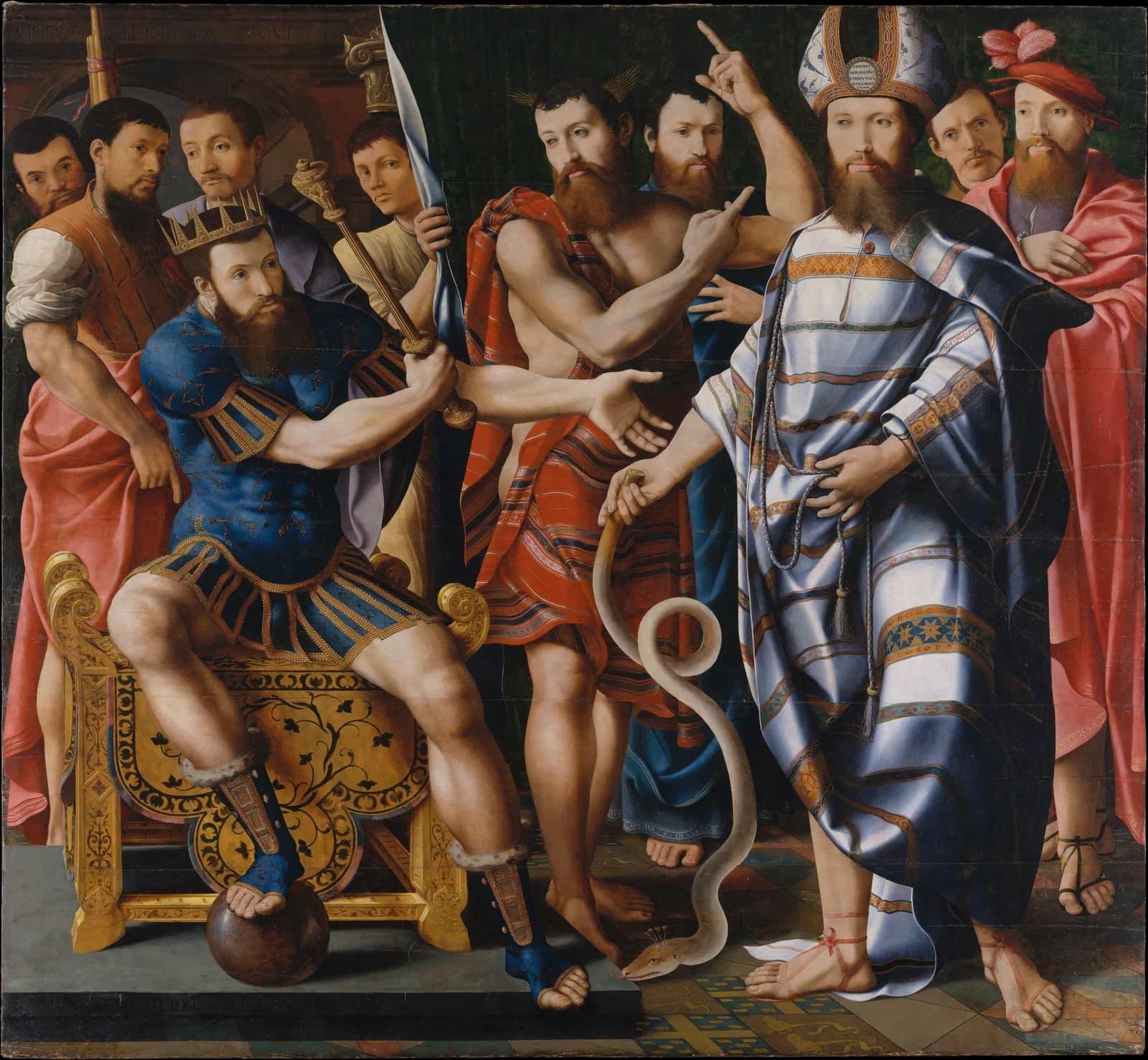
Aaron's pivotal decisions reveal a complex character shaped by both obedience and weakness. In Leviticus 9:8-24, Aaron faithfully performs his priestly duties, offering sacrifices as commanded by God through Moses. This obedience underscores his commitment to his divine role. However, his decision to create the Golden Calf in Exodus 32:1-4, during Moses' prolonged absence on Mount Sinai, exposes a critical flaw in his leadership. While Moses often displays resolute leadership and direct communication with God, Aaron falters under pressure, opting for an action that appeases the people but betrays his priestly mission. In contrast to Moses' unwavering authority, Aaron’s choices highlight the tension between his role as a leader and his human frailties.

Modern readings of Aaron often simplify his character, focusing on his role as a faithful high priest while neglecting his moral and leadership failures. This one-dimensional view overlooks significant episodes that illustrate Aaron's human weaknesses. The Golden Calf incident, for instance, is a moment of complicity and failure that complicates the narrative of a steadfast religious leader. The text reveals Aaron as a man who, despite his divine appointment, grapples with the same vulnerabilities and pressures faced by any leader. Such complexities are often lost in popular interpretations that emphasize his priestly functions at the expense of his full, flawed humanity. The biblical account offers a more nuanced portrait, where Aaron's actions and choices reveal the intricate balance of faith, duty, and human imperfection.

The Significance of Aaron

Aaron's story highlights the paradox of divine election, where God chooses flawed individuals to fulfill sacred roles. This paradox is vividly illustrated in Aaron's involvement with the golden calf (Exodus 32:4) and his consecration as Israel's first high priest (Exodus 28-29). The Hebrew term כֹּהֵן (kohen) underscores Aaron's pivotal role as a mediator between God and the people of Israel. Despite his human imperfections, Aaron's priesthood signifies the necessity of holiness and atonement in approaching God. His consecration, detailed in Exodus 28-29, establishes the priesthood's foundational role in the community's spiritual life, demanding both ritual purity and moral integrity.

Aaron's narrative addresses several theological themes, including intercession, idolatry, and human weakness. As a mediator, Aaron's role is crucial during the rebellion of Korah, where he stands between the living and the dead to stop a plague (Numbers 16:46-50). This intercessory function emphasizes his position as a bridge between the divine and the human. Conversely, Aaron’s involvement in the golden calf incident (Exodus 32:4) reveals the vulnerability of leadership to communal sin and peer pressure. His compliance with the people's demands for an idol highlights the fragility of human nature, even among divinely appointed leaders. Aaron's story also engages with the theme of atonement, seen in the rituals of the Day of Atonement (Leviticus 16), where he makes atonement for the sins of the people. This typological aspect of Aaron's priesthood points forward to the New Testament, where the author of Hebrews contrasts Aaron's temporary priesthood with Christ's eternal one (Hebrews 5:4-5).

While Aaron's narrative does not intersect directly with a gentile dimension or the Messianic line, his role as a high priest places him at an important intersection of the Biblical narrative. He serves as a precursor to the ultimate High Priest, a role fulfilled by Christ, offering a pattern of mediation that is both temporary and flawed compared to the perfection found in Jesus. Aaron's sons, Nadab and Abihu, offer another dimension to his story, as they perish for offering unauthorized fire before the Lord (Leviticus 10:1-2). This event underscores the severe consequences of failing to adhere to God's holiness standards, setting a sobering tone for the priesthood's responsibilities and the seriousness of divine worship.

The Legacy of Aaron

In Jewish tradition, Aaron is deeply venerated as the inaugural Kohen Gadol, or High Priest, a role that underscored his significance in Israel's religious life. The Talmud speaks of Aaron as a figure of peace and reconciliation, particularly in Sanhedrin 6b, where his efforts to bring harmony among people are extolled. The Pirkei Avot 1:12 highlights his peacemaking nature, urging followers to "be of the disciples of Aaron, loving peace and pursuing peace." His controversial involvement in the Golden Calf episode, narrated in Exodus 32, is interpreted with a degree of leniency in Midrash Tanchuma, Ki Tisa 19. Here, Aaron's actions are seen as an attempt to delay the people's sin, buying Moses time to return and restore order. Liturgically, Aaron's role is remembered during Torah readings, especially in Parashat Tetzaveh and Parashat Shemini, which focus on priestly duties and the sanctification process.

In Christian interpretation, Aaron's legacy is often examined through the lens of typology, where he is seen as a precursor to Christ's eternal priesthood. Church Fathers like Augustine explored Aaron's role as a mediator and intercessor, drawing parallels to Christ's function in the New Testament. The Epistle to the Hebrews (5:4) underscores this typology, using Aaron to highlight the divine appointment inherent in the priestly office, contrasting it with Christ's ultimate and eternal priesthood. During the Reformation, figures such as John Calvin critiqued Aaron's perceived weakness in the Golden Calf incident as a cautionary tale against the perils of idolatry and moral compromise. This narrative choice underscores a broader theological discourse around leadership and the human propensity for failure.

Beyond religious texts, Aaron's influence permeates various cultural domains. Artists like Nicolas Poussin vividly depicted the Golden Calf incident in works such as "The Adoration of the Golden Calf," capturing both Aaron's pivotal role and the fraught nature of idol worship. In literature, Aaron's character appears in Thomas Mann's "Joseph and His Brothers," reflecting on the complexities of leadership and familial loyalty. His name has transcended its biblical origins to become a metaphor for supportive figures in leadership contexts, often used to describe those who play secondary yet crucial roles. In modern discourse, Aaron's story touches on themes of leadership accountability and the moral dilemmas inherent in positions of power, prompting reflections on the balance between duty and integrity in both religious and secular spheres.