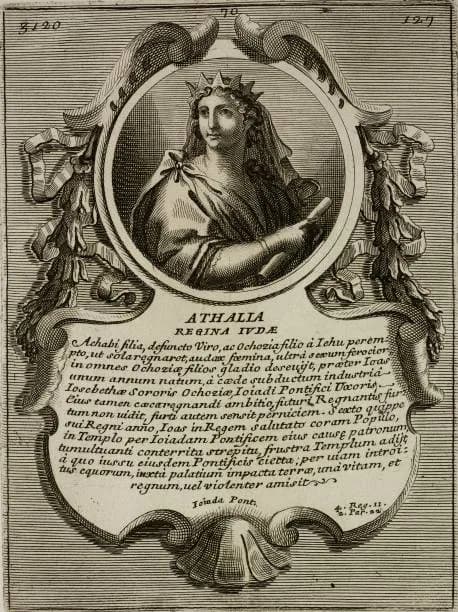
The Story of Athaliah
Athaliah, daughter of Ahab and Jezebel, emerges from a tumultuous backdrop in the Southern Kingdom of Judah around 840 BC. Her parents, the infamous rulers of the Northern Kingdom of Israel, promoted Baal worship, a legacy that Athaliah carried into Judah through her Marriage to King Jehoram. When her son, King Ahaziah, was killed, Athaliah seized the opportunity to consolidate power. In a move steeped in ambition and cruelty, she ordered the massacre of the royal family, as recorded in 2 Kings 11:1: "When Athaliah the mother of Ahaziah saw that her son was dead, she arose and destroyed all the royal family." This act of infanticide was intended to cement her position as queen regnant, a rare occurrence in the male-dominated monarchies of the time.
The massacre, however, was not as complete as Athaliah believed. Unknown to her, Jehosheba, the sister of Ahaziah and wife of the high priest Jehoiada, took a bold step to save the line of David. She hid Joash, Ahaziah's infant son, in the temple, away from Athaliah's murderous reach (2 Kings 11:2-3). Jehosheba's decision shows the deep intertwining of religious conviction and political maneuvering, as she risked her life to protect the rightful heir to the throne.
Six years later, Jehoiada, the high priest, orchestrates a coup to dethrone Athaliah. Gathering the captains of the guard and the Levites, Jehoiada devises a plan to anoint Joash as king. In a dramatic public ceremony described in 2 Kings 11:12, Joash is crowned in the temple courtyard, amid the cheers of the people and the sounding of trumpets. The coup reveals the fragile nature of Athaliah's power, built on treachery and fear. Her reign crumbles as the populace rallies around the young king.
Athaliah's downfall is swift. Upon hearing the commotion, she rushes to the temple, tearing her clothes and shouting, "Treason! Treason!" (2 Kings 11:14). Her cries, however, fall on deaf ears. The guards seize her and execute her at the Horse Gate of the palace grounds, ensuring that her blood is not shed within the sacred temple precincts. Joash's Ascension marks not just the end of Athaliah's rule but the preservation of the Davidic line, which continues to hold significance in biblical history. Joash's kingship is a crucial link in the genealogy of Jesus, as recorded in the Gospels, highlighting the enduring impact of Jehosheba's courageous act and Jehoiada's strategic intervention. Athaliah's character can be described by the Hebrew word "חָזָק" (chazaq), meaning strong, firm, or resolute. This word appears in contexts of power and determination, qualities that Athaliah displayed in her tumultuous reign as queen regnant of Judah. In 2 Kings 11:1, we see the ferocity of her resolve: "When Athaliah the mother of Ahaziah saw that her son was dead, she arose and destroyed all the royal family." Her actions were not those of a passive figure; rather, she took decisive and brutal measures to secure her position. As the daughter of Ahab and Jezebel, Athaliah inherited a legacy of idolatry and ambition, traits that she carried into her governance. Her ruthless decision to exterminate potential rivals, including her own grandchildren, shows her unyielding grip on power.