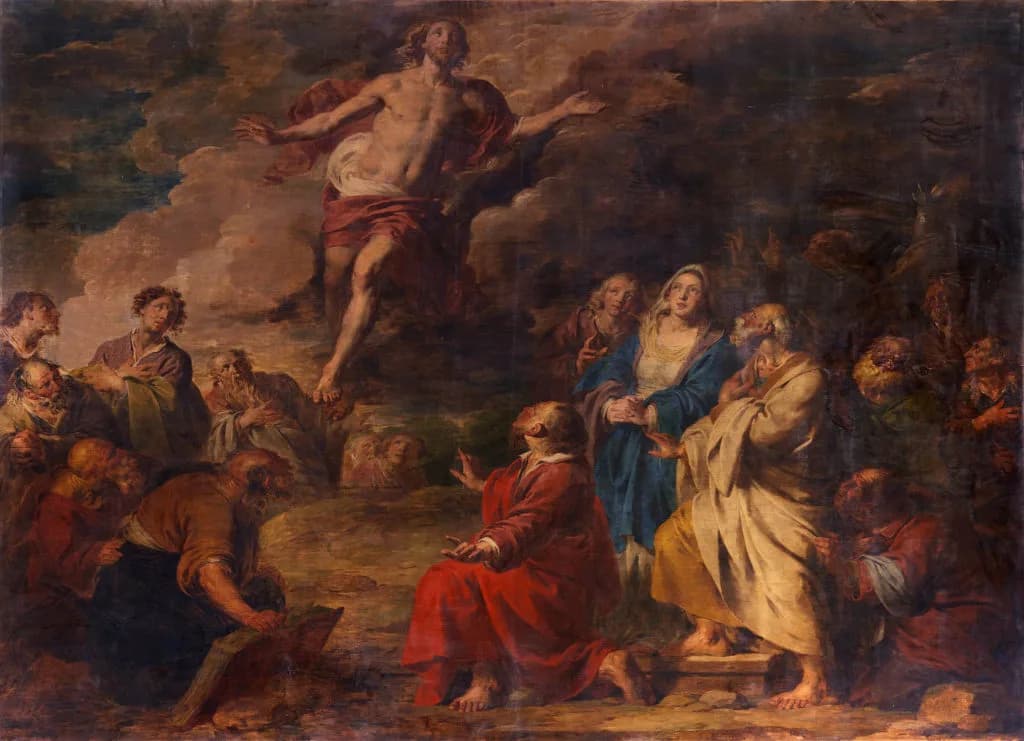
Ascension
Holidays & seasons · Updated August 15, 2026
Overview
During the early years of Christianity, the Feast of the Ascension lacked a fixed date and was celebrated in various ways by different communities. Some early Christian groups marked the Ascension as part of the broader Pentecost celebration, which occurs 50 days after Easter. At this time, the liturgical calendar was still taking shape, and the distinct events of Jesus' life were often commemorated together in a single, extended season of worship and reflection.
As Christianity grew and organized its practices, the fourth century marked a turning point for the Ascension. By this time, the event had gained recognition as a separate feast day. The Church of Constantinople played a key role in defining and spreading the liturgical calendar. Church leaders established the Ascension as an independent celebration, typically observed 40 days after Easter to reflect the biblical account of Jesus ascending to heaven 40 days following his resurrection. This decision helped to distinguish the Ascension from Pentecost, which remained fixed at 50 days after Easter.
Today, the Feast of the Ascension is widely observed on the 40th day of the Easter season, which always falls on a Thursday. This tradition is particularly strong in the Western Church, where the Ascension is celebrated as an event in its own right, marking the conclusion of Jesus' earthly ministry and his return to heaven. While some Eastern Christian communities may still observe the Ascension in conjunction with Pentecost, the 40-day interval has become the predominant practice worldwide, reflecting centuries of liturgical development and tradition.
The Feast of the Ascension was celebrated on different days in early Christianity, with some communities observing it as part of Pentecost.
Why Fighting Over Ascension Was a Big Deal
Fierce debates over the Ascension of Jesus were not merely about when or how to celebrate a feast day. At their core, these arguments were about authority and identity within the early Christian community. For many, the Ascension was not just a historical event but a statement affirming Jesus' divine nature. The implications were enormous: if Jesus truly ascended to heaven, it underscored his authority and validated the authority of church leaders who claimed to speak in his name. This battle concerned who held the legitimate power to interpret scripture and guide the burgeoning Christian faith. Church hierarchy and the unity of Christian doctrine were at stake.
In 325 AD, the Council of Nicaea became the battleground for these theological skirmishes, drawing in key figures like Emperor Constantine, Bishop Alexander of Alexandria, and Arius. The proto-Orthodox Christians, led by figures such as Irenaeus of Lyons, insisted on the physical Ascension as a literal event, reinforcing the divine authority of Christ and the church. Gnostic Christians, with leaders like Valentinus, pushed for a more symbolic interpretation, emphasizing personal spiritual enlightenment over institutional authority. Meanwhile, Arian Christians, led by Arius, challenged the full divinity of Christ, suggesting a hierarchy within the Trinity that placed Christ as secondary to God the Father. For the proto-Orthodox, winning meant solidifying a theological foundation for church leadership, while the Gnostics and Arians sought to reshape understanding in ways that suited their spiritual and doctrinal goals. The Nicene Creed emerged, affirming Christ's divinity, but the resolution was partial at best.
Despite the Council's efforts, the debates over Christ’s Ascension didn’t simply vanish. Theological disputes regarding the nature of Christ and how scripture should be interpreted continued to ripple through the church. Factions persisted, each clinging to their interpretations and evolving them in different directions as Christianity spread. The diversity of beliefs and practices across Christian traditions today reflects these unresolved tensions. Even as the Nicene Creed became a cornerstone of Christian orthodoxy, the arguments it sought to quell continued to shape the faith long after the council had ended. Varied Christian teachings across the globe today reflect the enduring nature of these debates.
Continue reading with a Scholar plan
Upgrade to ScholarCommon questions
- What is the Ascension of Jesus?
- The Ascension of Jesus refers to the event where Jesus was taken up to heaven 40 days after his resurrection, marking the end of his earthly ministry.
- Why is Ascension Day important in Christianity?
- Ascension Day is important because it commemorates Jesus' ascent to heaven, affirming his divine nature and the completion of his earthly mission.
- How is Ascension Day celebrated in different cultures?
- Ascension Day is celebrated with church services, processions, and sometimes public holidays, with variations depending on cultural and denominational practices.
- What does the Bible say about the Ascension?
- The Bible describes the Ascension in the Book of Acts, where Jesus is taken up into heaven in the presence of his disciples.
- Why do Christians celebrate Ascension Day?
- Christians celebrate Ascension Day to honor Jesus' return to heaven and to acknowledge his continued spiritual presence and authority.
- What is the significance of the Ascension in Christian theology?
- The Ascension signifies Jesus' exaltation and divine authority, reinforcing his role as mediator between God and humanity.
- How does the Ascension relate to the concept of the Holy Spirit?
- The Ascension is closely linked to the promise of the Holy Spirit, which Jesus said would come to empower his followers after his departure.
- What are the traditional hymns sung on Ascension Day?
- Traditional hymns for Ascension Day include 'Hail the Day That Sees Him Rise' and 'Crown Him with Many Crowns,' celebrating Jesus' triumph and kingship.
- How does the Ascension influence Christian beliefs about heaven?
- The Ascension reinforces the belief in heaven as a real place where Jesus reigns and where believers hope to join him after life on earth.
- What are the differences in how Protestant and Catholic churches observe Ascension Day?
- While both Protestant and Catholic churches observe Ascension Day, Catholics often hold special masses, whereas Protestant services may include additional hymns and sermons focused on the Ascension.
- Why is Ascension Day celebrated 40 days after Easter?
- Ascension Day is celebrated 40 days after Easter to align with the biblical account of Jesus ascending to heaven 40 days after his resurrection.
- What are common symbols associated with Ascension Day?
- Common symbols of Ascension Day include clouds, representing Jesus' ascent, and the image of Jesus rising above his disciples.
- How is the Ascension depicted in Christian art?
- Christian art often depicts the Ascension with Jesus rising into the sky, surrounded by clouds and angels, while his disciples watch from below.
- What role does the Ascension play in the liturgical calendar?
- The Ascension is a major feast in the liturgical calendar, marking the end of the Easter season and leading into Pentecost.
- Why is Ascension Day sometimes celebrated on Sunday instead of Thursday?
- Some churches move Ascension Day to the following Sunday to allow more congregants to participate, as Thursday is a regular workday in many places.