Bible study / Biblical figures / Boaz

Old Testament

Boaz

Period of the Judges (c. 1100s BC)

hesedkinsman-redeemerredemptionprovisionfaithfulnessgenerosity

The Story of Boaz

Boaz emerges during the tumultuous period of the Judges, a time marked by social and religious instability in Israel, where "everyone did what was right in his own eyes" (Judges 21:25). Living in Bethlehem, Boaz is a wealthy landowner, overseeing fields ripe for harvest. The famine that had earlier driven Naomi and her family to Moab (Ruth 1:1) has passed, setting the stage for the return of Naomi and her Moabite daughter-in-law, Ruth. Ruth, widowed and foreign, chooses to glean in the fields to support herself and Naomi. By chance, she ends up in Boaz's field, a twist of fate that sets the entire narrative in motion (Ruth 2:3).

Boaz notices Ruth while she gleans, inquiring about her identity and learning of her loyalty to Naomi. This prompts him to extend protection and provision, an act of generosity and kindness that transcends cultural boundaries (Ruth 2:5). The real turn occurs at the threshing floor when Ruth approaches Boaz, requesting him to spread his garment over her — a symbolic gesture asking for marriage and redemption (Ruth 3:9). Despite the social norms that might discourage such a union due to Ruth’s Moabite origin, Boaz is moved by her request. He acknowledges the presence of a nearer kinsman-redeemer but vows to resolve the matter, promising to marry Ruth if the other relative declines (Ruth 3:12-13).

The narrative takes a decisive turn as Boaz confronts the unnamed kinsman at the city gate, a traditional place for legal transactions. In a public act, Boaz redeems Naomi's land and claims Ruth as his wife, ensuring her security and preserving the family line (Ruth 4:9-10). This moment highlights Boaz's commitment to the law of levirate marriage and his willingness to embrace Ruth, defying cultural norms. The stakes are high, as these actions not only secure Ruth and Naomi's future but also integrate Ruth into the community.

In the resolution, Ruth gives birth to a son named Obed, who becomes the grandfather of King David (Ruth 4:17). This lineage extends far beyond the immediate concerns of the narrative. Boaz, once a figure of local prominence, is now forever linked to the Davidic line. This connection finds its ultimate significance in the genealogy of Jesus, as outlined in Matthew 1:5, where Boaz’s marriage to Ruth connects the lineage of Israel’s greatest king with the Savior of the world.

Who Was Boaz

The character of Boaz is best encapsulated by the Hebrew word "חֶסֶד" (hesed), which signifies loving-kindness and loyalty. This term, used in Ruth 3:10, reflects Boaz's actions throughout the Book of Ruth. He is introduced as a wealthy landowner in Bethlehem during the time of the Judges, a period marked by social instability and frequent disregard for the law. Yet Boaz stands out for his adherence to the legal and ethical standards set by God. When Ruth, a Moabite widow, arrives to glean in his fields, Boaz not only allows her to do so but also instructs his workers to leave extra grain for her (Ruth 2:15-16). His actions reveal a profound generosity and a willingness to extend kindness beyond the expectations of the law. Boaz acknowledges Ruth’s loyalty to Naomi and blesses her, saying, "The LORD repay you for what you have done" (Ruth 2:12). His compassion is rooted in hesed, which manifests in tangible support and protection.
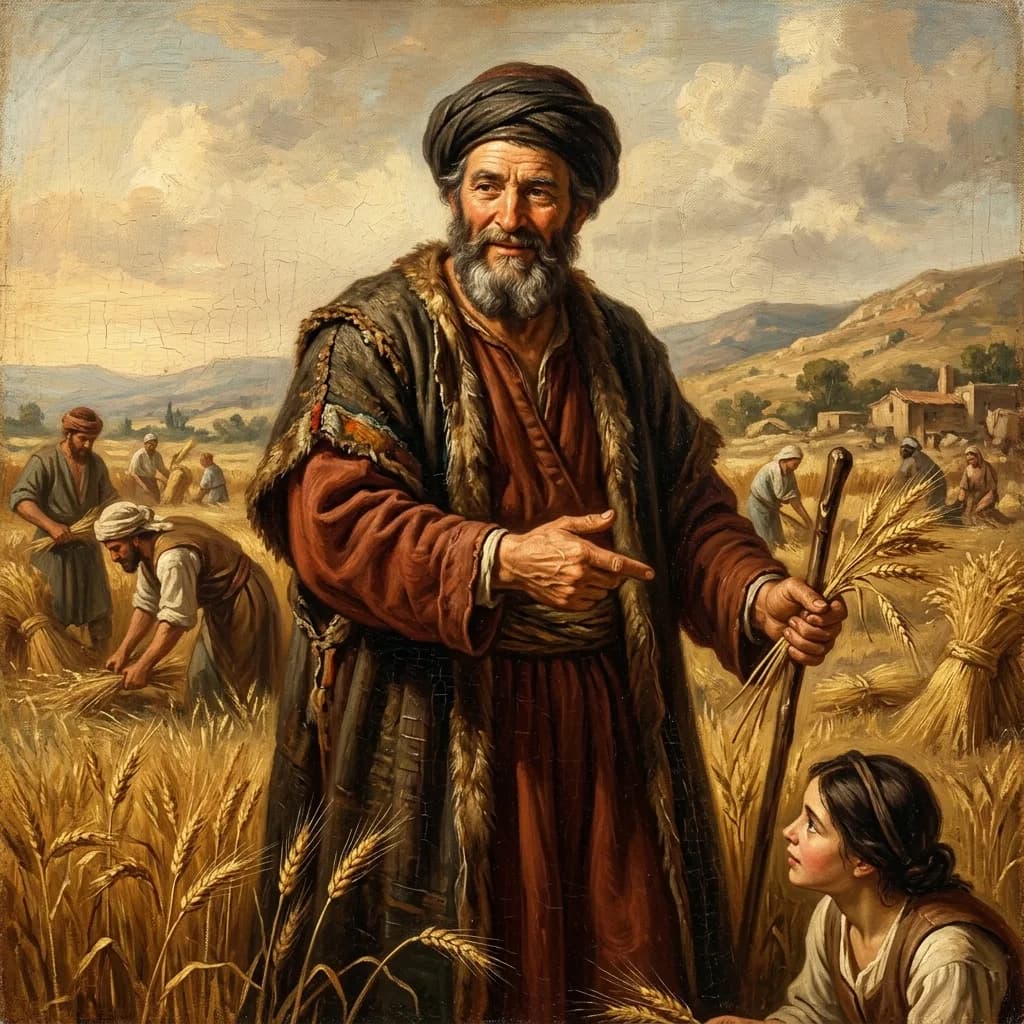
Boaz's defining decisions further illuminate his character. When faced with the opportunity to act as a kinsman-redeemer for Naomi's family, he first ensures that the closer relative has the chance to fulfill this duty (Ruth 4:1-6). This decision underscores his integrity and respect for legal procedures. The unnamed kinsman-redeemer, however, declines the opportunity, worried about jeopardizing his own inheritance. By contrast, Boaz willingly marries Ruth, thereby preserving the family line of Elimelech and securing Ruth and Naomi's future (Ruth 4:9-10). This decision reveals Boaz’s commitment to familial obligations and the welfare of others, even at personal cost. In Boaz’s choice, we see a selflessness that exceeds societal norms, highlighting his deep-seated faithfulness and willingness to embrace inclusivity by marrying a foreigner.

Popular readings often reduce Boaz to a benevolent benefactor in Ruth's story, but this simplification overlooks his strategic acumen and deep legal understanding. Boaz navigates the complexities of Israelite customs with precision, ensuring that every step he takes is both lawful and compassionate. For instance, his public transaction at the city gate in Ruth 4 demonstrates his awareness of social and legal protocols. The text does not portray him merely as a dispenser of charity but as a shrewd, principled man who balances kindness with a firm grasp of the law. By focusing solely on his generosity, modern interpretations risk flattening the rich dimensions of Boaz’s character, which include his intellect and his ability to effectuate change within the constraints of his society.

The Significance of Boaz

Boaz's role as a kinsman-redeemer in the Book of Ruth exemplifies God's provision and the inclusion of Gentiles in the covenant community through acts of hesed, or loving-kindness. The Hebrew term חֶסֶד captures the essence of Boaz's actions toward Ruth, a Moabite widow, as he provides for her and ultimately marries her, securing both her and Naomi's future. This narrative, found in Ruth 2-4, demonstrates the theological argument that divine care often manifests through human agency. When Boaz greets his workers with "The LORD be with you" (Ruth 2:4), it reflects his commitment to living out God's covenantal love in everyday interactions. His declaration to Ruth in Ruth 2:12, where he wishes her full reward under the wings of God, further anchors his actions in a framework of divine loyalty and protection.

The story of Boaz addresses several theological themes, starting with the concept of the kinsman-redeemer, or go'el. This role, crucial in Israelite society, required a relative to marry a widow and preserve the family line, as Boaz does in Ruth 4:9-10. By marrying Ruth, Boaz not only adheres to the legal obligations but also displays God's law of redemption and care for the vulnerable. Another significant theme is redemption, as Boaz's actions toward Ruth are a microcosm of divine restoration, prefiguring the ultimate redemption in Christ. The motif of provision is also evident; Ruth 2:14-16 describes Boaz ensuring Ruth and Naomi have ample food, demonstrating how God's providence works through human generosity. Boaz's unwavering faithfulness to the law and his integrity in dealing with Naomi and Ruth underscore the importance of covenant loyalty, as highlighted in Ruth 3:11.

Boaz's marriage to Ruth introduces a gentile dimension to the biblical narrative, emphasizing the inclusion of non-Israelites within God's plan. Ruth, a Moabite, becomes part of the covenant community through this union, as seen in Ruth 4:13, signaling an early biblical openness to ethnic diversity. Moreover, Boaz's place in the genealogy of Jesus, mentioned in Matthew 1:5, underscores the unexpected and diverse lineage through which the Messiah would come. This lineage not only highlights God's grace but also the breaking of ethnic barriers, illustrating a comprehensive redemptive plan. The concrete detail of Boaz purchasing all that belonged to Elimelech and taking Ruth as his wife in Ruth 4:9-10 encapsulates this intersection of law, love, and lineage, setting the stage for the arrival of King David and, eventually, Jesus.

The Legacy of Boaz

In Jewish tradition, Boaz is celebrated as a paragon of righteousness and hesed, a Hebrew term for loving-kindness. The Talmud, particularly in Bava Batra 91a, identifies Boaz with the judge Ibzan, who is noted for maintaining social justice during the tumultuous period of the Judges. This identification underscores Boaz's commitment to upholding the law and ensuring the welfare of his community. The Midrash Ruth Rabbah further highlights his exemplary behavior, particularly his generosity and adherence to the law in his interactions with Ruth. Boaz's role as a kinsman-redeemer, who marries Ruth to preserve her deceased husband's lineage, is read as an act of profound kindness and legal righteousness. In Jewish liturgy, Boaz is mentioned during the reading of the Book of Ruth on Shavuot, which not only commemorates the giving of the Torah but also the agricultural bounty that Boaz embodies through his harvest fields.

In Christian interpretation, Boaz assumes a typological role as a forerunner of Christ, the ultimate Redeemer. Church Fathers like Augustine saw Boaz's marriage to the Moabite Ruth as prefiguring the inclusion of Gentiles into the Christian Church, a theme that resonates with the message of universal grace and redemption. During the Reformation, Martin Luther emphasized Boaz's part in God's providential plan, highlighting themes of grace that transcend ethnic boundaries. Boaz's willingness to redeem and restore Ruth and Naomi's fortunes is seen as a reflection of Christ's redemptive work. In the Christian liturgical calendar, Boaz appears in readings for the feast of the Holy Family, emphasizing themes of family loyalty and divine faithfulness.

Beyond religious texts, Boaz's legacy permeates cultural works, such as John Bunyan's "The Pilgrim's Progress," where he symbolizes provision and protection. In art, he is often depicted in scenes of the harvest or his interactions with Ruth, embodying generosity and faithfulness. In a modern secular context, Boaz resonates as a figure of integrity and social responsibility. He touches on enduring themes of justice, compassion, and the importance of community support, making him a relevant symbol in contemporary discussions about social ethics and communal care. His story, though ancient, continues to be a touchstone for discussions about moral integrity and the power of steadfast kindness in society.