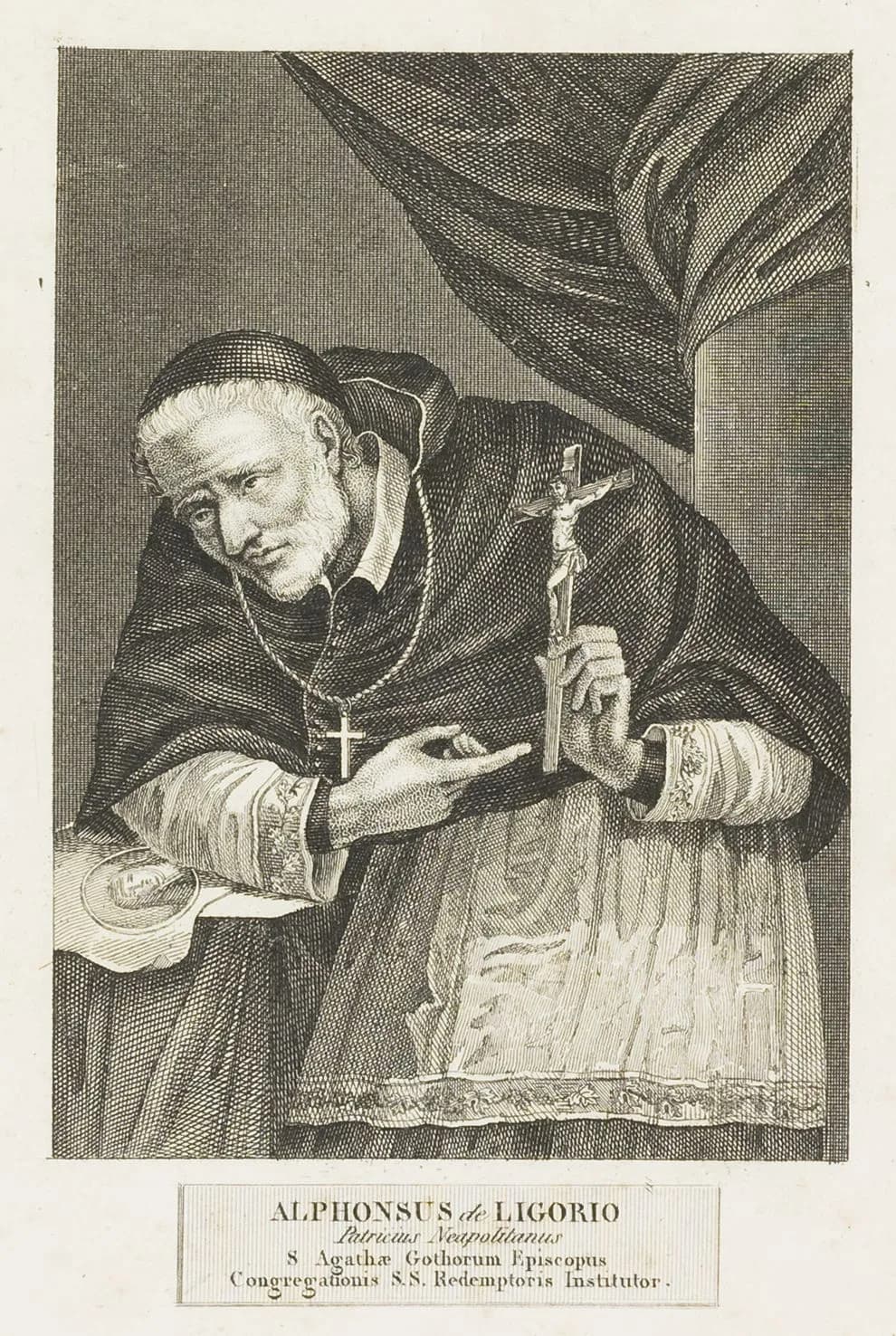
Alphonsus Liguori
theologianModern (17th C+) · 1696-1787 CE · Updated April 9, 2026
Biography
Alphonsus Liguori was an Italian bishop, founder of the Redemptorists, and Doctor of the Church, who lived from 1696 to 1787 and became the patron saint of moral theologians. He rose to prominence during a time of intense theological debate in the Catholic Church. Known for his groundbreaking work in moral theology and devotion to the Virgin Mary, Liguori's influence extended beyond his lifetime, leaving a lasting legacy on Catholic thought and practice.
Born on September 27, 1696, in Marianella near Naples, Alphonsus Liguori was destined for a life of religious and intellectual pursuit. He founded the Congregation of the Most Holy Redeemer, or the Redemptorists, in 1732 to serve the neglected rural poor. His life's work, "Moral Theology," published between 1748 and 1785, laid the foundations for Catholic moral teachings. In 1750, he authored "The Glories of Mary," advocating Marian devotion — a theme that stirred both admiration and critique. Liguori was recognized by Pope Pius IX as a Doctor of the Church in 1871, affirming his significant contributions to theology. He died on August 1, 1787, in Pagani, Italy.
Liguori's era was marked by theological tensions, particularly between laxism and rigorism in moral decisions. He navigated these waters by developing equiprobabilism, advocating a balanced approach to ethical dilemmas. The rise of Jansenism, with its somber take on predestination, contrasted sharply with Liguori's more approachable spirituality. His dedication to the rural poor and Marian devotion reflected broader Catholic themes, though they sometimes invited criticism for overshadowing Christ-centric worship. Amid these debates, Liguori's work offered a guiding light, and his influence continues, underscored by his status as patron saint of moral theologians.
How does Christian moral theology guide ordinary people through genuine ethical uncertainty — and how does devotion to Mary relate to devotion to Christ?
The ideas
Alphonsus Liguori dedicated his life to making Christian moral theology accessible and practical for everyday believers. He saw that many people struggled with moral uncertainty, often caught between strict and lenient interpretations of Church teachings. Liguori's central question was how to guide Christians through these ethical dilemmas with compassion and clarity. He believed that moral theology should not burden believers but instead offer them a path to holiness that acknowledges the complexities of real life.
Among his most significant ideas was equiprobabilism, which offered a way forward in moral decision-making. When faced with two equally probable opinions on a moral issue, Liguori argued that one could choose either option, especially the more lenient one. This approach emerged as a middle ground between the extremes of laxism, which allowed too much freedom, and rigorism, which demanded too much strictness. Another key idea was his deep devotion to Mary, which he promoted as a source of spiritual strength and guidance. Liguori believed Mary's intercession was crucial for a faithful life, and his emphasis on Marian devotion influenced Catholic spirituality profoundly.
Liguori also made spirituality more accessible to ordinary people. Drawing from his pastoral experience, especially with the rural poor, he aimed to democratize theological knowledge. His work, including writing the influential "Moral Theology," provided practical guidance and encouragement for believers. In 1732, he founded the Redemptorists, a missionary congregation focused on serving marginalized communities, emphasizing the Church's role in both spiritual and social justice.
Liguori's signature argument was that moral theology should be both compassionate and practical. His approach to equiprobabilism exemplified this, offering a balanced method for navigating ethical uncertainty. This reasoning respected the individual's conscience while staying faithful to Church teachings. It changed how believers approached moral decision-making, allowing them to engage with their faith without falling into extremes. Liguori's work remains a testament to the power of understanding and empathy in guiding the Christian moral life.
What changed
Before Alphonsus Liguori made his mark, Christian moral theology was a battleground between two opposing camps: laxism and rigorism. Laxists advocated for leniency in moral decision-making, often allowing individuals to interpret rules as they saw fit. Rigorists, on the other hand, demanded strict adherence to moral laws, leaving little room for personal judgment. This polarized debate left many theologians and believers struggling to find a balanced approach to morality. Devotion to Mary existed but faced criticism for overshadowing Christ's central role. Furthermore, spiritual guidance often felt out of reach for ordinary people, particularly those in rural areas. Theological discussions used complex language, and church missions focused on urban populations, neglecting the spiritual needs of the countryside.
Alphonsus Liguori introduced equiprobabilism, shifting the moral theological landscape. He advocated for a middle ground that allowed reasonable doubt and moral flexibility, avoiding the extremes of laxism and rigorism. Liguori argued that in cases of moral uncertainty, individuals could follow a probable opinion favoring freedom without committing sin. His approach to Marian devotion also brought change. Liguori emphasized a balanced devotion to Mary that complemented devotion to Christ, portraying Marian devotion as a pathway to deepen one's relationship with Jesus. He also revolutionized spiritual outreach by focusing on the rural poor. Through simple language and practical guidance, Liguori made spirituality accessible, ensuring that even those far from urban centers could engage with their faith meaningfully.
The impact of Alphonsus Liguori's work resonates throughout modern Catholic moral theology. Equiprobabilism continues to influence theological discussions and teachings. His emphasis on accessible spirituality and balanced Marian devotion shaped the pastoral strategies of later movements like the Redemptorists, a religious congregation he founded. These movements prioritized outreach and accessibility, paving the way for the Second Vatican Council's focus on pastoral care and lay participation. Without Liguori, the Church's approach to moral theology and pastoral care might look very different today. His legacy remains, as seen in the continued importance of making spiritual guidance available to all, regardless of their social or geographical standing.
Disputed legacy
Alphonsus Liguori, a towering figure in Catholic theology, faced significant criticism for several of his teachings. His doctrine of equiprobabilism, which allows individuals to choose the easier moral option when uncertain, drew fire from Jansenists and rigorists who saw it as a pathway to moral laxity. Critics argued this approach undermined the Church's moral rigor. Liguori's attempt to make moral theology accessible also faced backlash for oversimplifying complex issues, which some scholars felt diluted the depth necessary for serious ethical discussions. Additionally, his fierce opposition to Jansenism was criticized for contributing to deep divisions within the Church, exacerbating polarization during a period of doctrinal conflict.
The most contentious aspect of Liguori's legacy centers on his promotion of Marian devotions. Critics, including Protestants and some Catholic theologians, argued that his intense focus on Mary overshadowed Christ, risking a slide toward idolatry. This emphasis challenged the core Christocentric tenet of Christianity, which places Christ at the center of worship and devotion. The consequences were significant, as some saw this as a distortion of Christian worship, detracting from the centrality of Christ and altering the focus of religious practice.
Despite these criticisms, some modern theologians defend Liguori's approach by suggesting his Marian devotions can deepen one's relationship with Christ rather than detract from it. They argue that his teachings on Mary complement a Christ-centered faith. Nonetheless, the controversy over his doctrine of equiprobabilism and his approach to Jansenism remains unresolved. The Catholic Church still officially rejects Jansenism, aligning with Liguori’s stance. His impact endures, with his writings continuing to influence Catholic moral theology and pastoral practice worldwide.
Legacy
After the condemnation of his theological positions, Alphonsus Liguori persevered in his duties as a bishop and continued writing. He faced significant challenges, especially from the Jansenists who criticized his focus on mercy and forgiveness. Despite these obstacles, Liguori's dedication to his work never wavered. He maintained his role as a spiritual leader until his death in 1787. His commitment to his faith and pastoral duties earned him a lasting legacy, culminating in his canonization in 1839. Later, in 1871, the Catholic Church recognized his profound impact by declaring him a Doctor of the Church, a title reserved for those whose teachings have greatly shaped Christian doctrine.
Liguori's teachings, particularly on moral theology, found a strong foothold through the Redemptorists, the religious congregation he founded. His approach, known for advocating a balance between strictness and leniency, influenced Catholic moral theology significantly. Equiprobabilism, one of his key ideas, offered a practical method for resolving moral dilemmas by suggesting that when faced with equally probable opinions, one could choose either without sin. This approach resonated especially in rural and mission areas where clergy needed practical guidance. His emphasis on a spirituality accessible to ordinary people ensured that his ideas spread beyond academic circles, impacting how Catholic pastoral care evolved across Europe and into the Americas.
Today, Alphonsus Liguori's influence remains visible in the Catholic Church's approach to moral theology, where pastoral care and the individual conscience hold a central place. His devotion to Mary, showcased through practices like the Rosary and Marian feast days, continues to be a vibrant part of Catholic life worldwide. In particular, his teachings have left a lasting mark on how Catholics engage with their faith, emphasizing a compassionate and understanding approach. His relics and writings can still be found in churches, and his feast day is celebrated annually on August 1st, a testament to his enduring impact.
Continue reading with a Scholar plan
Upgrade to ScholarCommon questions
- What is Alphonsus Liguori most known for in Christian history?
- Alphonsus Liguori is most known for founding the Congregation of the Most Holy Redeemer, commonly known as the Redemptorists, and for his contributions to moral theology. He is recognized as a Doctor of the Church and is the patron saint of moral theologians.
- What were Alphonsus Liguori's most important works?
- Alphonsus Liguori's most important works include 'Moral Theology' (Theologia Moralis), 'The Glories of Mary,' and 'The Practice of the Love of Jesus Christ.' These works have had a lasting impact on Catholic theology and devotion.
- What were Alphonsus Liguori's most influential theological ideas?
- Liguori's most influential theological ideas include the concept of equiprobabilism, which offers a middle ground between laxism and rigorism in moral decision-making. He also emphasized devotion to Mary and promoted accessible spirituality for ordinary people, focusing on the redemptive mission to the rural poor.
- What controversies did Alphonsus Liguori engage in — and what was at stake?
- Liguori was involved in controversies over moral theology, particularly concerning the balance between strict and lenient approaches to moral decision-making. The stakes involved the proper guidance for confessors and the faithful in navigating moral dilemmas, with Liguori advocating for a more compassionate and practical approach.
- How did Alphonsus Liguori influence later Christianity — Catholic, Protestant, and beyond?
- Liguori's influence is most pronounced within Catholicism, where his moral theology and devotional writings have shaped pastoral practice and spirituality. His emphasis on mercy and practical guidance has also resonated with some Protestant thinkers, contributing to broader discussions on ethics and pastoral care.
- What did Alphonsus Liguori get wrong, or what ideas have been seriously disputed?
- Some critics argue that Liguori's approach to moral theology, particularly equiprobabilism, can be too lenient and may lead to moral relativism. However, his ideas have been largely defended and remain influential in Catholic moral teaching.
- Is Alphonsus Liguori considered a saint? By which traditions?
- Yes, Alphonsus Liguori is considered a saint in the Roman Catholic Church. He was canonized in 1839 by Pope Gregory XVI and is also recognized as a Doctor of the Church.
- Why does Alphonsus Liguori still matter today?
- Alphonsus Liguori matters today because his teachings on moral theology continue to provide guidance for ethical decision-making within the Catholic Church. His emphasis on compassion, mercy, and accessibility in spirituality remains relevant for addressing contemporary pastoral challenges.
- What is the most surprising or counterintuitive thing about Alphonsus Liguori?
- One surprising aspect of Liguori's life is that he initially pursued a career in law before experiencing a religious conversion that led him to the priesthood. This background in law may have influenced his structured and practical approach to moral theology.
- What is the best place to start reading Alphonsus Liguori?
- A good starting point for reading Alphonsus Liguori is 'The Practice of the Love of Jesus Christ,' which provides an accessible introduction to his spiritual and theological insights. This work reflects his emphasis on practical spirituality and devotion.