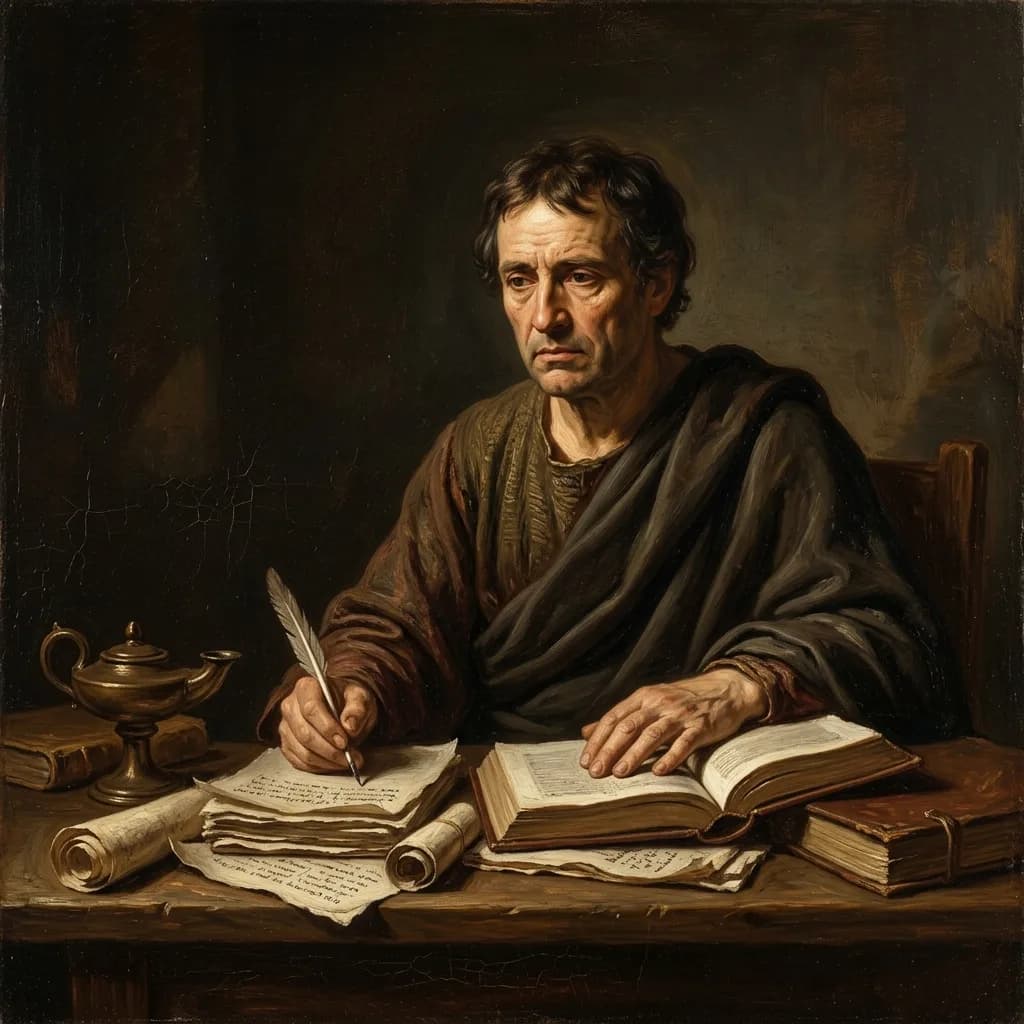
Carpocrates
hereticEarly Church (2nd-3rd C) · fl. c. 130 CE · Updated April 9, 2026
Biography
Carpocrates was a Gnostic philosopher in Alexandria during the Early Church era, known for founding the Carpocratian sect around 130 CE. In the bustling intellectual hub of Alexandria, he developed a radical interpretation of Christianity that set him apart from other thinkers. Carpocrates proposed an audacious path to spiritual liberation, challenging the conventional beliefs of his time.
Carpocrates taught that souls must experience every possible human act, including sin, to break free from the cycle of reincarnation. He saw moral laws as creations of the Demiurge, a lesser deity responsible for the material world, and believed these laws held no power over the spiritual soul. His son, Epiphanes, continued spreading these beliefs, which were later condemned by early church father Irenaeus in his work "Against Heresies" around 180 CE. Despite the condemnation, Carpocrates' ideas attracted followers who embraced the freedom to transcend traditional moral constraints.
The early Christian world, particularly in Alexandria, was a melting pot of theological ideas and debates. Without a centralized church authority, figures like Carpocrates could openly challenge mainstream doctrines. Gnosticism thrived in this environment, offering secret knowledge and a clear distinction between the material and spiritual realms. Carpocrates' teachings stirred controversy by directly confronting accepted Christian moral frameworks. His sect's existence underscores the theological diversity of the time, highlighting the fierce debates over the nature of moral law and the path to spiritual enlightenment.
Are moral laws divinely binding, or human constructs created by an inferior deity — and must the soul experience all things, including evil, to achieve liberation?
The question
Carpocrates stood in the bustling intellectual hub of Alexandria, a city teeming with diverse ideas. He absorbed the teachings of Plato and the Gnostics, encountering the concept of the Demiurge. This notion of a lesser god as the creator of the material world fascinated him. He saw the imperfections of the world and questioned the source of its flaws. To Carpocrates, the Demiurge explained the presence of evil. He believed that moral laws, with their rigid demands, were the constructs of this inferior deity. For him, liberation required transcending these constructs, urging the soul to embrace all experiences, both virtuous and sinful.
Accepting the first horn means submitting to a divine order established by a supreme deity. This model demands obedience to moral laws as reflections of divine justice. It confines individuals to a life of restraint, where ethical norms dictate behavior. Every sinful act becomes an obstacle, requiring repentance and moral purification. The soul remains trapped in the cycle of reincarnation, endlessly striving for an unattainable purity. This path offers certainty but at the cost of true freedom, as it shackles the soul to rigid moral boundaries. The cost is high: spiritual growth stifled by adherence to laws that dictate and limit human experience.
The second horn shatters those chains. If moral laws are the whims of a lesser deity, they hold no authority over the enlightened soul. True liberation, Carpocrates argued, comes through the full spectrum of human experience. The soul must taste every fruit, good and evil, to break free from reincarnation. This approach demands courage, as it rejects societal norms and moral certainties. The soul becomes an adventurer, unbound by conventional ethics, seeking truth in every experience. The cost here is the loss of societal approval and the comfort of moral absolutes. Yet, Carpocrates saw this as the path to ultimate freedom and spiritual fulfillment.
Both positions face an insurmountable challenge. The dualistic worldview that Carpocrates embraced leaves a gap. The existence of a just and loving supreme deity cannot align with a world marred by suffering if ruled by a lesser power. This philosophical trap leaves followers struggling to reconcile divine goodness with earthly imperfection. For the ordinary person, these debates shaped their understanding of salvation. The choices between moral adherence or radical freedom influenced daily life, affecting decisions and their relationship with the divine. Carpocrates' ideas forced believers to confront the nature of sin, redemption, and the purpose of their spiritual journey.
The teaching
Carpocrates taught that moral laws are not divinely binding but are instead human constructs created by an inferior deity. He believed that the soul must experience every possible human act, including sin, to achieve liberation from the cycle of reincarnation. This view challenged the traditional understanding of morality as divinely ordained, suggesting instead that moral laws were merely part of the material world's constraints.
Carpocrates based his teachings on the belief that the material world and its laws were created by a lesser deity, so they lack ultimate authority over the spiritual realm. He argued that by experiencing all aspects of human life, the soul could transcend the limitations imposed by the material world and achieve true freedom. In "On the Transcendence of the Law," he used scriptures like Matthew 5:17, 1 Corinthians 6:12, and Romans 7:6 to support his view. Carpocrates interpreted these passages as evidence that Jesus and the apostles advocated for a spiritual liberation that transcends earthly laws. He saw the fulfillment of the law as a spiritual transcendence, not a strict adherence to moral codes.
Carpocrates's teachings resonated with those who felt constrained by traditional moral laws and sought a more liberating spiritual path. His ideas spread among individuals disillusioned with the material world, offering a deeper, more personal spiritual experience. While the movement did not become mainstream, it found a foothold among certain Gnostic groups. Today, the influence of Carpocrates can be traced in the writings of early church fathers who opposed his views, highlighting the enduring tension between law and spiritual freedom in early Christian thought.
The counterargument
The decisive argument against Carpocrates came from Irenaeus of Lyons, a bishop and theologian who dismantled Carpocrates's teachings by asserting that moral laws are not arbitrary but are rooted in the divine nature of God, who is inherently just and good. In his work "Against Heresies," around 180 CE, Irenaeus contended that true liberation of the soul does not come through experiencing all acts, including sin, but through aligning with God's will, which embodies morality and love. Irenaeus argued that the moral law reflects God's eternal nature and that liberation is achieved through faith and righteousness, not through sin. This argument rendered Carpocrates's position untenable because it underlined that divine nature is inherently opposed to sin, thus any engagement with sin could not align with true spiritual freedom.
Carpocrates's interpretation of scripture was systematically countered by orthodox arguments. For instance, he misread Matthew 5:18 as suggesting that all aspects of the law, including sin, must be fulfilled. The orthodox response clarified that Jesus fulfilled the law through perfect obedience and love, setting an example for believers to follow without sin. Carpocrates also cited 1 Corinthians 6:12 to claim that all things are permissible for the soul, but orthodoxy emphasized that not all things are beneficial, and believers should live to glorify God. He further used Romans 7:15 to argue the necessity of sin in spiritual growth, but the orthodox view highlighted Paul's message of overcoming sin through Christ, not embracing it. The internal contradiction in Carpocrates's argument lay in the implication that a divine soul needs evil acts for liberation, which contradicts the very nature of a pure soul.
The orthodox counter-argument required a deeper exploration into the nature of divine justice and mercy, raising new problems about the fate of sinners and the process of repentance and forgiveness. This exploration forced the early church to grapple with the complexities of salvation and the means by which a soul can return to grace after sin. While it challenged the church to articulate concepts of forgiveness, it also solidified the understanding that sin is not a necessary path to liberation. This doctrinal development underscored the belief that believers, through Christ, can overcome sin and truly embody the moral nature of God.
The resolution
Around 180 CE in Lyons, Gaul, Irenaeus of Lyons spearheaded a theological showdown that sought to resolve a pressing question: were moral laws divinely ordained or mere constructs of a lesser deity known as the Demiurge? This gathering brought together Irenaeus and fellow early Christian theologians to confront the teachings of Carpocrates, whose followers, the Carpocratians, were gaining attention for their radical views. They claimed that to achieve spiritual liberation, the soul must experience all acts, including those deemed sinful. Although the debate primarily unfolded within the church, local rulers in regions like Alexandria watched with concern. The potential undermining of public morality by Carpocratian teachings worried them, even if they did not directly intervene.
The theological battle hinged on the interpretation of terms like 'Demiurge' and 'pneumatic soul.' Carpocratians viewed the Demiurge as a lesser creator, thereby challenging the divine authority of moral laws. In contrast, orthodox Christians, led by Irenaeus, insisted these laws were divinely binding, crucial for salvation. Irenaeus's condemnation of Carpocratian Gnosticism in his work 'Against Heresies' labeled their teachings as heretical. This declaration reinforced the Church's position, shutting down the Carpocratian challenge and affirming that moral laws were not just human constructs but divinely mandated.
Despite this decisive condemnation, the resolution did not eradicate Gnostic influence. Various Gnostic sects continued to thrive, each with its interpretations and practices, spreading across different regions and persisting in theological debates. Even as the Church solidified its orthodoxy, the questions of divine law and human freedom lingered, echoed in later theological discussions and influencing movements like the Cathars in the Middle Ages. The debate over these fundamental issues continued to shape Christian thought long after Irenaeus's time, showing that the question was far from settled. Indeed, echoes of these early theological battles can still be found in modern discussions about the nature of morality and freedom.
Legacy
After Irenaeus condemned Carpocrates in his work "Against Heresies," Carpocrates's teachings faced rejection within mainstream Christian circles. The historical record remains silent about Carpocrates's personal fate, but his followers did not vanish. They continued to practice in small, isolated groups, particularly in Alexandria, a city known for its diverse religious landscape. These groups, though marginalized, held onto their beliefs, which included a radical approach to morality and spiritual knowledge that set them apart from other Christian communities.
Carpocratian Gnosticism left its mark on later Gnostic movements, especially those that disregarded moral laws imposed by the Demiurge, a creator figure perceived as flawed. These ideas resonated with other Gnostic sects, influencing regions such as Egypt and the Levant, where Gnostic thought thrived for centuries. The Carpocratians contributed to the broader tapestry of Gnosticism, blending into movements like the Sethians and Valentinians, who also questioned the nature of divine authority and moral restrictions.
Today, Carpocrates's legacy echoes in modern esoteric and New Age movements. These groups often prioritize personal spiritual experiences over traditional moral codes, resonating with the Carpocratian view of moral laws as human constructs. In secular philosophy, the idea that ethics and morality are human-made rather than divinely ordained continues to spark debate. Carpocrates's influence persists, demonstrating the enduring power of challenging established norms.
Continue reading with a Scholar plan
Upgrade to ScholarCommon questions
- Why was Carpocratian Gnosticism considered dangerous?
- Carpocratian Gnosticism was considered dangerous because it rejected moral laws as mere inventions of a lesser god, the Demiurge. This teaching encouraged followers to engage in all kinds of behavior, including sin, as a means to spiritual liberation, which threatened social and religious order.
- What exactly did Carpocrates teach?
- Carpocrates taught that souls must experience every possible human act, including sin, to be released from the cycle of reincarnation. He believed that moral laws were not binding on the true spiritual self, as they were created by the Demiurge, a lesser divine being.
- Why did Carpocratian Gnosticism spread so widely?
- Carpocratian Gnosticism spread widely due to its radical challenge to established moral norms and its promise of spiritual liberation through the experience of all earthly acts. Its appeal lay in its rejection of conventional religious authority and its offer of a direct, personal path to spiritual enlightenment.
- Who opposed Carpocrates, and what was their argument?
- Irenaeus, an early Church Father, opposed Carpocrates, arguing that his teachings undermined Christian morality and the authority of the Church. In 'Against Heresies,' Irenaeus condemned Carpocratian beliefs as heretical and dangerous to the faith.
- Was Carpocrates excommunicated, exiled, or executed?
- There is no historical evidence that Carpocrates was excommunicated, exiled, or executed. His teachings were condemned, but specific actions against him personally are not documented.
- Which council condemned Carpocratian Gnosticism, and what did it decide?
- Carpocratian Gnosticism was not condemned by a specific council but was denounced by Irenaeus in 'Against Heresies' around 180 CE. The condemnation focused on the sect's rejection of moral laws and its perceived threat to Christian doctrine.
- Did Carpocrates ever recant?
- There is no historical record of Carpocrates recanting his teachings. His doctrines continued to be propagated by his followers even after his death.
- What is the difference between Carpocratian Gnosticism and orthodox Christianity?
- Carpocratian Gnosticism differs from orthodox Christianity in its rejection of moral laws as divine mandates and its belief in the necessity of experiencing all human acts for spiritual liberation. Orthodox Christianity upholds moral laws as divinely ordained and essential for salvation.
- Are there modern versions of Carpocratian Gnosticism?
- There are no direct modern versions of Carpocratian Gnosticism, but some New Age and esoteric spiritual movements share similar themes of personal spiritual exploration and liberation from traditional moral constraints.
- Is there anything Carpocrates got right?
- Carpocrates highlighted the importance of personal spiritual experience and questioned the rigidity of established religious norms. His emphasis on individual spiritual exploration resonates with contemporary spiritual seekers.
- Why does Carpocratian Gnosticism still matter today?
- Carpocratian Gnosticism matters today as it challenges conventional religious and moral frameworks, encouraging discussions about the nature of morality, spiritual freedom, and the role of religious authority. It serves as a historical example of alternative spiritual perspectives.
- Why did Carpocrates sincerely believe his position was correct? What was he actually defending — and why did he see the alternatives as worse?
- Carpocrates believed his position was correct because he saw moral laws as constraints imposed by a lesser divine being, the Demiurge, rather than true spiritual mandates. He defended the idea of spiritual liberation through personal experience, viewing the alternative of strict adherence to moral laws as a limitation on the soul's journey to enlightenment.