Library
Library
Medieval (9th-15th C) · c. 1266-1308 CE · Updated April 9, 2026
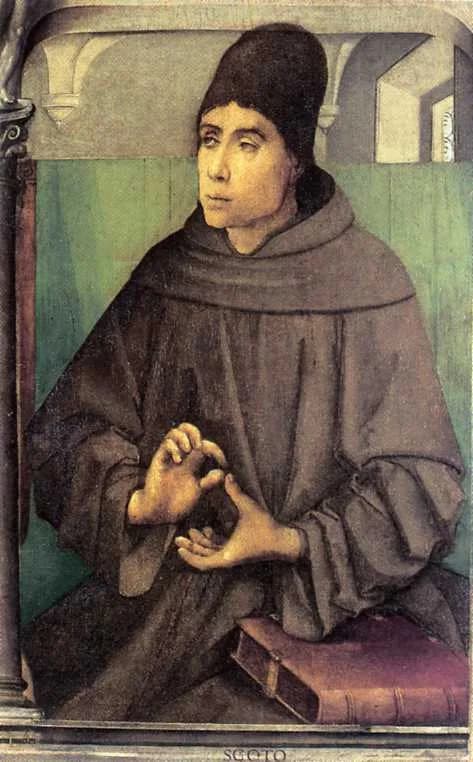
Duns Scotus was a Franciscan friar and philosopher-theologian who lived in the late 13th and early 14th centuries, known for his work at Oxford, Paris, and Cologne. He earned the nickname "the Subtle Doctor" for his complex and nuanced arguments. In an era when Scholasticism dominated medieval universities, Scotus stood out for his bold ideas and intellectual rigor. His contributions to philosophy and theology left a lasting impact, particularly through his exploration of individuality and divine nature.
Born around 1266, Duns Scotus embarked on an academic journey that took him to some of the most prestigious centers of learning in Europe. He studied and taught at Oxford before moving to the University of Paris, a hub of theological debate. His major works, such as Ordinatio and Questions on the Metaphysics of Aristotle, reflect his deep engagement with philosophical issues. In 1308, Scotus moved to Cologne, where he continued his work until his death later that year. Throughout his career, he challenged prevailing ideas and introduced new concepts that reshaped theological discourse.
During Scotus's lifetime, theological debates were fierce, with figures like Thomas Aquinas shaping discussions on the nature of God and morality. Scotus's ideas on the univocity of being challenged the Thomistic view that God's being is fundamentally different from all other beings. He also advocated for the Immaculate Conception of Mary, long before the Catholic Church officially recognized it. The intellectual climate of the period allowed for such controversies, as scholars pushed the boundaries of established doctrines. Scotus's concept of "thisness" or haecceitas remains an enduring contribution to the understanding of individual uniqueness.
Is God's will bound by reason, or is reason itself a product of God's free will — and what does it mean to say that God is 'good' if goodness is whatever God wills?
Duns Scotus grappled with the tension between God's will and reason, seeking to understand how divine and human actions align. He questioned whether intellect or will had greater primacy, challenging the dominant views of his time that often placed reason above all. Scotus believed that will, not intellect, held the superior role in both divine and human realms. This conviction drove him to explore how free will and divine freedom shape the unfolding of creation and morality.
Among Scotus's most important ideas is the univocity of being, asserting that the concept of 'being' applies equally to God and creatures. This challenged Thomas Aquinas's view that being is only analogous, not the same, when speaking of God and humans. Scotus sought a more precise metaphysical language, aiming to elevate theological discourse. Another critical idea is haecceitas, or 'thisness,' which posits that each individual possesses a unique quality distinguishing it from all others. This concept addressed questions of individuality and identity that Aristotle's frameworks left unresolved. Scotus also championed the Immaculate Conception of Mary, arguing she was conceived without original sin, a stance that stirred controversy but later became dogma in 1854.
Scotus's thoughts on the contingency of creation further illustrate his emphasis on divine freedom. He argued that Creation is not necessary but contingent, dependent solely on God's free will. This stood in stark contrast to deterministic views, reinforcing the notion that the universe could have been otherwise. His voluntarism highlighted the freedom inherent in divine action, impacting later theological and philosophical discussions. Scotus’s work, particularly his writings from the early 14th century, influenced thinkers such as William of Ockham and paved the way for developments in metaphysics and theology.
The signature argument of Scotus lies in his univocity of being. By claiming that 'being' is used in the same sense for all entities, he provided a common ground for discussing God and creatures without diminishing God's transcendence. This clarity in metaphysical language allowed for more precise theological debate, challenging the prevailing Thomistic framework. Scotus's approach redefined how theologians and philosophers spoke about existence, emphasizing the need for a shared linguistic foundation to explore divine and human realities. In doing so, he shifted the metaphysical landscape and laid the groundwork for future theological inquiry.
Before Duns Scotus revolutionized Christian thought, Thomas Aquinas dominated theological discussions. Aquinas taught that God's existence and attributes were understood through analogy. God and creatures were not the same, but they shared a distant resemblance that allowed humans to grasp divine attributes indirectly. The Immaculate Conception of Mary remained controversial and largely unaccepted. Theological focus leaned heavily toward intellect, with God's plans seen as the result of divine logic rather than will. Individuality lacked a clear metaphysical grounding, leaving questions of identity and uniqueness vague.
Duns Scotus challenged these prevailing ideas head-on. He proposed that being is univocal, meaning God's existence and that of creatures could be understood in the same way, providing a more direct grasp of God's nature. Scotus introduced the idea of haecceitas, or "thisness," giving each individual a unique identity, transforming how individuality was perceived. He defended the Immaculate Conception, arguing that Mary was preserved from original sin, a stance that eventually became Catholic dogma. Scotus also prioritized will over intellect, suggesting that God's actions stem from divine will, not merely logic, altering theological perspectives on divine freedom and human choice.
The impact of Duns Scotus's ideas rippled through history. His thoughts gave rise to Scotism, a school of thought that thrived into the Renaissance. The defense of the Immaculate Conception set the stage for its formal acceptance by the Catholic Church in 1854. His emphasis on will influenced later theologians like William of Ockham and played a crucial role in developing voluntarism, which highlights the importance of will in theology. Without Scotus, these movements and ideas might not have shaped the church's theological landscape. His influence remains visible today, a testament to his transformative role in church history.
Duns Scotus, a medieval philosopher and theologian, stirred significant controversy with several of his ideas. His notion of the "univocity of being" challenged the traditional view that God's existence is qualitatively distinct from that of creatures. Critics, particularly followers of Thomas Aquinas, argued that this blurred the transcendental gap, leading to a more human-like perception of God. Scotus also introduced "voluntarism," the idea that God's will reigns supreme over intellect, implying potential divine arbitrariness. This unsettled thinkers like William of Ockham, who worried about the stability of moral and natural law. Furthermore, Scotus's defense of the Immaculate Conception of Mary clashed with established beliefs about original sin, creating a theological rift that persisted until the doctrine's formal acceptance in 1854. Finally, his abstract concept of "haecceitas," or "thisness," failed to offer a practical understanding of individuality, leaving many unconvinced of its utility.
The most contentious aspect of Scotus's work lies in his voluntarism. This idea suggested that God's will operates independently of reason, raising fears of a capricious deity whose actions lack a rational basis. Critics argued this view inadvertently paved the way for moral relativism, as it implied moral truths could shift at God's whim. This challenged the very foundation of moral and natural law, sowing doubt about their objective and stable nature. Theologians and philosophers wrestled with the implications, fearing that if divine actions were not anchored in reason, the consistency and predictability of moral principles could collapse.
Despite the storm of criticism, some modern scholars attempt to rehabilitate Scotus's legacy. They propose that his emphasis on God's will was not about randomness but underscored divine freedom and love. This reinterpretation suggests that Scotus intended to celebrate the boundless nature of God rather than reduce Him to whimsy. Nevertheless, the critiques largely hold, especially regarding voluntarism's potential to destabilize moral law. The Church eventually accepted the Immaculate Conception, but Scotus's views on God's will and being remain contentious. To this day, Scotus's ideas spark debate, revealing the enduring impact of his unconventional thoughts on theology and philosophy.
Duns Scotus passed away in 1308, buried in Cologne. After his death, his teachings faced considerable opposition, especially from followers of Thomas Aquinas, known as Thomists. They challenged Scotus's ideas, particularly his views on the univocity of being, which proposed that existence is the most common attribute shared by all entities. Likewise, his strong defense of the Immaculate Conception was controversial at the time, as it contradicted prevailing theological opinions. Despite this resistance, Scotus's intellectual contributions did not fade into obscurity but instead sparked debates that would fuel theological exploration for centuries.
Scotus's philosophical legacy endured through the formation of Scotism, a school of thought that flourished among the Franciscans. This movement found fertile ground at the University of Paris, where his ideas received significant attention. Over time, Scotism spread to Spain and Italy, where universities incorporated his teachings into their curricula. The influence of Scotism extended beyond individual thinkers, impacting late medieval and early modern philosophy as scholars grappled with his ideas about individuality and existence. While Thomism often overshadowed Scotism in broader theological circles, Scotus's theories continued to attract dedicated followers who valued his nuanced approach to philosophy and theology.
Today, the impact of Duns Scotus's work persists, especially in the realm of metaphysics. His concept of "haecceitas," or "thisness," which captures the unique individuality of each entity, remains a topic of interest in contemporary philosophy. Moreover, his staunch advocacy for the doctrine of the Immaculate Conception eventually bore fruit when it became a formal dogma of the Roman Catholic Church in 1854. This acknowledgment underscores Scotus's lasting influence and highlights a concrete instance where his once-contested views have become an integral part of Catholic doctrine.
Continue reading with a Scholar plan
Upgrade to Scholar