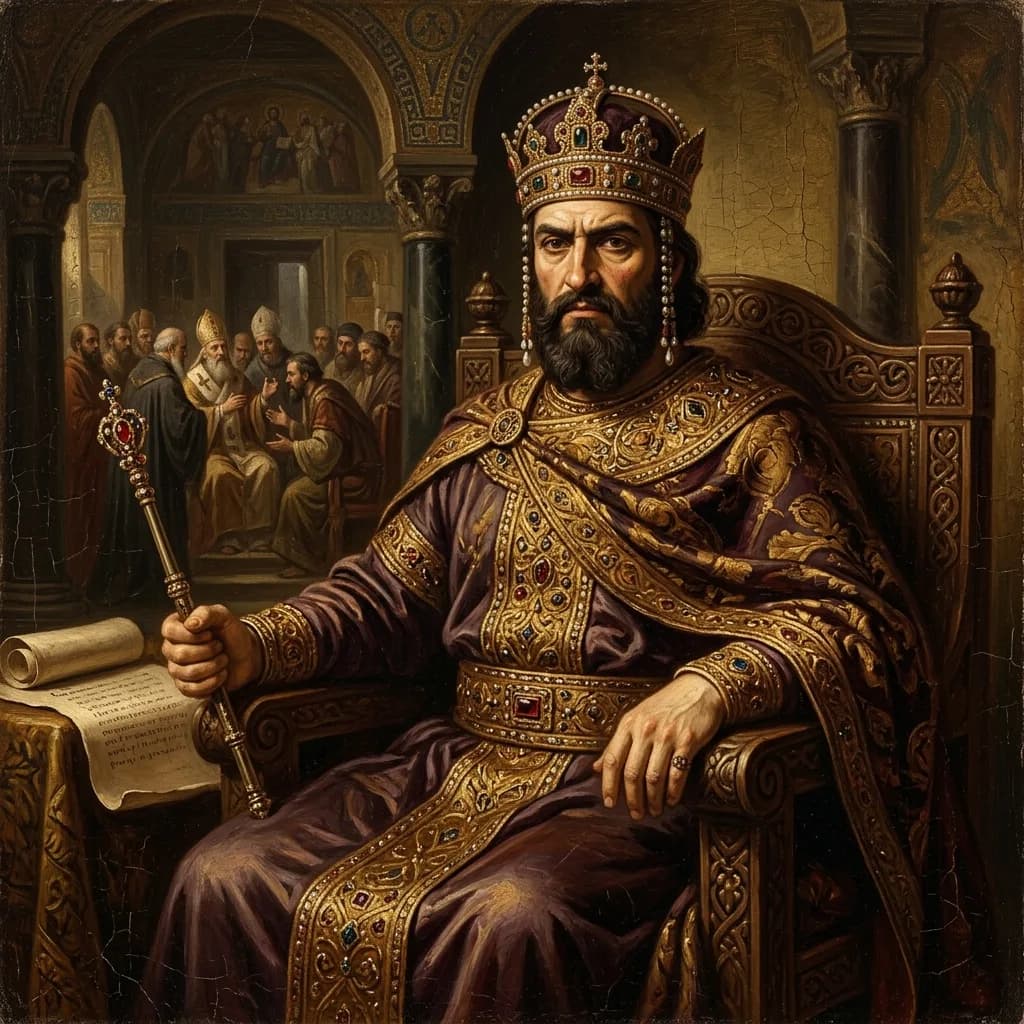
Emperor Constantine V
hereticLate Patristic (5th-8th C) · 718-775 CE · Updated April 9, 2026
Biography
Emperor Constantine V was a Byzantine Emperor during the Late Patristic era, known for his aggressive promotion of iconoclasm from 718 to 775 CE. He ruled a Byzantine Empire embroiled in religious and political turmoil. Constantine V’s reign was marked by his staunch opposition to the veneration of icons, which he saw as idolatrous. This stance placed him at odds with iconophiles who believed icons were essential to religious devotion and theological expression.
Born in 718 CE, Constantine V assumed the throne in a time of upheaval. He became a central figure in the Iconoclast Controversy, which polarized the empire. In 754 CE, he convened the Iconoclast Council of Hieria, which bolstered his campaign against icons, declaring that the veneration of images equaled idolatry. Constantine argued that Christ's human nature could not be accurately depicted in art without misrepresenting his divine personhood. Beyond theology, he proved a formidable military leader, launching campaigns against the Bulgars and Arabs to fortify Byzantine borders. His military successes were overshadowed by his controversial religious policies, which faced rejection after his death.
Constantine V ruled during a period when the Byzantine Empire grappled with deep theological disputes and external threats. The Iconoclast Controversy erupted from differing views on religious imagery, fueled by debates over Christ’s nature and the incarnation. Political dynamics and cultural tensions also played roles, as emperors sought to consolidate power and define orthodoxy. Despite Constantine's efforts, the Seventh Ecumenical Council in 787 CE overturned the decisions of the Council of Hieria, restoring the veneration of icons. This reversal marked a significant chapter in the ongoing struggle over religious imagery within the Byzantine Empire.
Can the humanity of Christ be depicted in art without committing idolatry — and what does the veneration of images say about the nature of the incarnation?
The question
Emperor Constantine V, deeply disturbed by the widespread use of icons in Christian worship, saw a direct conflict between this practice and the biblical commandment against idolatry. Influenced by a genuine desire to maintain the purity of Christian doctrine, he believed that the veneration of icons compromised the unique nature of Christ. His conviction stemmed from a sincere interpretation of scripture and a commitment to preserving what he saw as the true essence of Christianity. Constantine viewed icons as a potential threat to the faith, fearing that they might lead believers away from the spiritual and into the realm of the physical, thus undermining the divine mystery of Christ.
If the humanity of Christ cannot be depicted without committing idolatry, then icons must be destroyed. This approach demands a radical shift in Christian worship, eliminating centuries-old practices that involve visual representation. It requires believers to abandon their traditional means of connecting with the divine through art. This stance forces the church to embrace a more abstract and intangible form of devotion, stripping away the rich tapestry of visual aids that have long supported the spiritual life of countless Christians. It alienates those whose faith is nurtured by such images and risks fracturing the unity of the church by disregarding a significant aspect of its heritage.
Conversely, if the humanity of Christ can be depicted in art, icons become a vital bridge between the human and the divine. Accepting icons as legitimate tools for devotion acknowledges their role in the spiritual lives of believers. This position supports the continued use and veneration of images within Christian practice, allowing art to serve as a conduit for divine connection. Yet, it opens the door to accusations of idolatry and the risk of theological misunderstandings. It challenges the church to ensure that veneration does not blur into worship, maintaining a careful balance between reverence for the divine and respect for its incarnate expression.
Both positions grapple with the indivisibility of Christ's nature. This core belief makes the debate over icons particularly thorny. The rejection of icons risks denying the tangible reality of Christ’s incarnation, while their acceptance risks overshadowing his divinity with human artistry. For ordinary believers, these theological debates had profound implications. They shaped how Christians expressed their faith, altered the aesthetics of their worship spaces, and influenced their understanding of Christ's presence in the world. The controversy over icons was not just a theological dispute; it was a clash that touched the very heart of Christian identity and practice.
The teaching
Emperor Constantine V taught that veneration of icons equated to idolatry, as it involved worshipping created images instead of God. He argued that only the Eucharist served as a true image of Christ because it offered direct participation in His body and blood. Constantine rejected painted or sculpted representations, believing they misrepresented Christ's divine nature.
Constantine V's logic hinged on the belief that depicting Christ's humanity in art divided His divine and human natures. He argued that this practice violated the unity of Christ, leading to idolatry forbidden by Scripture. He referenced Exodus 20:4-5, which prohibits making images for worship, and John 4:24, which emphasizes spiritual worship over physical representations. He cited Colossians 1:15 to assert that Christ alone is the true image of God. His views were articulated at the Council of Hieria in 754 CE, where he declared the veneration of icons heretical.
This teaching resonated with the Byzantine military and administrative elite. They saw iconoclasm as a way to purify Christian practice and unify the empire spiritually and politically. The teaching spread due to Constantine's authority and the belief in the need for religious reform. By aligning with the emperor's stance, many sought to strengthen and stabilize the empire, reflecting their commitment to his vision.
The counterargument
Emperor Constantine V argued against the veneration of icons, claiming it divided Christ's person and led to idolatry. However, his opponents, notably St. John of Damascus, refuted this by emphasizing the incarnation's significance. In his "Apologia Against Those Who Decry Holy Images," St. John argued that depicting Christ in His human form acknowledges the reality of the incarnation. By taking on flesh, the Word made God visible, reinforcing that the honor given to an icon passes to the one it represents. Thus, venerating an icon does not equate to idol worship but affirms the truth that the divine became human.
Constantine V relied on scriptures like Exodus 20:4 and Deuteronomy 4:15-16, which forbid making images and emphasize God's formlessness. Orthodox theologians countered by explaining that these prohibitions applied before The Incarnation. With Christ's birth, God took a visible form, allowing depictions of His human nature. John 4:24 states God is spirit, yet The Incarnation demonstrates that this spiritual God also embraced human flesh, making art a valid expression of truth. Constantine's stance inadvertently suggested a separation of Christ’s divine and human natures, contradicting the established doctrine that these natures coexist in one person.
While the orthodox argument successfully countered Constantine, it introduced the challenge of distinguishing veneration from worship. This nuanced distinction risked being misinterpreted by the faithful, potentially leading to superstition. The Church had to ensure that veneration did not cross into idolatry. Despite these concerns, the position that icons affirm The Incarnation prevailed. The debate left behind the enduring challenge of guiding believers in the proper reverence of icons, balancing respect for tradition with theological clarity.
The resolution
In 754 CE, Emperor Constantine V summoned the Iconoclast Council of Hieria near Constantinople. He gathered 338 bishops, but notably absent were any papal legates, reflecting the council's limited representation of the broader Christian world. The emperor's goal extended beyond theological discourse; he aimed to solidify his control over the Byzantine Empire. By endorsing iconoclasm, Constantine sought to weaken monastic influence, which was deeply tied to the veneration of icons, and to establish a unified religious policy that bolstered imperial authority.
The council's central debate revolved around the depiction of Christ in icons. Iconoclasts, led by Constantine, argued that any attempt to create an image of Christ inherently divided his divine and human natures. They claimed that such images bordered on idolatry by attempting to confine the divine within a human form. In contrast, iconodules, although absent from the council, believed that icons were a valid means of honoring Christ's humanity, essential for understanding the incarnation. The council ultimately declared that only the Eucharist represented a true image of Christ, condemning icon veneration as heretical. This decision aligned with the emperor’s vision, reinforcing his position and marginalizing the opposition.
Despite the council's firm stance, the resolution failed to end the controversy. The Seventh Ecumenical Council in 787 CE reversed the decision, reinstating the veneration of icons and highlighting the enduring divide. Iconoclasm did not vanish; it reemerged during the second iconoclast period from 814 to 842 CE, showing persistent theological and political rifts. The debate only truly settled when the Triumph of Orthodoxy in 843 CE permanently restored icon veneration. This conclusion marked the end of the iconoclast controversy, but it left a lasting imprint on the church’s history and its relationship with political power.
Legacy
After the condemnation of his iconoclast policies, Emperor Constantine V remained a potent force in the Byzantine Empire until his death in 775 CE. Despite the backlash against his religious reforms, he left a legacy of military prowess and administrative innovation. Constantine V strengthened the empire's defenses and secured its borders through strategic campaigns, particularly against the Bulgars. His administrative reforms improved tax collection and streamlined governance, ensuring stability. Yet, his theological views faced rejection at the Seventh Ecumenical Council in 787 CE, which reinstated the veneration of icons, marking a decisive turn against his iconoclastic stance.
Iconoclasm did not vanish with Constantine V's death. It lingered in parts of the Byzantine Empire, particularly in regions with strong military ties where soldiers and leaders had embraced the iconoclast cause. The movement retained support among certain factions who viewed the veneration of icons as a threat to the purity of Christian worship. In the early 9th century, Emperor Leo V briefly revived iconoclasm, appealing to those who saw it as a means to unify the empire under a single religious vision. This resurgence was short-lived, however, as the final restoration of icons in 843 CE, known as the Triumph of Orthodoxy, marked the end of official iconoclasm.
Today, the echoes of this ancient debate persist in some Protestant denominations, which hold reservations about the use of religious images. These groups often view icons as distractions or potential idols, preferring a more austere approach to worship. This theological stance reflects ongoing tensions between tradition and reform that have shaped Christian practices for centuries. In a broader cultural context, the discussion of religious imagery continues in debates over artistic freedom and the portrayal of sacred subjects. The legacy of Constantine V's iconoclasm still influences modern dialogues about the role of images in both religious and secular spheres.
Continue reading with a Scholar plan
Upgrade to ScholarCommon questions
- Why was Iconoclasm considered dangerous?
- Iconoclasm was seen as dangerous because it threatened the unity of the Church by rejecting the veneration of icons, which had become an integral part of Christian worship. It also challenged the authority of the Church hierarchy that supported the use of icons, leading to significant theological and political conflicts.
- What exactly did Emperor Constantine V teach?
- Emperor Constantine V taught that the veneration of icons was equivalent to idolatry, which was forbidden by Scripture. He argued that only the Eucharist was a true image of Christ, as Christ's human nature could not be depicted without dividing his person.
- Why did Iconoclasm spread so widely?
- Iconoclasm spread widely due to the support of several Byzantine emperors, including Constantine V, who enforced it through imperial edicts and military power. Additionally, it appealed to certain theological and social groups who viewed the veneration of icons as a form of superstition.
- Who opposed Emperor Constantine V, and what was their argument?
- Opposition came from monastic communities and church leaders who argued that icons were a legitimate means of honoring the saints and Christ. They contended that icons served as visual aids for the faithful and were not objects of worship themselves.
- Was Emperor Constantine V excommunicated, exiled, or executed?
- Emperor Constantine V was not excommunicated, exiled, or executed. He remained in power until his death in 775 CE, continuing to enforce iconoclasm throughout his reign.
- Which council condemned Iconoclasm, and what did it decide?
- The Seventh Ecumenical Council, also known as the Second Council of Nicaea in 787 CE, condemned Iconoclasm. It decided that the veneration of icons was permissible and reaffirmed the use of icons in Christian worship as a means to honor the saints and Christ.
- Did Emperor Constantine V ever recant?
- Emperor Constantine V did not recant his iconoclastic beliefs. He remained a staunch supporter of Iconoclasm until his death.
- What is the difference between Iconoclasm and orthodox Christianity?
- The main difference is that Iconoclasm rejects the veneration of religious images, viewing it as idolatry, while orthodox Christianity accepts the use of icons as a legitimate way to honor the divine. Orthodox Christianity sees icons as windows to the divine, not objects of worship.
- Are there modern versions of Iconoclasm?
- Modern versions of Iconoclasm can be seen in some Protestant denominations that reject religious images and focus on a more direct, unmediated relationship with God. These groups often emphasize the authority of Scripture over church traditions involving images.
- Is there anything Emperor Constantine V got right?
- Emperor Constantine V's emphasis on avoiding idolatry was consistent with biblical teachings against idol worship. His focus on the Eucharist as a central element of Christian worship also aligns with traditional Christian emphasis on the sacrament.
- Why does Iconoclasm still matter today?
- Iconoclasm matters today because it raises ongoing questions about the role of images in religious practice and the balance between tradition and scripture. It also highlights the historical tensions between church and state in defining religious orthodoxy.
- Why did Emperor Constantine V sincerely believe his position was correct? What was he actually defending — and why did he see the alternatives as worse?
- Emperor Constantine V believed his position was correct because he saw the veneration of icons as a violation of the biblical prohibition against idolatry. He was defending what he perceived as the purity of Christian worship and feared that icons could lead to superstition and a misunderstanding of the divine nature of Christ.