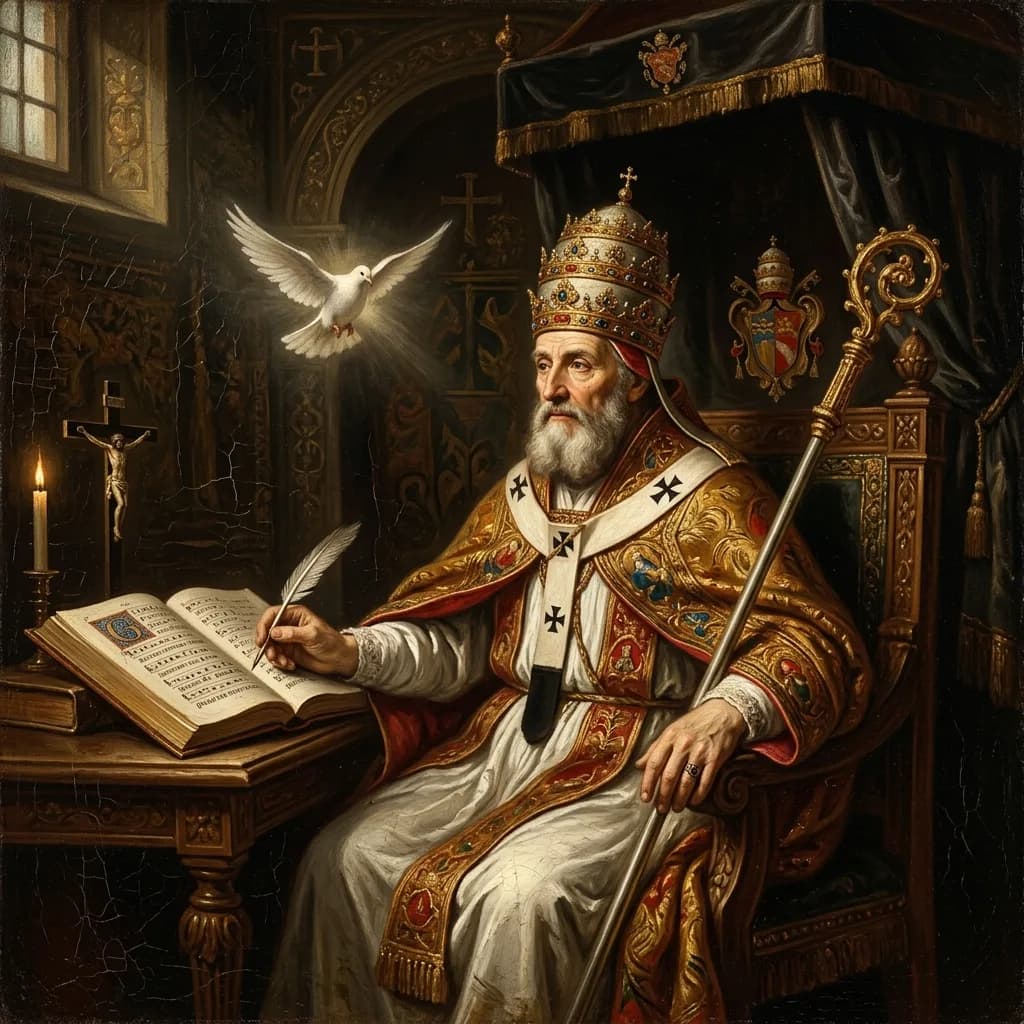
Gregory I the Great
theologianLate Patristic (5th-8th C) · c. 540-604 CE · Updated April 9, 2026
Biography
Gregory I the Great was the Pope of Rome from around 590 to 604 CE, a pivotal figure in the patristic era who profoundly influenced medieval Western Christianity. He led the Church during the late Roman Empire's decline, a time of political fragmentation and the rise of various barbarian kingdoms. Known for his administrative genius and pastoral care, Gregory's papacy marked a turning point in establishing the papal authority that would shape the medieval Church.
Born around 540 CE into a wealthy Roman family, Gregory received an excellent education and served as the Prefect of Rome before turning to monastic life. He founded several monasteries, including one on his family estate, which deeply shaped his theological outlook. Elected pope in 590 CE amid political instability and plague, Gregory quickly demonstrated his ability to lead. In 596 CE, he sent Augustine of Canterbury to convert the Anglo-Saxons, significantly expanding Christianity in Europe. His writings, such as "Moralia in Job," "Pastoral Rule," and "Dialogues," left a lasting impact on Christian thought and practice.
Gregory's time as pope coincided with theological controversies about the nature of purgatory and the role of papal authority. He navigated these challenges by integrating Roman administrative practices with Christian pastoral care, strengthening the papacy's role as a central authority in Western Christianity. Although he did not directly compose Gregorian chant, his efforts to organize and codify church music led to its development, leaving a cultural legacy that endures in church liturgy today.
What is the relationship between authority and service in Christian leadership — and how does a church leader care for souls while governing an institution?
The ideas
Gregory I the Great faced a world in turmoil. The Roman Empire's collapse left Europe fragmented and vulnerable. Chaos and instability threatened the church's role as a guiding force. Gregory saw the necessity for strong, compassionate leadership that could stabilize society while nurturing the spiritual well-being of its people. He aimed to redefine Christian leadership, focusing on humility and service. His life's work revolved around crafting a model of pastoral care that could address both spiritual and societal needs, ensuring the church remained a beacon of hope and stability in uncertain times.
Gregory's key ideas reshaped the church's approach to leadership and care. First, he introduced the concept of 'servus servorum Dei,' meaning 'servant of the servants of God.' This idea insisted that true leadership meant serving others, a radical departure from the traditional view of authority as dominion. His experiences as a monk and administrator, along with political challenges, drove this emphasis on humility. Secondly, Gregory's 'Pastoral Rule' outlined the essential qualities of effective church leaders, stressing wisdom, compassion, and deep understanding of human nature. As Roman civic structures declined, this guide became a cornerstone for clergy, ensuring spiritual guidance amidst political instability. Lastly, Gregory's teaching on purgatory provided a theological framework for practices like prayers for the dead, deeply influencing medieval Christian beliefs about the afterlife.
Beyond these central ideas, Gregory made other significant contributions. He championed liturgical reform, leading to the development of Gregorian Chant, which became a cornerstone of Western liturgical music. This reform aimed to standardize church practices across the Western church, enhancing unity and coherence. Gregory also integrated Roman administrative principles into church governance, ensuring the institution's survival and influence during the early medieval period. His ability to blend Roman and Christian practices helped stabilize the church's role in society, making it a resilient institution amid political disarray.
Gregory's signature argument centered on redefining leadership as service and humility, encapsulated in 'servus servorum Dei.' This perspective was compelling because it transformed the papal role into one of moral authority rather than sheer power. By promoting a model where authority in the church served others, Gregory not only redefined the papacy but also set a standard for Christian leaders. His vision changed how leadership was perceived, emphasizing that true authority comes from serving those you lead. This approach provided a lasting foundation for the church's moral and spiritual influence, ensuring its role as a guiding light through the medieval era and beyond.
What changed
Before Gregory I the Great, Christian thought lacked a unified approach to pastoral care and governance. The teachings of Augustine and other early Church Fathers shaped theology, but they did not provide a comprehensive framework for the practical aspects of leading a Christian community. Bishops served primarily as spiritual leaders, with little emphasis on administrative duties or the integration of spiritual and temporal authority. The concept of Purgatory existed in a rudimentary form, but it was neither fully developed nor widely accepted. Liturgical practices varied greatly, lacking standardization across different regions. The separation between church and state remained distinct, with limited overlap in their respective roles.
Gregory I the Great transformed this landscape by redefining the bishop's role as a "servant of servants." He coined the term "servus servorum Dei," emphasizing humility and service as key virtues for church leaders. Gregory's "Pastoral Rule" offered a detailed guide for bishops, merging spiritual care with administrative responsibilities. This work laid the foundation for pastoral theology, shaping how church leaders approached their duties. Gregory also developed the doctrine of purgatory, providing a clearer explanation of its role in the afterlife. He integrated Roman governance practices with church administration, bolstering the church's influence in political and social spheres. Through these actions, Gregory established a model for Christian leadership that blended spiritual and temporal authority.
The impact of Gregory I's changes rippled through history. His emphasis on pastoral care influenced later theologians like Thomas Aquinas and the Scholastic tradition. The integration of Roman governance with church administration set the stage for the medieval papacy's political power. Gregory's reforms in church music led to the development of Gregorian chant, which became a cornerstone of Western liturgical music. The doctrine of purgatory, as articulated by Gregory, shaped medieval theology and practices related to penance and indulgences. Without Gregory's innovations, the church's role in medieval society and its theological developments would look very different. His legacy endures, with the Gregorian chant still echoing in churches today.
Disputed legacy
Gregory I the Great expanded the papacy's reach, setting a precedent for political entanglements that critics argue distracted from the Church's spiritual mission. By enhancing the pope's temporal power, Gregory laid the groundwork for a church mired in politics rather than faith. His policies toward Jewish communities, though occasionally protective, also entrenched their marginalization, contributing to a long history of Christian-Jewish tensions. Gregory's integration of Roman administrative practices into church governance created a bureaucratic system. This structure, while stable, often stifled spiritual vitality and resisted reform.
The development of the doctrine of purgatory stands as Gregory's most controversial legacy. Critics, especially during the Reformation, condemned it as lacking biblical foundation. This doctrine opened the door to the sale of indulgences, a practice that Martin Luther and other reformers denounced. These indulgences became a cash cow for the Church, selling forgiveness and corrupting spiritual intentions. The backlash played a significant role in the Protestant Reformation, one of the most divisive events in church history.
Some Catholic theologians defend Gregory, arguing his intentions were pastoral, focused on spiritual purification and hope. They claim the abuses linked to Purgatory came later and were not inherent in his teachings. Yet, the criticisms remain potent. The precedent Gregory set for papal power and the doctrine of purgatory are still viewed as pivotal missteps with lasting impact. By the time of The Reformation, the Church's political and doctrinal issues were undeniable, driving a permanent wedge in Christianity.
Legacy
Gregory I, known as Gregory the Great, died in 604 CE after a transformative papacy. His tenure redefined the role of the Pope, establishing him not just as a spiritual leader but also as an adept administrator. Gregory navigated the complexities of a crumbling Roman Empire, effectively managing both spiritual and temporal affairs. He organized the distribution of food, reformed church finances, and strengthened the papal estates. His diplomatic skills soothed tensions with the Byzantine Empire and various barbarian tribes. This dual focus on spiritual leadership and practical governance left an enduring mark on the Church's structure, cementing the Pope's role as both shepherd and steward.
Gregory's teachings and reforms fueled the medieval Church's evolution and influenced Western Christianity's trajectory. His book "Pastoral Care" became a cornerstone text for bishops, emphasizing the moral and spiritual responsibilities of church leaders. This work laid the groundwork for the Carolingian Renaissance, a revival of learning and culture under Charlemagne that shaped European intellectual life. Monastic communities, particularly the Benedictines, adopted Gregory's principles, spreading them throughout Europe. His ideas on church governance and pastoral responsibility became embedded in the ecclesiastical practices of the time, impacting regions far beyond Rome.
Today, Gregory's legacy lives on within the Roman Catholic Church. The concept of the Pope as a servant leader traces directly back to his example. Gregory's influence also resonates in the realm of sacred music through the enduring tradition of Gregorian chant. This form of plainchant, named in his honor, remains integral to Catholic liturgical practices. Its haunting melodies continue to fill cathedrals around the world, a testament to Gregory's enduring impact on the spiritual and cultural life of the Church.
Continue reading with a Scholar plan
Upgrade to ScholarCommon questions
- What is Gregory I the Great most known for in Christian history?
- Gregory I the Great is most known for his role in shaping medieval Western Christianity, particularly through his development of pastoral theology and the doctrine of purgatory. He also played a crucial role in the Christianization of England by sending Augustine of Canterbury to convert the Anglo-Saxons.
- What were Gregory I the Great's most important works?
- Gregory I's most important works include 'Moralia in Job,' a commentary on the Book of Job; 'Pastoral Rule,' a guide for bishops on how to lead their congregations; 'Dialogues,' which includes the life of St. Benedict; and his 'Homilies on Ezekiel and the Gospels.' These works were foundational for medieval Christian thought.
- What were Gregory I the Great's most influential theological ideas?
- Gregory I's influential ideas include the concept of the bishop as 'servant of the servants of God,' the development of pastoral care as a central duty of church leaders, and the formalization of purgatory as a doctrine. He also contributed to the development of Gregorian chant, which influenced Western liturgical music.
- What controversies did Gregory I the Great engage in — and what was at stake?
- Gregory I engaged in controversies over the title 'Ecumenical Patriarch' claimed by the Patriarch of Constantinople, which he saw as a challenge to papal authority. He also dealt with disputes over church governance and the integration of Roman administrative practices into the church.
- How did Gregory I the Great influence later Christianity — Catholic, Protestant, and beyond?
- Gregory I's emphasis on pastoral care and church governance influenced the structure of the medieval Catholic Church. His ideas on purgatory and liturgical music impacted Catholic doctrine and practice. Protestant reformers later critiqued some of his teachings, but his influence on church leadership and liturgy persisted.
- What did Gregory I the Great get wrong, or what ideas have been seriously disputed?
- Gregory I's teachings on purgatory and the intercession of saints have been disputed, particularly by Protestant reformers who rejected these doctrines. His integration of Roman administrative practices into the church has also been criticized for contributing to the centralization of church power.
- Is Gregory I the Great considered a saint? By which traditions?
- Yes, Gregory I the Great is considered a saint by the Roman Catholic Church, the Eastern Orthodox Church, the Anglican Communion, and some Lutheran traditions. He is venerated as a Doctor of the Church and is celebrated for his contributions to Christian theology and church leadership.
- Why does Gregory I the Great still matter today?
- Gregory I the Great matters today because his ideas on pastoral care, church governance, and liturgical music continue to influence Christian practices. His role in the Christianization of Europe and his theological contributions remain significant in discussions on church history and doctrine.
- What is the most surprising or counterintuitive thing about Gregory I the Great?
- One surprising aspect of Gregory I the Great is his humility and reluctance to become pope, despite his significant impact on the church. He initially preferred a monastic life and only accepted the papacy out of a sense of duty, which contrasts with his later authoritative role in shaping the church.
- What is the best place to start reading Gregory I the Great?
- A good starting point for reading Gregory I the Great is his 'Pastoral Rule,' which outlines his vision for church leadership and pastoral care. This work provides insight into his theological priorities and his approach to guiding the church.