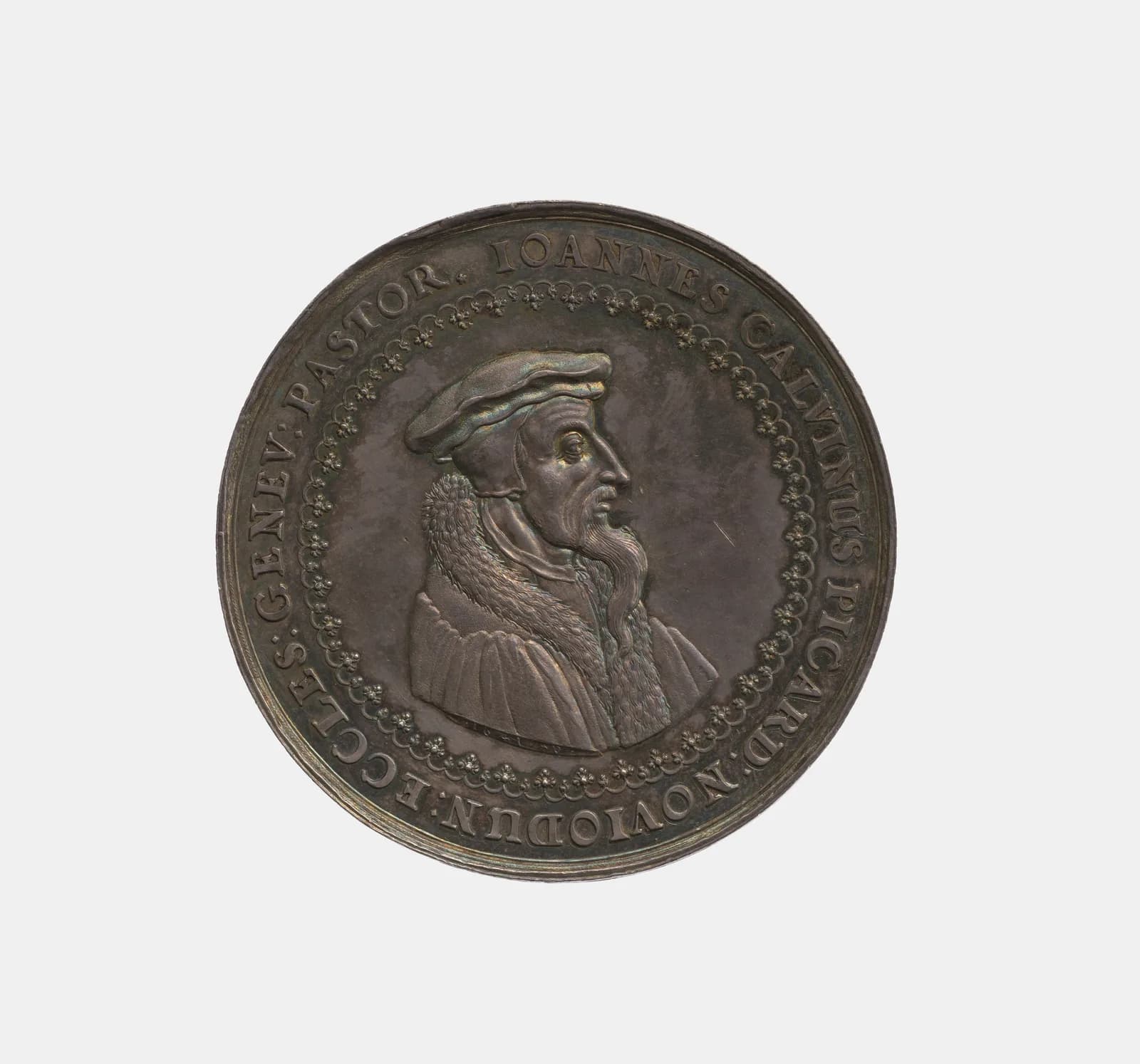
John Calvin
theologianReformation (15th-16th C) · 1509-1564 CE · Updated April 9, 2026
Biography
John Calvin was a French lawyer turned reformer, pastor, and theologian in Geneva during the Protestant Reformation era (1509-1564 CE). Known for his deep influence on Protestant theology, Calvin shaped the development of The Reformation with his teachings and writings. He emerged as a leading figure in Geneva, where his ideas helped transform the city into a center of Protestant thought and practice.
Born on July 10, 1509, in Noyon, Picardy, France, Calvin initially pursued a career in law before turning his attention to theology. In 1536, he published "Institutes of the Christian Religion," a seminal work that laid out his theological views and continued to evolve until its final edition in 1559. Calvin became a significant influence in Geneva, where he played a crucial role as both a pastor and a theologian. His doctrine of double predestination, which argued that God had predetermined the eternal fate of every individual, became one of his most controversial teachings. His involvement in the trial and execution of Michael Servetus in 1553, for heresy against the Trinity, further cemented his reputation as a formidable theological force.
Calvin's life unfolded during the Protestant Reformation, a time of religious upheaval as reformers challenged the Catholic Church's dominance. The rise of the printing press enabled the rapid spread of reformist ideas, allowing theological debates to flourish. Europe was a patchwork of fragmented states, which provided fertile ground for religious reformers like Calvin to establish new doctrines and communities. In this charged atmosphere, Calvin's insistence on a spiritual presence in the Eucharist differentiated his views from those of the Lutherans, fueling further theological debate. His ideas left a lasting mark on Protestantism, influencing religious thought far beyond his lifetime.
If God sovereignly decrees all things including salvation and damnation, is human freedom real — and can a theology of absolute sovereignty be reconciled with the goodness of God?
The ideas
John Calvin dedicated his life to addressing the question of divine sovereignty. In a world embroiled in the chaos of the Reformation, Calvin sought to provide assurance that God governed everything with absolute authority. This quest was not just theological; it was deeply practical. He wanted to offer believers a framework that could explain their place in a tumultuous universe and reassure them of a higher order amidst human uncertainty. Calvin's focus on God's control over all aspects of life, including salvation, stemmed from his desire to affirm that everything unfolded according to a divine plan, offering a bulwark against the unpredictability of existence.
Calvin's most important ideas revolved around God's supreme authority and the nature of salvation. He championed the belief that God has absolute control over the universe, a view that emphasized divine omnipotence and provided comfort to believers. Responding to the Catholic Church's focus on human works for Salvation, Calvin asserted the doctrine of double predestination. This radical idea declared that God predetermined who would be saved and who would be damned, independent of human actions. It was a direct challenge to those who believed in free will and earned Salvation. Calvin also upheld the principle of Scripture Alone, advocating that the Bible, rather than church tradition, should guide faith. This empowered individuals to read and interpret the Bible themselves, breaking the church's monopoly on religious knowledge.
Beyond these core ideas, Calvin made other significant contributions. He emphasized the concept of total depravity, arguing that humans are entirely fallen and incapable of choosing good without divine help. This reinforced the necessity of grace for Salvation. Calvin also identified the marks of the true church as the correct preaching of the Word and proper administration of the sacraments. This provided a clear criterion for distinguishing genuine Christian communities from those deemed corrupt. His seminal work, "Institutes of the Christian Religion," published in 1536, systematically laid out his theological views, influencing Protestant thought for centuries.
Calvin's signature argument was his doctrine of double predestination. This idea uniquely integrated God's justice with mercy, asserting that God’s sovereign will alone determined each individual's eternal fate. It was compelling because it offered a consistent and comprehensive view of divine sovereignty, leaving no room for human agency in salvation. By doing so, it fundamentally challenged both contemporary Catholic teachings and traditional views, sparking intense theological debate. Calvin's reasoning reshaped the understanding of salvation and divine fairness, leaving a lasting legacy on Protestant theology.
What changed
Before John Calvin, medieval scholasticism shaped Christian thought. The Catholic Church stood as the central authority, mediating God's will and emphasizing the necessity of sacraments for Grace. Salvation, Grace, and human will were viewed through the lens of church teachings, with heavy reliance on tradition. The Church's power extended beyond spiritual matters, influencing political realms as well. The concept of predestination lingered in theological discussions but lacked a coherent framework. The emphasis was more on human cooperation with divine grace than on any predetermined divine plan.
John Calvin challenged these assumptions and reshaped Christian theology. He emphasized God's absolute sovereignty, arguing that God decrees all events, including who receives salvation or damnation, without human influence. This idea of double predestination became a cornerstone of his teachings. Calvin also insisted that Scripture alone should be the supreme authority, reducing the Church's traditional role as a mediator. He advocated for a distinct separation between church and state, assigning the church a role in guiding moral and spiritual matters without political entanglements. These shifts forced the Church to reconsider its authority and the nature of divine grace and Salvation.
Calvin's ideas spurred the development of Reformed theology, influencing movements like Presbyterianism and Congregationalism. His emphasis on God's sovereignty and Predestination shaped theological debates, leading to significant events like the Synod of Dort. Calvin's work laid the groundwork for later theologians such as Jonathan Edwards and the Puritans, who expanded his ideas in their cultural contexts. Without Calvin, these movements and theological developments might not exist. His influence endures, evident in the many denominations today that trace their roots back to his teachings.
Disputed legacy
John Calvin's doctrine of double predestination stands as one of his most controversial teachings. He believed that God predetermined some people for salvation and others for damnation. This view has faced criticism for portraying God as unjust and undermining human free will. Arminians, Universalists, and many modern theologians object to this harsh and deterministic understanding of God's sovereignty. In Geneva, Calvin's model of close church-state relations invited further criticism. His intertwining of religious and civic authority often led to authoritarianism and suppression of dissent. Advocates of religious freedom and separation of church and state view this as a cautionary example of the dangers of theocratic governance. Additionally, Calvin's insistence on Scripture alone as the supreme authority has led to interpretive conflicts, contributing to the fragmentation within Protestantism.
The execution of Michael Servetus in 1553 marks the darkest chapter in Calvin's legacy. Servetus, an anti-Trinitarian heretic, faced execution in Geneva with Calvin's approval. This act of religious intolerance and the use of state power to enforce theological conformity clash with modern values of religious freedom. Calvin's role in Servetus's death remains a stain on his legacy, often cited as a warning against theocratic rule. The consequences were severe, casting a long shadow over Calvin's contributions to theology and highlighting the potential dangers of intertwining religious zeal with political authority.
Some Calvinist scholars attempt to contextualize Calvin's actions within the norms of the 16th century, suggesting that heresy was seen as a threat to social order. They argue that while Calvin's role in Servetus's execution was severe, it was not unusual for the time. Despite these defenses, the criticisms of Calvin's actions and teachings hold firm. The doctrine of double predestination remains controversial. The execution of Servetus is widely condemned. The model of church-state relations in Geneva continues to serve as a cautionary tale. Calvin's legacy is complex, but the concrete facts of his actions and their consequences are indisputable.
Legacy
After the Catholic Church condemned him, John Calvin found refuge in Geneva, where he became a key leader of the Protestant Reformation. He reorganized the city's church structure and established a strict moral code that governed not just religious practices but daily life. His influence in Geneva turned the city into a hub for Protestant thinkers and reformers across Europe. Through his prolific writings, especially "Institutes of the Christian Religion," Calvin articulated a clear and compelling vision of Protestant theology. He remained a pivotal figure until his death in 1564, leaving behind a community deeply shaped by his teachings.
Calvin's ideas spread far beyond Geneva through the Reformed tradition. His teachings took root in Scotland, where John Knox led the Presbyterian movement, heavily influenced by Calvinist doctrine. In the Netherlands, Calvinism fueled the Dutch Reformed Church, which became a cornerstone of Dutch identity and resistance. In France, the Huguenots adopted his teachings, facing severe persecution yet persisting as a resilient minority. Calvin's theology also reached parts of Germany and inspired the Puritans in England and later in America. These groups valued his emphasis on the authority of Scripture and the sovereignty of God, which set the stage for their own religious and cultural developments.
Today, Calvin's legacy endures in denominations like the Presbyterian Church and the Reformed Church, both of which adhere to his theological principles. His doctrines on the sovereignty of God and predestination continue to spark debate and discussion, influencing conversations about free will and determinism in both religious and secular arenas. In the United States alone, there are millions of Presbyterians who trace their spiritual lineage directly to Calvin's teachings. This ongoing influence highlights how Calvin's ideas, born in the tumultuous era of the Reformation, still resonate in modern faith and discourse.
Continue reading with a Scholar plan
Upgrade to ScholarCommon questions
- What is John Calvin most known for in Christian history?
- John Calvin is most known for his role as a leading figure in the Protestant Reformation, particularly for his development of Reformed theology. His work in Geneva established a model for Protestant church governance and liturgy. Calvin's emphasis on the sovereignty of God and predestination significantly shaped Protestant thought.
- What were John Calvin's most important works?
- John Calvin's most important works include 'Institutes of the Christian Religion,' first published in 1536 and revised until 1559, which systematically outlines his theological views. He also wrote extensive commentaries on most books of the Bible, providing detailed exegesis and interpretation. His sermons and letters further contributed to his theological influence.
- What were John Calvin's most influential theological ideas?
- Calvin's most influential theological ideas include the sovereignty of God, the doctrine of double predestination, and the authority of Scripture alone. He also emphasized the total depravity of human nature and the necessity of grace for salvation. His views on church governance and the sacraments as marks of the true church were also significant.
- What controversies did John Calvin engage in — and what was at stake?
- John Calvin engaged in controversies with figures like Michael Servetus, whom he opposed on the doctrine of the Trinity, leading to Servetus's execution in Geneva. He also had disputes with other reformers like Martin Luther and Huldrych Zwingli over issues such as the Eucharist. These controversies were crucial in defining the boundaries of Reformed theology.
- How did John Calvin influence later Christianity — Catholic, Protestant, and beyond?
- Calvin's influence extended through the spread of Reformed churches across Europe and later to North America. His ideas shaped Protestant denominations like Presbyterians and Congregationalists. While the Catholic Church opposed his teachings, his emphasis on Scripture and church reform indirectly influenced Catholic reform efforts during the Counter-Reformation.
- What did John Calvin get wrong, or what ideas have been seriously disputed?
- Calvin's doctrine of predestination has been heavily disputed, with critics arguing it undermines human free will and moral responsibility. His role in the execution of Michael Servetus has been criticized as inconsistent with his theological principles. Some also question his strict church discipline and governance model.
- Is John Calvin considered a saint? By which traditions?
- John Calvin is not considered a saint in any major Christian tradition. The Reformed tradition, which he helped establish, does not practice the canonization of saints. His legacy is more as a reformer and theologian than a saintly figure.
- Why does John Calvin still matter today?
- John Calvin matters today because his theological ideas continue to influence Protestant denominations worldwide. His emphasis on Scripture and church governance resonates in contemporary discussions on church authority and practice. Calvin's work also contributes to ongoing debates about predestination and divine sovereignty.
- What is the most surprising or counterintuitive thing about John Calvin?
- One surprising aspect of John Calvin is his initial career as a lawyer, which influenced his systematic approach to theology. Despite his reputation for sternness, Calvin was known for his pastoral care and concern for the welfare of his congregation in Geneva.
- What is the best place to start reading John Calvin?
- The best place to start reading John Calvin is his 'Institutes of the Christian Religion,' particularly the 1559 edition, which provides a comprehensive overview of his theology. For those interested in his biblical interpretation, his commentaries on the New Testament are accessible and insightful.