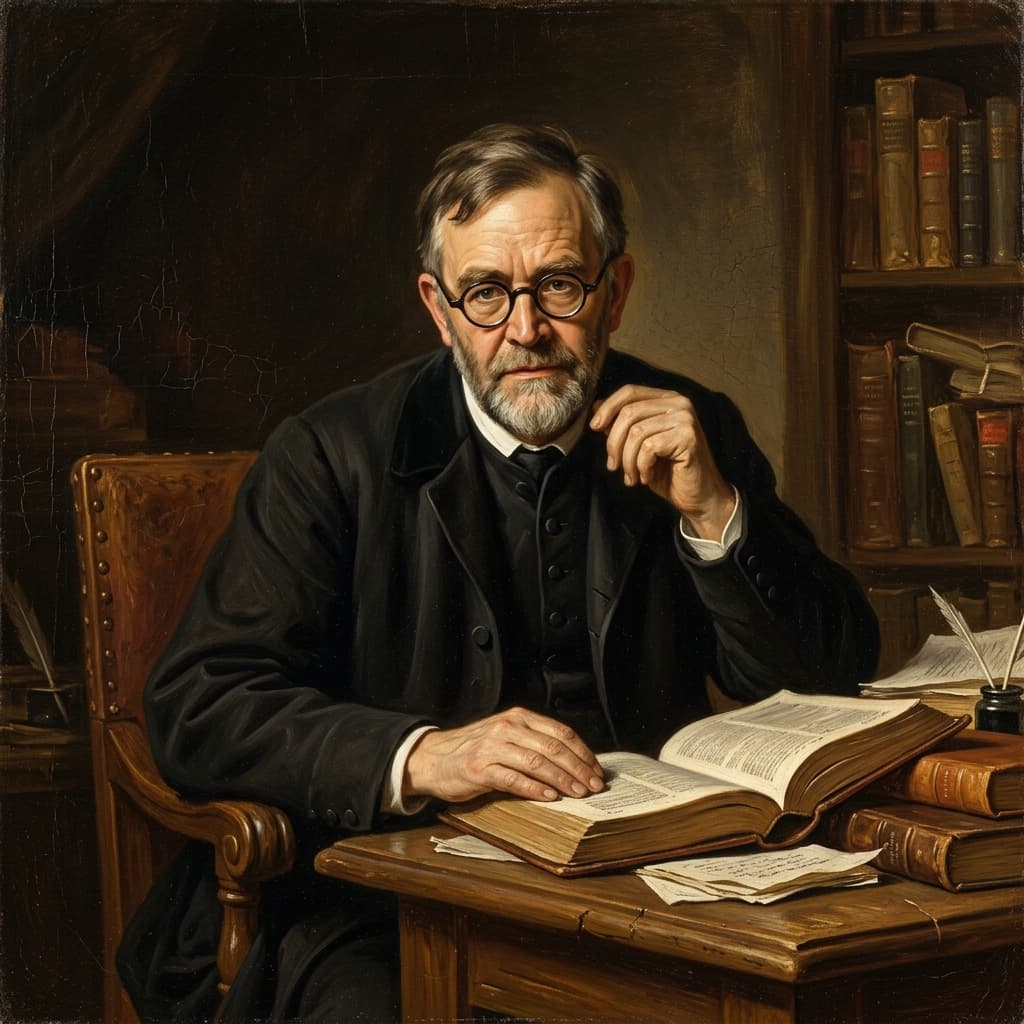
Karl Barth
theologianModern (17th C+) · 1886-1968 CE · Updated April 8, 2026
Biography
Karl Barth was a Swiss Reformed theologian, widely regarded as the most important Protestant theologian of the 20th century, who played a leading role in the Confessing Church in Germany during the Nazi era. He is best known for his monumental work, "Church Dogmatics," which reshaped Protestant theology by emphasizing the sovereignty of God and divine revelation over human reason. Barth's influence extended beyond academia; he became a key figure in resisting Nazi attempts to control the German church.
Born in 1886 in Basel, Switzerland, Karl Barth initially studied under the liberal theologian Adolf von Harnack but eventually broke away from liberal theology. Barth's early career was marked by his groundbreaking commentary on "The Epistle to the Romans," published in 1919, which challenged the prevailing theological norms. In 1934, he became one of the principal authors of the Barmen Declaration, a document that rejected the Nazi-aligned German Christians' distortion of Christian doctrine. Barth's stance against Nazism led to his removal from his professorship in Germany, and he returned to Switzerland, where he continued his theological work until his death in 1968.
Barth lived during a time of immense upheaval, with Europe caught in the turmoil of two world wars and the rise of totalitarian regimes. Theological liberalism, which emphasized human experience and reason, dominated Protestant circles, but Barth challenged this by asserting the primacy of divine revelation. His opposition to the Nazification of Christianity led to the formation of the Confessing Church, a movement that sought to preserve the integrity of the Christian faith. The Barmen Declaration, which he helped draft, remains a testament to this resistance, standing as a clear rejection of any ideology that seeks to subordinate the church to the state.
If God is wholly other and revelation comes only from above, can human culture, reason, or religion serve as a point of contact for the gospel — or does all such contact betray it?
The ideas
Karl Barth devoted his life to a singular, pressing question: How can theology speak truthfully about God? In the early 20th century, he confronted a theological landscape dominated by liberal theology, which often prioritized human experience and reason as sources of knowledge about God. Barth saw this as a crisis because it diluted the divine mystery, making God a mere extension of human understanding. He believed that theology must be grounded in the Word of God, which he considered the only legitimate source of divine revelation. Barth sought to reclaim the transcendence and otherness of God, insisting that human constructs should not dictate theological truths.
Central to Barth's theology were several key ideas. First, he emphasized the Word of God as the starting point for all theological reflection, challenging the liberal theology's reliance on human experience. This was driven by his conviction that God is wholly other and cannot be reduced to human concepts. Another crucial idea was the infinite qualitative distinction between God and humanity, a concept influenced by the philosopher Kierkegaard. This notion reinforced the idea that God's nature is fundamentally different from human nature, underscoring divine mystery. Additionally, Barth insisted that Jesus Christ is the definitive revelation of God. For Barth, all theology must be centered on Christ, as He is the one Word through whom God communicates.
Beyond these foundational ideas, Barth made significant contributions to various theological doctrines. His doctrine of election reinterpreted traditional views by framing it as God's gracious choice to be for humanity in Jesus Christ, rather than a deterministic decree. This was a departure from conventional Reformed theology and offered a fresh perspective on divine grace. Barth also employed a dialectical method in his theology, embracing paradox and tension to acknowledge the limits of human understanding of the divine. This approach was influenced by existentialist thought and represented a critique of rigid systematic theology.
Barth's signature argument was the radical transcendence of God and the assertion that revelation comes solely from above. This argument was compelling because it firmly established the divine as beyond human comprehension, challenging any theology grounded in human culture, reason, or religion. It shifted the focus of theology back to divine revelation, demanding a humble acknowledgment of human limitations. By insisting that genuine knowledge of God depends entirely on God's self-disclosure, Barth redefined the theological landscape, pushing theologians to reconsider the foundation upon which they built their understanding of the divine.
What changed
Before Karl Barth, Christian theology leaned heavily on liberal ideas that prized human reason, experience, and culture as valid ways to understand God. Theologians often embraced an optimistic view of human progress, seeing God as intimately involved in the world and human history. This led to a diminished focus on God’s otherness and transcendence. Theological discussions often began with human experience or cultural context, treating these as starting points for understanding the divine. This approach blurred the lines between the human and the divine, making God seem more like a part of human history than a being entirely beyond it.
Karl Barth changed this landscape by insisting that theology must begin with the Word of God, not human experience or reason. He argued that divine revelation, particularly through scripture, should be the sole foundation of theological thought. Barth also emphasized the infinite qualitative distinction between God and humanity, reinforcing the idea of God's radical otherness. He centered his theology on Jesus Christ, asserting that Christ is the definitive revelation of God and the lens through which all theology must be understood. Barth rejected natural theology, which claimed that knowledge of God could be derived from nature and human reason, insisting instead that true knowledge of God comes only through divine revelation.
The impact of Barth's ideas is evident in the development of neo-orthodoxy, a movement that sought to restore the centrality of scripture and the transcendence of God in Protestant theology. His influence extended to theologians like Dietrich Bonhoeffer and Reinhold Niebuhr, who engaged deeply with his emphasis on revelation and Christocentrism. His rejection of natural theology sparked debates that continue to shape Christian thought. Post-liberal theology and modern discussions on universalism and election can trace their roots to Barth's work. By 1968, Barth's influence was so significant that Time magazine featured him on its cover, underscoring his lasting impact on modern theology.
Disputed legacy
Karl Barth, a towering figure in 20th-century theology, had several contentious areas in his work. His outright rejection of natural theology dismissed the role of human reason and the natural world in understanding God, leading to objections from theologians like Emil Brunner. They argued that natural theology could offer a valid point of contact for divine revelation. Barth's doctrine of election, which suggested that all humanity is elected in Christ, was criticized for suggesting an implicit universalism, undermining traditional beliefs about individual salvation and damnation. His break with liberal theology was seen by some, like Adolf von Harnack, as overly dismissive, creating a divide between traditional and modern approaches. Barth's stance potentially isolated theology from broader intellectual discourse.
The darkest chapter in Barth's legacy was his initial reluctance to fully engage politically against Nazi Germany. Despite his leadership in the Confessing Church, Barth's focus on theological purity over direct political action limited his effectiveness in opposing the regime's atrocities. Some contemporaries and later historians believed that more decisive action was needed during this critical period. Barth's theological focus, while significant, was seen as a missed opportunity to take a stronger stand against the Nazi regime's growing influence and brutality.
Some scholars have argued that Barth's emphasis on the sovereignty of God and the centrality of Christ offers a necessary corrective to both liberal and conservative theological excesses. They suggest that such criticisms of Barth's work may overlook its depth and nuance. However, the criticisms of his stance on natural theology, his doctrine of election, and his initial political hesitance remain significant. Barth's ideas continue to provoke debate, but the fact that he was hesitant in his political resistance during a critical historical moment stands as a concrete aspect of his legacy.
Legacy
After his break with liberal theology, Karl Barth emerged as a leading figure in the Confessing Church, a movement that stood against the Nazi regime's attempt to control German Christianity. In 1935, Barth faced expulsion from Germany because he refused to pledge allegiance to Adolf Hitler. This steadfast refusal highlighted his commitment to maintaining the independence of Christian doctrine from political pressures. Barth returned to his native Switzerland, where he resumed his academic career at the University of Basel. There, he continued to teach and write until his retirement, cementing his role as a major theologian of his time.
Barth's theological approach gave rise to neo-orthodoxy, a movement that redirected focus to the Bible and emphasized God's transcendence. His work profoundly influenced theologians like Dietrich Bonhoeffer and Reinhold Niebuhr, who integrated Barth's emphasis on the Word of God into their own teachings. Neo-orthodoxy reshaped Protestant theology across Europe and North America by challenging prevailing liberal theological trends and reasserting the centrality of scripture and the significance of Christ in Christian thought. Barth's ideas thus laid the groundwork for a renewed engagement with foundational Christian beliefs.
Today, Barth's influence persists in many Reformed and mainline Protestant denominations, where his focus on scripture and Christ as the cornerstone of faith remains influential. His theological insights continue to shape contemporary discussions about revelation and the intersection of faith and culture. For instance, seminaries and theological schools often include Barth's works in their curricula, ensuring that new generations of theologians and clergy engage with his ideas. His legacy lives on as a vital part of theological education and discourse, illustrating his enduring impact on the Christian faith.
Continue reading with a Scholar plan
Upgrade to ScholarCommon questions
- What is Karl Barth most known for in Christian history?
- Karl Barth is most known for his role in the development of neo-orthodoxy, a movement that emphasized the transcendence of God and the centrality of Christ. He is also recognized for his opposition to liberal theology and his leadership in the Confessing Church during Nazi Germany.
- What were Karl Barth's most important works?
- Karl Barth's most important works include 'Church Dogmatics,' a massive multi-volume work published between 1932 and 1967, and 'The Epistle to the Romans,' which was first published in 1919 and revised in 1922. He also contributed significantly to the Barmen Declaration of 1934, which opposed the Nazi influence on German Christianity.
- What were Karl Barth's most influential theological ideas?
- Barth's influential ideas include the concept that theology should begin with the Word of God, not human experience or reason. He emphasized the infinite qualitative distinction between God and humanity and viewed Jesus Christ as the sole revelation of God. His dialectical method highlighted the paradoxical nature of speaking about God.
- What controversies did Karl Barth engage in — and what was at stake?
- Barth engaged in controversies with liberal theologians who emphasized human reason and experience in theology. He also opposed the German Christian movement, which sought to align Christianity with Nazi ideology. At stake was the integrity of Christian doctrine and the church's independence from political ideologies.
- How did Karl Barth influence later Christianity — Catholic, Protestant, and beyond?
- Barth's emphasis on the centrality of Christ and the Word of God influenced Protestant theology, leading to a reevaluation of liberal theology. His ideas also impacted Catholic theologians, contributing to discussions at the Second Vatican Council. Beyond Christianity, his work influenced existentialist and postmodern thinkers.
- What did Karl Barth get wrong, or what ideas have been seriously disputed?
- Some critics argue that Barth's rejection of natural theology and human reason is too extreme, potentially undermining the role of human experience in understanding God. His views on election and universalism have also been debated, with some seeing them as inconsistent or unclear.
- Is Karl Barth considered a saint? By which traditions?
- Karl Barth is not considered a saint in any Christian tradition. He is recognized as a significant theologian but not canonized or venerated as a saint.
- Why does Karl Barth still matter today?
- Barth matters today because his theology challenges modern Christians to reconsider the foundations of their faith, emphasizing the transcendence of God and the centrality of Christ. His work continues to influence theological discussions and provides a counterpoint to secular and liberal theological trends.
- What is the most surprising or counterintuitive thing about Karl Barth?
- One surprising aspect of Barth's theology is his assertion that God's revelation is entirely independent of human culture and reason, which contrasts sharply with the liberal theology of his time. This radical focus on divine revelation over human understanding was counterintuitive to many of his contemporaries.
- What is the best place to start reading Karl Barth?
- A good starting point for reading Karl Barth is 'The Epistle to the Romans,' which provides insight into his early theological development. For a more comprehensive understanding, 'Church Dogmatics' is essential, though readers might begin with the shorter 'Dogmatics in Outline' for an overview.