Library
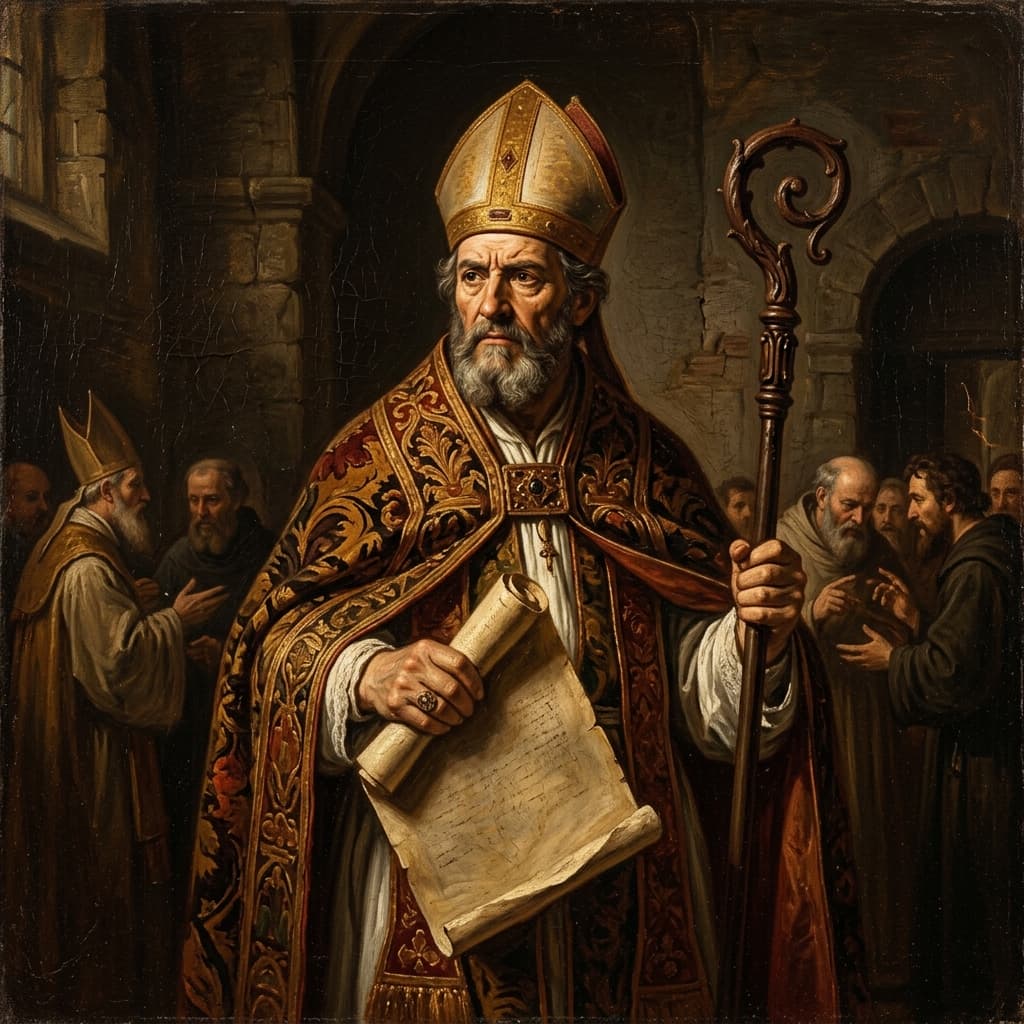
AI-generated illustration
Library
Nicene Era (4th C) · d. c. 325 CE · Updated April 9, 2026
Meletius of Lycopolis was a bishop in Lycopolis, Egypt, during the Nicene Era of the 4th century. He is best remembered for leading a rigorist schism known as Meletianism, which opposed the authority of the Bishop of Alexandria. This schism emerged during a time of great ecclesiastical tension and discord within the early Christian church, as Meletius championed strict adherence to Christian discipline and practices.
Meletius's career as a bishop began against the backdrop of the Diocletianic persecution, a period of intense hardship for Christians. During this time, he defied the established ecclesiastical hierarchy by ordaining clergy and administering churches outside his jurisdiction. His refusal to recognize the authority of Bishop Peter of Alexandria sparked a significant conflict. This defiance continued into the era of Athanasius, a leading church figure, with whom Meletius's followers clashed for decades. Despite efforts to address the schism at the First Council of Nicaea in 325 CE, the divide persisted, highlighting Meletius's lasting impact on the church.
The early 4th century presented a landscape of theological and ecclesiastical turmoil. The Diocletianic persecution had destabilized the church's structure, making the question of episcopal authority and jurisdiction critical. As bishops like Meletius challenged the established order, the struggle for unity and orthodoxy intensified. The First Council of Nicaea was convened to address these controversies, but the Meletian schism remained unresolved. This period underscored the fragile nature of early church unity, as demonstrated by Meletius's enduring influence and the continuing conflicts that followed his lead.
Does a bishop have the right to administer sacraments and ordain clergy in another bishop's territory during a crisis — and who has authority over the church in times of persecution?
Meletius of Lycopolis saw a church in turmoil. The Diocletianic persecution left many communities without leadership. Bishops were imprisoned or in hiding, and congregations were adrift. Meletius acted decisively, ordaining clergy across borders to fill the void. He believed that the spiritual needs of the people outweighed canonical boundaries. His actions were not impulsive; they were born from a profound belief in the necessity of pastoral care during a crisis. For Meletius, the absence of leadership was a greater threat than the breach of jurisdictional lines. He prioritized the immediate spiritual welfare of the faithful over rigid adherence to traditional boundaries.
The stance that a bishop can intervene in another's territory during a crisis has a clear and dangerous logic. It means that in times of emergency, the preservation of the church's spiritual mission demands flexibility. Pastoral care cannot wait for bureaucracy. This approach risks chaos. It encourages bishops to act unilaterally, undermining the established hierarchy. If every bishop followed Meletius's example, the church would fragment into competing factions, each led by those who claim the mantle of savior in chaotic times. The cost is a fractured church, where authority is constantly in flux and unity is sacrificed for expediency.
Insisting on strict adherence to jurisdictional boundaries even during persecution has its own ironclad logic. It maintains the church's structural integrity and respects the authority of each bishop. This approach requires communities to endure hardship without immediate relief, waiting for their rightful leaders to return or be replaced through proper channels. It prioritizes long-term unity over short-term solutions. The cost is tangible: neglected congregations without sacraments or guidance. While this strategy preserves ecclesiastical order, it risks alienating the faithful and failing them when they need the church most.
The church faced an impossible dilemma. It needed both the unity of a coherent structure and the responsiveness of leaders like Meletius during crises. Neither side could fully concede. For believers, this debate wasn't just theological; it was personal. Access to sacraments and guidance during persecution affected their ability to sustain faith. The conflict between maintaining order and meeting immediate needs left ordinary people caught in the crossfire. They needed both stability and care, and the resolution of this tension would shape the church's future and their own spiritual lives.
Meletius of Lycopolis taught that during times of persecution, bishops could step beyond their traditional boundaries to administer sacraments and ordain clergy in another bishop's territory. He argued that if local church leadership was compromised or unable to function, preserving the church's sacramental life and leadership became the top priority. This meant that the usual rules governing church jurisdictions could be set aside to maintain the spiritual well-being of the community.
Meletius grounded his teaching in both logic and scripture. He saw the extraordinary circumstances of persecution as demanding equally extraordinary responses to ensure the church's mission continued. He cited Acts 8:1-4 to show that the early Christians spread the Gospel despite established structures being disrupted. He also referenced 2 Timothy 4:2, emphasizing that church leaders must be ready to act in all situations, including crises. Furthermore, the Great Commission in Matthew 28:19-20, with its call to make disciples everywhere, supported his view that spiritual needs could override jurisdictional limits. Meletius made his case in his "Letter to the Bishops of Egypt," written around 320 CE, arguing that the persecution justified his actions.
This teaching attracted those frustrated by the perceived inaction of local leaders during the Diocletianic persecution. Clergy and laity who valued decisive action and the continuity of church functions found his emphasis on preserving sacramental life compelling. His ideas spread among those who prioritized the church’s mission over strict adherence to canonical boundaries. By the time of the Council of Nicaea in 325 CE, Meletius's stance had sparked significant debate, underscoring its impact on the early church.
The decisive argument against Meletius of Lycopolis centered on the necessity of maintaining ecclesiastical order and unity, even during persecution. This argument, championed by Athanasius of Alexandria, held that the Church's authority stems from divine institution, not individual discretion. Athanasius asserted that Meletius's actions, which involved appointing bishops outside his jurisdiction, undermined the Church's unity and thus its mission. According to Athanasius's defense at the First Council of Nicaea in 325 CE, the authority of bishops derives from apostolic succession. This authority must be respected to preserve ecclesiastical order. Meletius's disregard for established boundaries threatened the Church's integrity, which was a betrayal of apostolic tradition and early council decisions.
Meletius attempted to justify his actions with specific scripture, but these were systematically countered. He cited Acts 8:14-17, claiming that the apostles' actions in Samaria supported his independent operations. The orthodox response highlighted that the apostles acted with mutual consent, emphasizing unity over unilateral action. Meletius also referenced the Great Commission in Matthew 28:19-20 to argue for unrestricted evangelism, but orthodoxy pointed out that the commission was a collective charge, implying a unified mission under Church hierarchy. Lastly, Meletius used 1 Corinthians 3:5-9 to defend his role, but this was rebutted by clarifying that Paul's message promoted unity within diverse roles, not division of authority. The trap in Meletius's position lay in its implication that any bishop could act independently during crises, leading to fragmentation. This contradicted his claim of preserving Church purity, revealing an inconsistency that made his position self-defeating.
In countering Meletius, the Church emphasized the importance of ecclesiastical hierarchy and councils, which introduced a potential for increased centralization. This shift risked making the Church's response to future crises more rigid. By reinforcing hierarchical structures, the Church sought to prevent fragmentation, but it also faced the challenge of balancing authority with flexibility. The tension between maintaining unity and allowing for pastoral discretion remained a complex issue. This debate over authority and unity had lasting impacts, as evidenced by the ongoing challenges the Church faced in balancing centralized control with responsiveness to local needs.
In 325 CE, the First Council of Nicaea convened in the city of Nicaea, gathered by Emperor Constantine I. Constantine aimed to bring unity to the Christian church as a means of stabilizing his empire. Bishops from across the Roman Empire, including representatives from the Meletian faction, attended. The council's primary goal was to address the schism caused by Meletius, who had continued to ordain clergy and administer sacraments outside his jurisdiction during the Diocletianic persecution. The emperor saw the resolution of this ecclesiastical conflict as crucial for maintaining political cohesion.
The debate revolved around church governance and the limits of episcopal authority. Meletius and his faction argued that their actions were necessary to maintain church order under duress, suggesting that extraordinary circumstances justified their overreach. Opponents, including the influential bishop Athanasius, insisted on the importance of adhering to established ecclesiastical boundaries. The council's decision was a compromise: Meletius could retain his title but not his episcopal functions. His ordinations stood, but only after confirmation by the Bishop of Alexandria. This decision reinforced the hierarchical structure of the church and the central authority of key bishops.
Despite the council's efforts, the resolution fell short of ending the Meletian schism. Meletius's followers continued their independent operations, frequently clashing with Athanasius and his successors. This division persisted in Egyptian ecclesiastical politics for decades, with Meletian bishops even aligning with other dissenting factions like the Arians. The schism contributed to ongoing conflicts and debates that extended well into the late 4th century. The Meletian schism's influence lingered, illustrating the enduring complexity of early church disputes and the difficulties of achieving lasting unity through council decrees alone.
After the First Council of Nicaea in 325 CE condemned Meletius of Lycopolis, he faced restrictions rather than immediate exile. He was confined in his ability to perform ecclesiastical duties but continued to lead his followers steadfastly. Meletius and his group, the Meletians, maintained a separate church structure that stood in defiance of the established ecclesiastical hierarchy. This defiance was not merely symbolic; it represented a tangible schism in the early Christian community, particularly in Egypt. Up until his death around the same year as the council, Meletius remained a thorn in the side of the mainstream church, underscoring the deep divisions within the early Christian community.
The Meletian schism did not die with Meletius. It lingered for decades, presenting a persistent challenge to the authority of prominent Alexandrian bishops like Athanasius. The Meletians continued to assert their independence, creating friction within the Egyptian church. This division contributed to a climate of tension and fragmentation. Over time, their influence waned, but the schism left a mark on the ecclesiastical landscape of the region. It fueled debates about authority and governance within the church, debates that echoed beyond Egypt and influenced broader Christian discourse.
Today, echoes of Meletius's push for ecclesiastical independence resonate in certain Christian groups that prioritize local autonomy over centralized control. These groups reflect a legacy that values the ability of local communities to govern themselves, especially in times of crisis. The Meletian emphasis on questioning centralized authority persists in modern discussions about church leadership and governance. This ongoing dialogue demonstrates that the issues Meletius raised continue to be relevant, illustrating the enduring impact of his movement on the broader Christian tradition.
Continue reading with a Scholar plan
Upgrade to ScholarAI-generated illustration