Library
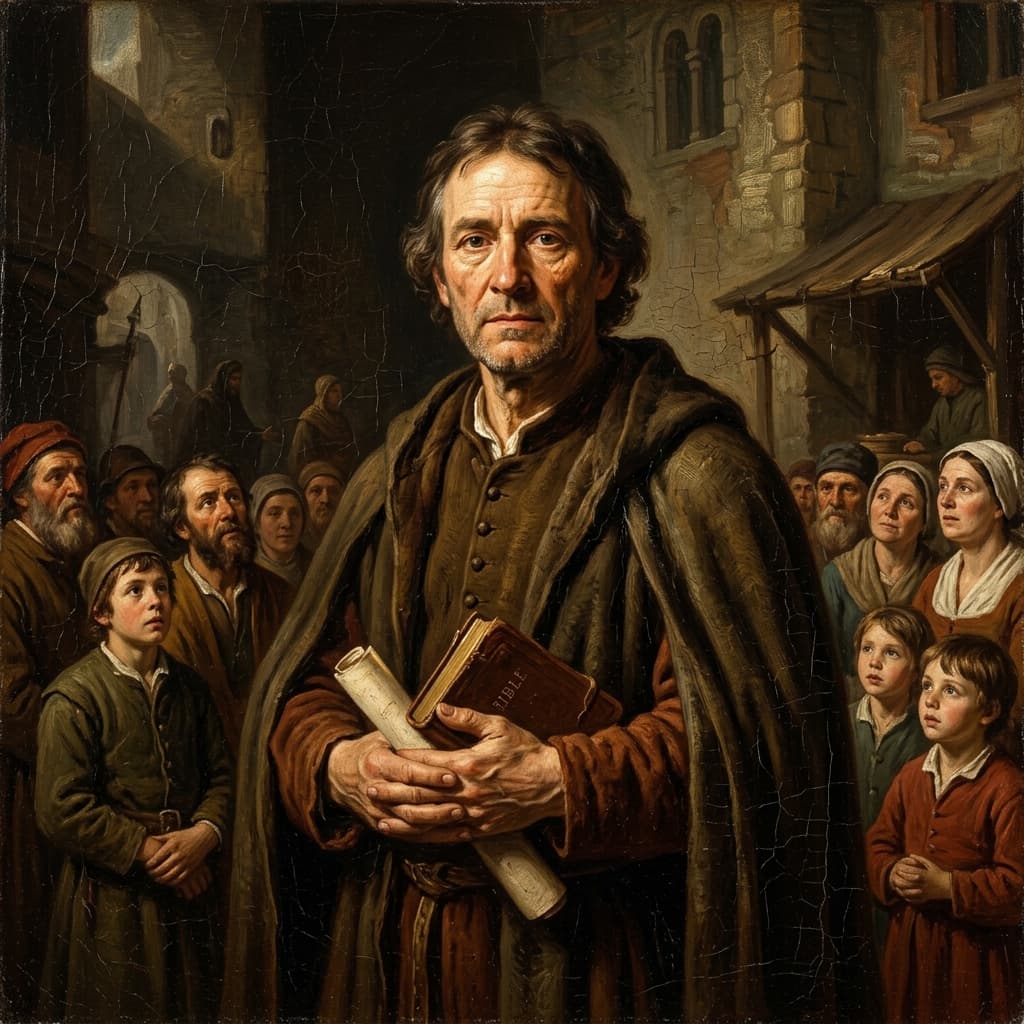
AI-generated illustration
Library
Medieval (9th-15th C) · c. 1140-1205 CE · Updated April 20, 2026
Peter Waldo was a 12th-century merchant from Lyon who founded the Waldensian movement, advocating for apostolic poverty and lay preaching. In a time when the wealth of the Church raised eyebrows, Waldo's message resonated with many who yearned for a simpler, more authentic Christian life. He is known for challenging the established Church by promoting the idea that ordinary people could preach and live according to the teachings of the early apostles.
Born around 1140 in Lyon, France, Peter Waldo amassed wealth as a successful merchant. His life took a dramatic turn when he decided to give away his fortune and embrace a life of poverty around 1170. Waldo translated the Bible into vernacular French, making Scripture accessible to laypeople, which was revolutionary for his time. His actions and beliefs led to the formation of the Waldensian movement, which was condemned at the Third Lateran Council in 1179. Despite the Church's disapproval, Waldo continued his mission until he faced excommunication by Pope Lucius III in 1184. He died around 1205, leaving behind a legacy that would endure despite persecution.
During the 12th century, Europe experienced significant religious upheaval. The Church's wealth and perceived corruption drew increasing criticism. People like Waldo saw a need for reform, believing that a return to the simplicity and poverty of the apostles could restore the Church's integrity. This period also witnessed heated debates about the authority of Scripture versus Church tradition. Many laypeople, inspired by Waldo's example, sought greater involvement in religious life. The excommunication of Peter Waldo highlighted the Church's resistance to such challenges, but his movement persisted, laying the groundwork for later reformers.
Must the church be poor to be legitimate — and do laypeople have the right to preach and interpret Scripture when the official clergy have abandoned the apostolic life?
Peter Waldo was a merchant who found wealth spiritually bankrupting. After reading the Gospels in his own language, he saw a stark contrast between the opulence of the church and the poverty of Christ. He embraced a life of poverty, giving away his possessions and preaching a return to the apostolic lifestyle. This personal transformation was not a rebellion but a sincere attempt to live according to the Gospel's demands. Waldo believed that true Christianity required living as Christ and the apostles did, in simplicity and humility. His conviction was not just personal piety but a call for the church to reform itself.
The call for apostolic poverty demanded that the church abandon its wealth, requiring clergy to live modestly. This would dismantle the church's financial empire, stripping it of its worldly power. Bishops and priests, accustomed to privilege, would face the loss of status and influence. The church would have to redistribute its resources, prioritizing spiritual integrity over economic might. This radical shift promised a church more aligned with Christ's teachings but at the cost of its traditional authority and social standing. It posed a threat to the established order, unsettling those who relied on the church's wealth for their livelihoods.
On the flip side, maintaining wealth allowed the church to exert influence and manage its vast responsibilities. The church argued that its resources funded missions, education, and charity, justifying its affluence as necessary for its mission. Yet, this stance deepened the divide between clergy and laity, as the faithful saw leaders living in luxury while preaching humility. This contradiction bred resentment and accusations of hypocrisy. The church prioritized stability and outreach, but it risked alienating its followers and compromising its moral authority. The gap between the church's teachings and its practices grew wider, causing disillusionment among believers.
The church's dilemma was clear: it could not fully embrace poverty without dismantling its power structure, nor could it ignore the call for reform without undermining its spiritual credibility. Lay preaching, as advocated by Waldo, threatened the church's monopoly on scriptural interpretation. For ordinary believers, this controversy was not just theological but deeply personal. It challenged their understanding of faith and who had the authority to guide them. As the church resisted change, it reinforced its hierarchical control, leaving many to question the legitimacy of their spiritual leaders and the path to salvation. This crisis of faith reflected a broader struggle between institutional authority and genuine spiritual renewal.
Peter Waldo taught that the church must embrace apostolic poverty to remain legitimate. He believed that wealth and corruption within the church invalidated its spiritual authority. Waldo argued that all believers, including laypeople and women, have the right to preach and interpret Scripture. When the clergy abandoned the apostolic life, laypeople could step in to restore true Christian teaching. He saw this as a return to the practices of the early church, where simplicity and shared responsibility for the faith were central.
Waldo's logic rested on the example of the apostles, who lived in poverty and simplicity, which he saw as essential for spiritual integrity. He used biblical passages to support his views. Matthew 19:21 was key, where Jesus advises a young man to sell all possessions to achieve spiritual perfection. Waldo also cited 1 Corinthians 14:31 to argue that all Christians could share in the ministry, not just the clergy. Acts 4:32-35 showed the early Christian community sharing everything, reinforcing his vision of a church rooted in communal living. His ideas were encapsulated in "The Noble Lesson," a treatise that outlined the Waldensian belief in a life of poverty and the right of laypeople to preach.
Waldo's teachings resonated with those disillusioned by the church's wealth and corruption, particularly among laypeople who felt marginalized by the religious hierarchy. His call for a return to apostolic poverty and direct access to Scripture attracted followers who sought a more authentic Christian experience. The movement spread across Europe, gaining traction in regions dissatisfied with the existing church structure. By emphasizing community and simplicity, Waldo's ideas laid the groundwork for later reform movements. The Waldensians continued to practice his teachings, surviving as a distinct group for centuries.
The decisive argument against Peter Waldo centered on the Church's claim to exclusive authority over interpreting Scripture and administering sacraments. This authority, according to the Church, derived from its divine foundation and continuity through apostolic succession, not from the personal holiness or poverty of its clergy. Pope Lucius III articulated this position in his 1184 papal bull, "Ad Abolendam." He argued that the Church's legitimacy rests on its apostolic roots and the sacramental grace it provides, which remains valid regardless of individual clerical failings. Lucius emphasized that the Church's teaching authority is essential for maintaining doctrinal unity and preventing heretical interpretations. This argument left no room for Waldo's insistence that only those who embraced apostolic poverty could legitimately minister, as it divorced the Church's divine mission from the personal virtue of its members.
Peter Waldo cited several scriptural passages to support his views, but the Church systematically countered these interpretations. To Waldo's claim that Matthew 19:21 mandated poverty for all, the Church responded that this was a counsel of perfection, not a command for everyone. Waldo's reading of 1 Corinthians 14:31 as endorsing lay preaching was dismissed by the Church, which insisted that authoritative interpretation of Scripture belonged to ordained clergy to maintain orthodoxy. Likewise, his interpretation of Matthew 23:8-10 as rejecting hierarchical authority was countered with the Church's understanding of these verses as a call to humility within its necessary structure. The trap in Waldo's argument lay in his insistence on apostolic poverty. By advocating for lay interpretation of Scripture, he inadvertently opened the door to doctrinal chaos, undermining the very apostolic purity he sought to restore.
The Church's counter-argument, while effective in reinforcing its hierarchical and sacramental authority, introduced new challenges. It risked alienating believers who viewed clerical wealth and corruption as contrary to the Gospel. Moreover, it left the question of addressing genuine clerical abuse unresolved. The Church had to reaffirm its authority without appearing indifferent to corruption, a delicate balance that required ongoing attention. Despite these challenges, the Church's stance prevailed, and Waldo's movement was marginalized. The tension between maintaining authority and addressing corruption remained a persistent issue, underscored by the continued calls for reform that echoed through the subsequent centuries.
In 1179, the Third Lateran Council convened in Rome under the leadership of Pope Alexander III. Bishops and church officials from all over Christendom gathered to address pressing theological and political issues. Central to their discussions was the challenge posed by the Waldensians, a movement advocating for apostolic poverty and lay participation in preaching and interpreting Scripture. These ideas threatened the established church hierarchy and alarmed secular rulers, who feared that allowing laypeople, especially women, to preach could destabilize social order and undermine their control. Thus, both church officials and political leaders had a vested interest in maintaining the status quo.
The debate at the council focused on whether apostolic poverty was essential for clergy legitimacy and if laypeople could preach. The Waldensians insisted on poverty and lay preaching as true Christian practices, challenging the wealth and authority of the church. The council, however, prioritized ecclesiastical authority and tradition. The language of 'apostolic poverty' and 'lay preaching' carried significant weight, as it directly opposed the church's power structure. Ultimately, the council condemned Waldensian teachings as heretical. It excommunicated Peter Waldo and his followers, reinforcing the church's exclusive right to interpret Scripture and asserting the necessity of clerical wealth.
Despite the council's resolution, the Waldensian movement did not vanish. Instead, it persisted and spread, particularly in the remote Alpine regions. The issues of lay preaching and church wealth continued to simmer beneath the surface, influencing later movements like the Lollards in England and eventually fueling the Protestant Reformation in the 16th century. The struggle over clerical poverty and lay access to Scripture remained unresolved for centuries, only formally addressed with the broader Reformation changes that permanently altered the religious landscape of Europe.
After Peter Waldo's condemnation, he faced increasing hostility from the Catholic Church. Excommunication by Pope Lucius III in 1184 marked him as a target, forcing him into exile. Despite this, Waldo continued to preach his message of returning to the simplicity of early Christianity. His followers, known as Waldensians, became targets for persecution. The Church viewed them as heretics for their emphasis on lay preaching and rejection of clerical excess. This persecution drove the Waldensians into remote areas, but their movement did not die.
The Waldensian movement took root in the Alpine regions of France and Italy, where they maintained their focus on apostolic poverty and lay preaching. For centuries, they faced hostility but persisted in secret, meeting in homes and remote locations. In the 16th century, the Protestant Reformation sparked hope and opportunity for the Waldensians. They found theological kinship with reformers like Martin Luther and John Calvin, aligning with the broader reformist movement. This connection helped them survive and integrate into the new Protestant landscape, expanding their influence and adapting their practices to the changing times.
Today, the Waldensian Church remains active, especially in Italy and parts of South America. They continue to uphold the principles of lay preaching and scriptural authority, rooted in their historical struggle against oppressive church structures. Their legacy also appears in various Protestant denominations that emphasize social justice, egalitarianism, and a return to simple faith. In Italy, the Waldensian Church is recognized for its commitment to these values, evidenced by their involvement in social programs and advocacy for the marginalized. Their endurance is a testament to the lasting impact of Peter Waldo's vision.
Continue reading with a Scholar plan
Upgrade to ScholarAI-generated illustration