Library
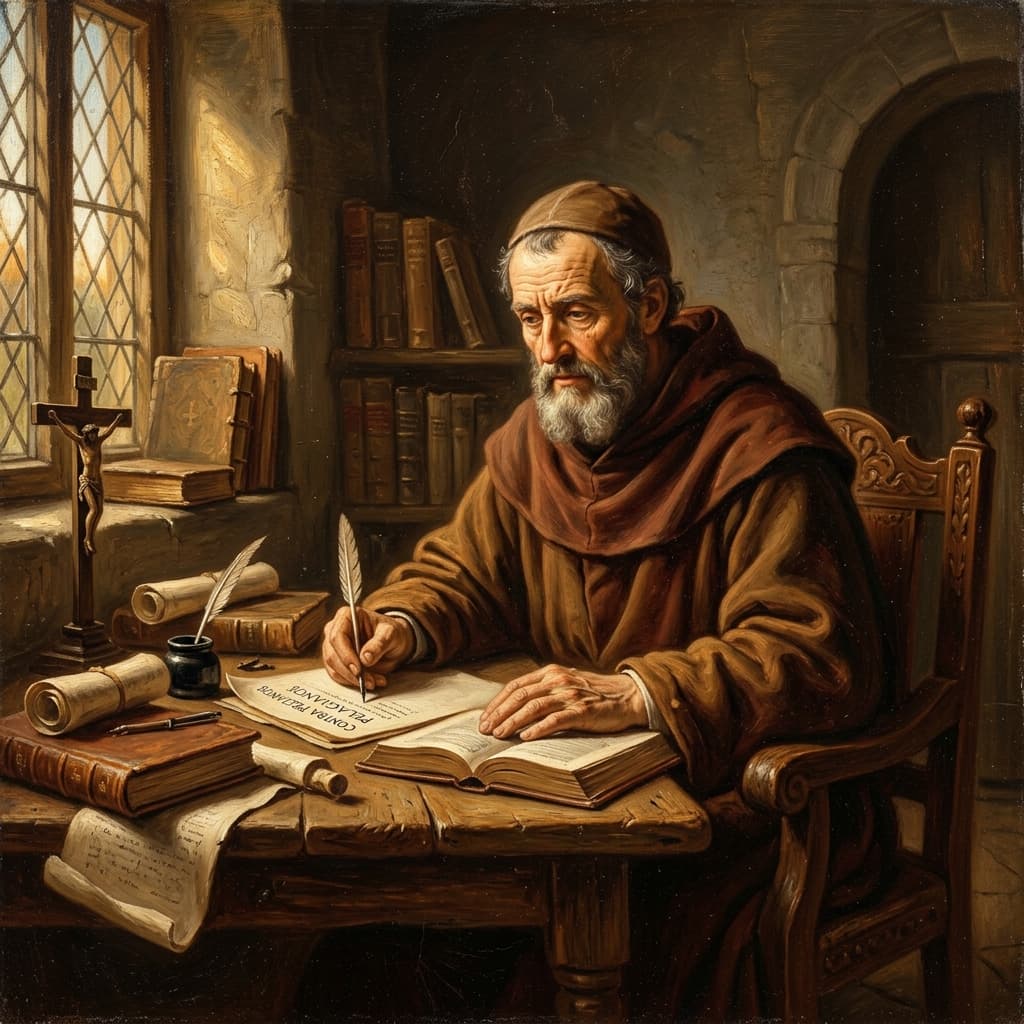
AI-generated illustration
Library
Post-Nicene Patristic (4th-5th C) · c. 390-455 CE · Updated April 8, 2026
Prosper of Aquitaine was a lay theologian in Gaul during the early 5th century, known for defending Augustine's doctrine of grace after Augustine's death. He played a crucial role in the theological debates of his time, particularly against the Semi-Pelagian movement, which sought to compromise between Augustine's teachings and the belief in human cooperation in salvation. Prosper's commitment to Augustine's views made him a significant figure in the Christian Church's efforts to clarify the nature of divine grace.
Born around 390 CE, Prosper lived through a transformative period in the Western Roman Empire. He eventually became the secretary to Pope Leo I, highlighting his influence and prominence within the Church. Prosper's major works include "On Grace and Free Will Against Cassian," "Chronicle," and "Sentences from Augustine," through which he articulated his defense of Augustine's ideas. His writings emphasized the universality of God's desire to save humanity while also underscoring the specific nature of predestination. He died around 455 CE, leaving behind a legacy of theological advocacy.
Prosper lived in a time when the Christian Church was wrestling with the complex implications of Augustine's teachings on Grace and predestination. The Semi-Pelagian controversy in southern Gaul emerged as a challenge to Augustine's views, with some theologians promoting a blend of divine grace and human effort in achieving salvation. This period was marked by intense debates over divine grace, human free will, and the Church's role in maintaining doctrinal purity. Prosper's steadfast defense of Augustine's doctrine helped shape the Church's understanding of grace, a debate that reverberated for centuries.
If God genuinely wills that all people be saved and yet predestines only some for salvation, is the predestination real or the universal salvific will?
Prosper of Aquitaine dedicated his life to resolving the tension between the universality of God's desire for human salvation and the specific nature of predestination. This was a pressing issue in the early 5th century, particularly during the Semi-Pelagian controversy in southern Gaul. The central question Prosper grappled with was how to reconcile the belief that God wants all people to be saved with the reality that only some are predestined for salvation. This was not merely an academic exercise; it was about understanding the nature of God's grace and how humans relate to it. Prosper sought to defend and systematize the teachings of Augustine of Hippo, his intellectual hero, whose ideas on Grace and predestination were under attack.
At the heart of Prosper's work were several key ideas. First, he staunchly defended Augustine's doctrine of Predestination, arguing that it is solely a divine act where God, through His Grace, chooses certain individuals for Salvation, independent of any human merit. This was in direct opposition to the Semi-Pelagian emphasis on human cooperation in achieving Salvation. Another critical idea was the universality of God's salvific will. Prosper maintained that God sincerely desires the Salvation of all people, despite not all being destined for salvation. This concept aimed to balance the apparent contradiction between God’s general will for salvation and the specific Predestination of individuals. Prosper was responding to scriptural interpretations and theological debates that questioned how both could be true.
Prosper's contributions also included a firm belief in the role of the papacy as the ultimate authority in maintaining theological orthodoxy. His later work as secretary to Pope Leo I reinforced his view that the Roman See was vital in resolving theological disputes. This perspective was essential during a time when the Church faced numerous doctrinal challenges. Prosper's critique of Semi-Pelagianism was another significant contribution, as he argued that it undermined the doctrine of grace by giving too much credit to human effort. Through his writings, such as "Contra Collatorem" and "Epitoma Chronicon," Prosper helped solidify Augustine's influence and shaped the Church's understanding of grace and salvation.
Prosper's signature argument was his claim that God's universal will for salvation and the particularity of Predestination are not contradictory but complementary. He proposed that while God desires all to be saved, the mystery of predestination is rooted in God's inscrutable will, which ultimately serves His purpose of grace. This argument was compelling because it offered a coherent framework for understanding divine grace without dismissing the reality of human experience and free will. By integrating Augustine's thought in a systematic way, Prosper provided a robust defense of grace that would influence Western theology for centuries, reinforcing the primacy of divine action in the process of salvation.
Before Prosper of Aquitaine entered the scene, Christian thought was embroiled in a heated debate over the roles of divine grace and human free will in salvation. The Semi-Pelagian controversy brewed in southern Gaul, where many theologians believed that human initiative played a crucial role in starting the process of salvation. Augustine's teachings on predestination and the primacy of Grace were influential but faced resistance. The theological landscape was marked by tension, as people struggled to reconcile God's omnipotence with the idea that humans could influence their own Salvation. This lack of consensus left the issue of Grace and free will unresolved.
Prosper of Aquitaine took decisive steps to address these theological disputes. He ardently defended Augustine's view that predestination was purely an act of divine grace, with human will merely responding to God's initiative. By doing this, Prosper solidified the Augustinian perspective as a cornerstone of Western Christian theology. He also tackled the apparent contradiction between God's desire for all to be saved and the doctrine of Predestination. Prosper argued that these could coexist, with God's grace being the decisive factor. Moreover, his role as secretary to Pope Leo I helped elevate the papacy's influence in enforcing theological orthodoxy, particularly concerning grace and Predestination.
Prosper's contributions had far-reaching impacts. His defense of Augustinian theology shaped the outcomes of the Council of Orange in 529 CE, which decisively condemned Semi-Pelagianism. His ideas laid the groundwork for later theologians such as Thomas Aquinas and John Calvin, who built on his interpretations of grace and Predestination. Additionally, Prosper's efforts to position the papacy as a key theological authority influenced its central role in medieval and early modern Christianity. His work ensured that The Papacy became a crucial player in doctrinal debates, a legacy that endured well beyond his time.
Prosper of Aquitaine, a staunch defender of Augustine's teachings, faced sharp criticism for several of his ideas. His unwavering commitment to predestination, which mirrored Augustine's, was seen as undermining human free will and moral responsibility. Critics, especially Semi-Pelagians, argued that this interpretation leaned too heavily on determinism, neglecting the role of human choice in salvation. Prosper's attempt to reconcile God's desire to save everyone with the notion that only some are predestined for salvation was deemed contradictory. This tension between universal Salvation and selective predestination remains unresolved, highlighting a logical inconsistency in his theology. Furthermore, Prosper's view of the papacy as the final authority on spiritual matters centralized ecclesiastical power, drawing objections from those who preferred a more collaborative approach to church governance, particularly from the Eastern Orthodox tradition.
The darkest chapter in Prosper's legacy is his unyielding stance on Predestination, which led to a theological rigidity that marginalized alternative views on grace and free will. By aggressively opposing Semi-Pelagianism, Prosper alienated many who sought a middle ground between the teachings of Augustine and Pelagius. His uncompromising position deepened divisions within the church, stifling dialogue and compromise. This inflexibility contributed to enduring conflicts in Christian theology, as his approach left little room for nuanced discussions on how divine grace and human agency interact.
Some modern theologians attempt to rehabilitate Prosper's reputation by arguing that his emphasis on Grace was a necessary response to the perceived excesses of Pelagianism. They suggest that his views have been misunderstood or misrepresented by later critics. However, the criticisms of his deterministic interpretation of Salvation and his centralizing view of papal authority continue to hold sway. The schism between Eastern and Western Christianity, in part fueled by these views, remains a testament to the lasting impact of Prosper's contested ideas.
After Augustine's death, Prosper of Aquitaine emerged as a staunch defender of his mentor's teachings on grace and predestination. Despite facing opposition, Prosper remained dedicated to these doctrines. He took on a significant role as a secretary to Pope Leo I, where he played a crucial part in shaping orthodox Christian doctrine. His close association with the Pope allowed him to influence the theological debates of his time, ensuring that Augustine's views on Grace continued to find support within the church. Prosper's tenacity and intellectual rigor helped solidify these teachings as foundational elements of Christian theology, and he remained a key figure in this theological discourse until his death around 455 CE.
Prosper's unwavering defense of Augustinian predestination left an enduring mark on Western Christian thought. His work laid the groundwork for the development of key Catholic doctrines, which were later articulated by influential theologians like Thomas Aquinas. Prosper's ideas resonated deeply during the Protestant Reformation, profoundly shaping the teachings of John Calvin and other Reformed theologians. These thinkers carried Prosper's ideas forward, embedding them within their own theological frameworks. As a result, Prosper's defense of Grace and Predestination found a home in various regions across Europe, influencing the formation of distinct Christian movements and denominations.
Today, Prosper's legacy endures in the doctrines of both the Roman Catholic Church and Reformed Protestant denominations, such as Presbyterianism. His influence is particularly evident in ongoing theological discussions about the interplay between divine sovereignty and human free will. Prosper's ideas continue to provoke debate and reflection, demonstrating their lasting impact. The theological principles he championed remain a crucial part of Christian thought, influencing how believers understand the nature of salvation and divine grace. His work is a testament to the enduring power of theological ideas to shape faith and practice across centuries.
Continue reading with a Scholar plan
Upgrade to ScholarAI-generated illustration