Library
Library
Early Church (2nd-3rd C) · c. 100-180 CE · Updated April 9, 2026
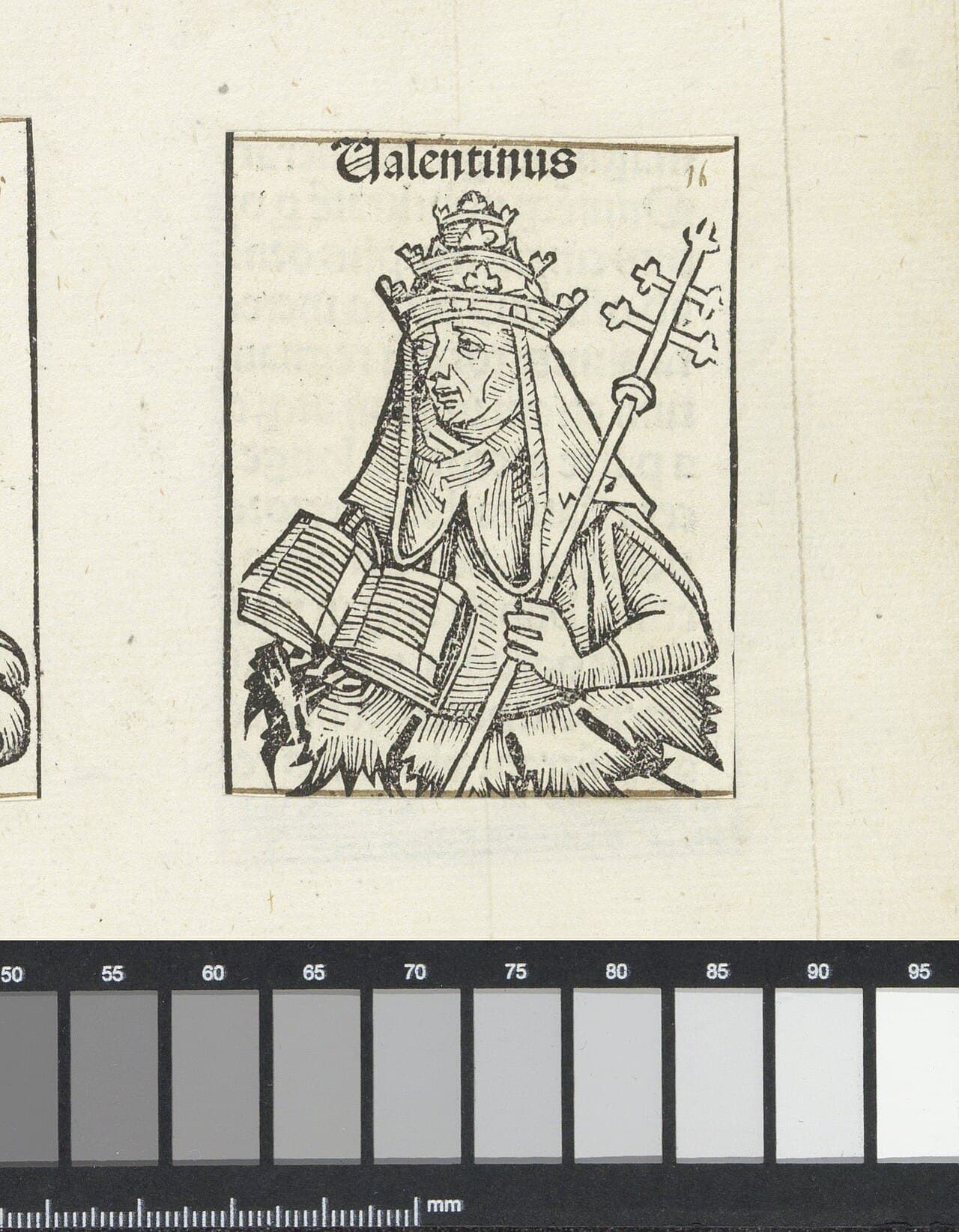
Valentinus was a Gnostic teacher and theologian active in Alexandria and Rome during the Early Church era (2nd-3rd century CE). Known for his influential role in the Gnostic movement, he emphasized esoteric knowledge as the key to spiritual enlightenment. Valentinus developed a theological system called Valentinianism, which proposed that the material world was the creation of a lesser deity, the Demiurge, distinct from the true, unknowable God.
Born around 100 CE, Valentinus spent his early years in Alexandria, a hub of intellectual and theological activity. His teachings soon gained attention, and he moved to Rome, where he continued to spread his ideas. Valentinus taught that salvation came through gnosis, or secret knowledge of one's divine origin, rather than through faith or traditional church sacraments. His doctrines attracted followers but also critics, most notably Irenaeus of Lyon, who condemned his teachings in "Against Heresies" around 180 CE.
Valentinus lived during a time when the early Christian church was still defining its doctrines and boundaries. The era allowed diverse theological interpretations, and the Gnostic movement's focus on secret knowledge and spiritual elitism clashed with emerging orthodox teachings that prioritized faith and sacraments. Theological debates about the nature of God, creation, and salvation created an environment where Valentinus's ideas could find an audience. Despite never being addressed by a single church council, his teachings faced opposition from many church fathers, highlighting the tensions in early Christianity.
Is the material world the creation of the true God, or the mistake of a lesser deity — and does salvation come through faith and sacrament, or through secret knowledge of one's divine nature?
Valentinus, a man of profound mystical insight, found himself deeply influenced by the teachings of earlier Gnostic thinkers. His own spiritual experiences led him to question the nature of the material world and the identity of its creator. He could not reconcile the imperfections and suffering inherent in the material world with the notion of a perfect and benevolent God. These contradictions drove him to propose that the material world might not be the work of the true God but rather the flawed creation of a lesser deity. For Valentinus, salvation lay not in blind adherence to established rituals but in the discovery of one's divine essence through secret knowledge.
The traditional Christian view held firm that the material world was the creation of the true God. This belief demanded faith in church teachings and participation in its sacraments as the path to salvation. It required the rejection of any mystical insights that deviated from accepted doctrine. Such a stance provided a sense of community and continuity but at the cost of stifling spiritual individuality. It necessitated a life lived within the strict boundaries of orthodoxy, leaving little room for personal exploration beyond the sanctioned religious practices.
Conversely, Valentinus's perspective embraced the notion that the material world stemmed from a lesser deity's error. Salvation, in his view, came through a personal awakening to one's divine nature, a journey marked by secret knowledge and esoteric insight. This path demanded a rejection of traditional religious authority, often resulting in isolation from the mainstream Christian community. It risked persecution but offered a deeply personal spiritual journey. The cost of this path was alienation, as it put believers at odds with the prevailing religious structure and left them without the communal support that orthodoxy provided.
At the heart of this theological conflict lay a fundamental dilemma: the commitment to a monotheistic worldview made it challenging to accept a lesser deity as the world's creator. Both sides wrestled with reconciling the existence of evil and suffering with the idea of a benevolent God. For ordinary believers, this debate was not just an abstract theological exercise but a matter of personal significance. It shaped their understanding of their relationship with the divine, influenced their religious practices, and defined their hopes for Salvation and redemption. The stakes were nothing less than the very nature of their spiritual journey and the means by which they sought ultimate truth.
Valentinus taught that the material world was the creation of a lesser deity, whom he called the Demiurge. He believed this lower god was ignorant and flawed, which explained the imperfections and suffering found in the world. Valentinus argued that the true God did not create the material realm. Instead, he focused on a higher spiritual plane. For Valentinus, salvation did not come through traditional faith and sacraments but through gaining secret knowledge about one's divine origin. This hidden wisdom revealed that people were connected to a greater spiritual reality beyond the material world.
Valentinus used both logic and scripture to support his teachings. He reasoned that a perfect, benevolent God could not be responsible for a flawed world filled with pain and suffering. He found support in scriptures like John 1:3 and Colossians 1:16, which he interpreted to suggest that the true God was only involved in the creation of the spiritual realm, leaving the material world to the Demiurge. In 1 Corinthians 2:7, he saw evidence that salvation required secret knowledge. In his treatise, "The Gospel of Truth," Valentinus wrote that ignorance of one's divine origin caused human suffering, and that understanding this truth led to Salvation.
Valentinus's teachings resonated with those disillusioned by the material world and seeking a deeper spiritual connection. His emphasis on secret knowledge and the divine origin of the soul attracted followers in Alexandria and Rome. People drawn to mysticism and a personal relationship with the divine found his ideas compelling. Valentinus's influence grew rapidly, spreading his ideas widely. By the mid-2nd century, his teachings had significant impact, sparking discussions and debates within early Christian communities.
The decisive argument against Valentinus centered on the nature of the material world. He suggested that the material world was the flawed creation of a lesser deity, distinct from the true, higher God. Irenaeus of Lyon, a bishop and theologian, challenged this in his work "Against Heresies" around 180 CE. He asserted that the true God, as revealed in the scriptures, is the creator of the material world and that this world is fundamentally good. Irenaeus emphasized the continuity between the Old and New Testaments, arguing that the God who created the world is the same God revealed in Jesus Christ. This God, Irenaeus claimed, offers salvation universally through Christ, accessible to all through faith and participation in the sacraments, rather than through secretive, esoteric knowledge available only to a select few.
Valentinus used specific biblical texts to support his ideas, but they were systematically countered. He interpreted John 1:3 as referring to a higher, unknown God, but Irenaeus maintained that "him" refers to Jesus Christ, the Logos, who is one with the Father and the creator of all things. In Colossians 1:16, Valentinus saw a division between the spiritual and material, but orthodox thought affirmed Christ's role as creator of both realms, highlighting the goodness of creation. Valentinus also pointed to 1 Corinthians 2:7, claiming that salvation required hidden knowledge. Orthodox theologians argued that the "mystery" was Christ's revelation, now available to all. Valentinus's position inherently implied that the true God was either incapable or unwilling to create a good material world, contradicting the concept of an all-powerful, benevolent deity. This contradiction undermined his theological stance.
The orthodox counter-argument necessitated a deeper examination of the problem of evil and the nature of the material world. By asserting the goodness of Creation, theologians had to grapple with why suffering and imperfection existed. This led to ongoing theological debates about how a good God could allow evil and suffering. These discussions did not resolve easily but pushed theologians to explore the relationship between divine goodness and human experience more thoroughly. Despite the challenges this posed, the assertion that the material world is fundamentally good became a cornerstone of Christian doctrine, as evidenced by ongoing teachings and discussions within the church.
In around 180 CE, Irenaeus of Lyon convened a significant gathering of early church theologians to address a pressing theological dispute. The central question was whether the material world was crafted by the true God or a lesser being, known as the Demiurge. This debate was not merely abstract; it touched on the foundations of Christian belief and the path to salvation. While secular powers like the Roman Empire kept a distance from the specifics of the debate, they favored religious unity for political stability. A fragmented church threatened this unity, and thus, indirectly, the Empire's interest aligned with the orthodox stance.
The arguments were fierce. Valentinus and his followers claimed that the material world was the work of the Demiurge, suggesting that true salvation lay in acquiring secret knowledge, or gnosis. In contrast, orthodox Christians insisted that the world was created by the true God, and Salvation came through faith and the sacraments. The terminology used was crucial. The term 'Demiurge' implied a flawed creator, whereas 'Creator God' affirmed a divine and perfect origin. The condemnation by Irenaeus declared Valentinianism heretical, reinforcing orthodox beliefs and aligning them with the Empire’s need for religious cohesion.
Despite the resolution, Gnostic ideas proved resilient. They continued to thrive under different guises, with groups like the Sethians and later the Manichaeans perpetuating similar dualistic concepts. These movements kept the debate alive, challenging the church's teachings for centuries. The controversy over the nature of God and creation lingered, influencing theological discourse well beyond the initial condemnation. It wasn't until the decline of Gnostic sects and the solidification of Christian orthodoxy in the later Roman Empire that these debates finally lost their immediate urgency, though echoes of the discussions can still be traced in theological reflections today.
After being condemned by Irenaeus and other early church fathers, Valentinus faced a significant decline in influence within mainstream Christianity. His teachings, which presented an alternative understanding of the divine and creation, were labeled heretical. Despite this, Valentinus retained a small group of dedicated followers who kept his ideas alive. These followers, however, could not match the growing strength of the orthodox Christian community, which was rapidly consolidating its doctrines. The church actively worked to suppress Gnostic beliefs, including those of Valentinus, and as a result, he and his teachings were pushed to the fringes of Christian thought.
Valentinianism did not vanish entirely. It found a home among various Gnostic sects that continued to thrive in the Mediterranean region, particularly in Egypt and the Near East. These groups, including the Sethians and the Basilideans, integrated Valentinus's teachings into their own theological systems. They maintained his core ideas about the divine realm and the flawed nature of the material world. These sects operated somewhat clandestinely due to the prevailing hostility from the orthodox church but managed to survive for centuries, adapting Valentinus's ideas to fit their evolving spiritual narratives.
In today's world, echoes of Valentinian thought appear in some New Age spiritual movements that focus on personal enlightenment and the discovery of one's divine essence. These movements share a belief in the potential for spiritual awakening and the transcendence of material limitations. Furthermore, the concept of a flawed creator god resonates in modern interpretations of Gnosticism found in literature and philosophy. For example, the idea that the physical world is an imperfect creation continues to capture the imagination of writers and thinkers. This enduring presence in contemporary spirituality and thought underscores Valentinus's lasting influence, despite the centuries of opposition he faced.
Continue reading with a Scholar plan
Upgrade to Scholar