Library
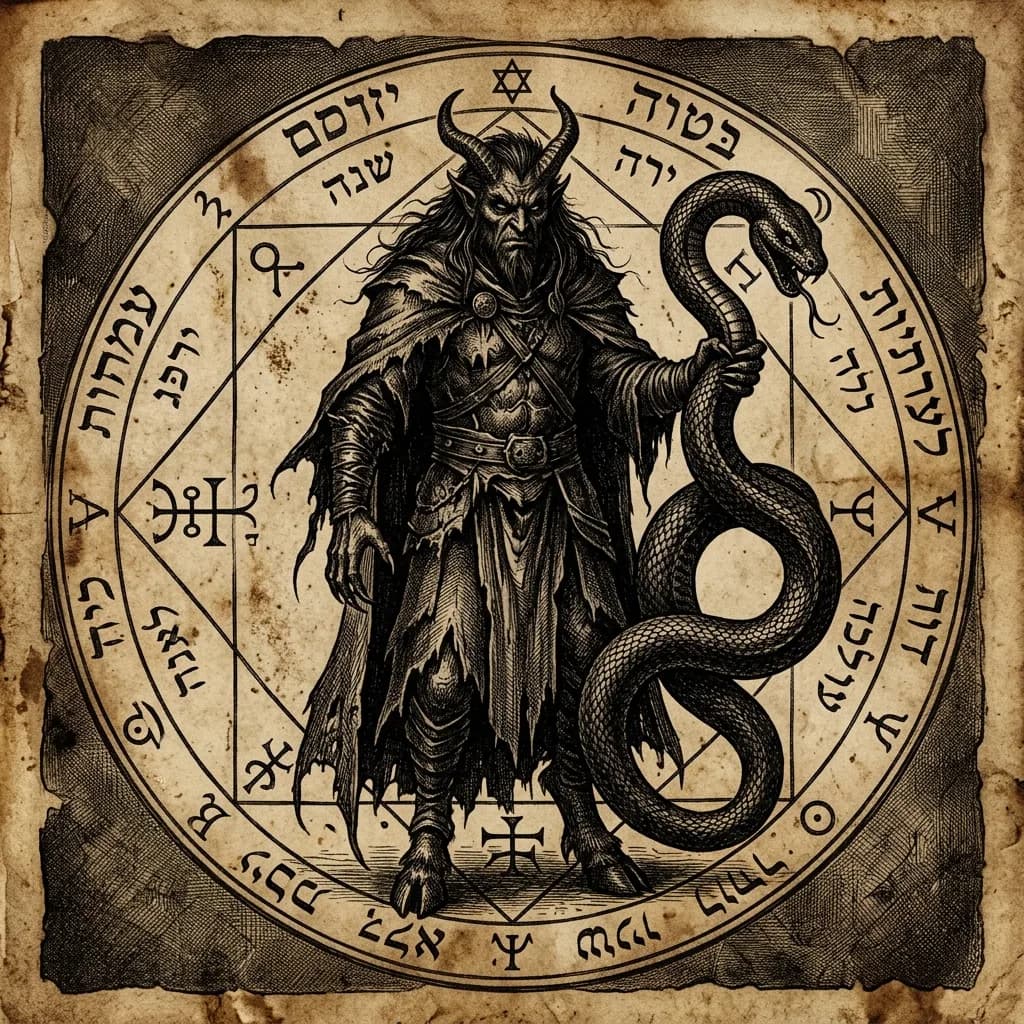
Andromalius
EarlSpirit #72 of the Ars Goetia · 36 legions
Description
Andromalius is an Earl of Hell who commands thirty-six legions of spirits. He appears as a man holding a great serpent in his hand. He punishes thieves and wicked people. He discovers all wickedness and underhand dealing. He returns stolen goods. He is the last of the seventy-two spirits.
Symbolic interpretation
The power to punish thieves and wicked people is the capacity to enforce consequence where consequence has been evaded. This is not the mechanical application of law through institutional process - it operates outside and beneath formal justice, reaching into spaces where courts do not reach and accusations cannot be proven. The operative mechanism is accountability without due process: Andromalius does not deliberate, he executes. What this produces in those it acts on is the collapse of impunity. The person who has acted wrongly and escaped notice discovers that escape is not permanent. The psychological weight of this is specific: it transforms the experience of having gotten away with something into a provisional state, always subject to termination. The wicked person lives under a sentence they do not yet know has been handed down.
The power to discover all wickedness and underhand dealing is a penetrative epistemic function - the capacity to read concealed intention and hidden action as plainly as visible conduct. The mechanism is not inference or deduction but direct disclosure: the concealment itself becomes transparent. What wickedness and underhand dealing share is their dependence on a gap between appearance and reality, between what is performed publicly and what is done in private. This power eliminates that gap. What those subject to this capacity experience is total exposure - the architecture of deception dismantled not from the outside in, by gathering evidence, but from the inside out, by rendering the concealment inoperative. The social and personal consequence of this is severe: identity built on the management of reputation becomes unsustainable when the gap that sustains it no longer exists.
The power to return stolen goods is a restorative function, but its mechanism is more specific than simple restitution. To return stolen goods is to reverse not just the physical displacement of an object but the asymmetry of relation that the theft created. Theft installs a permanent imbalance - one party gains at the direct expense of another, and that imbalance persists regardless of whether the theft is known. The return of the goods is the structural reversal of that imbalance. What the wronged party experiences is the restoration of a prior condition, but this is not merely material: it is the annulment of the violation itself as an ongoing state. The thief, correspondingly, experiences the loss of what was taken as both material deprivation and proof that the transaction was never completed. Nothing was kept.
The appearance - a man holding a great serpent in his hand - encodes the operative logic of the spirit's function. The serpent is the traditional emblem of what cannot be hidden: the creature that moves through concealed places, beneath surfaces, beneath the earth itself. It sees in darkness and inhabits the spaces between visible things. A man who holds the serpent rather than being threatened by it is a man who commands the knowledge of hidden things - who has domesticated revelation. The hand that grips the serpent is the hand that controls disclosure. The human form signals that this operation occurs within the human moral register: this is not cosmic judgment but interpersonal reckoning, applied at the scale of theft, betrayal, and private wickedness. That Andromalius is the seventy-second and final spirit - the last of the sequence - gives his function a closing quality, the sense of an account brought to completion. What has been left unresolved reaches him last, and after him, nothing remains open.
Archetype
Andromalius derives as Gemini - Mutable Air - and both axes are demonstrable from operational mechanics rather than surface character. The Air element follows from Direct à — Collective: Andromalius's action names something specific and locatable (the thief, the stolen object, the act of wickedness), which is the Direct signature, while his thirty-six legions and systemic jurisdiction over "all wickedness and underhand dealing" operate on whoever occupies the relevant position - thief, deceiver, wrongdoer in general - not on a specific named individual, which is the Collective signature. The mechanism runs on role, not person. Air is the correct medium: the force propagates through exposed information, through the removal of the gap between appearance and reality, through the social field that wickedness depends on managing. What Andromalius operates through is not earth (accumulated material pressure) or water (ambient emotional atmosphere) but the sudden transparency of concealed fact - a disclosure event that travels through the space between people. The Mutable modality is the harder argument and the more important one. Andromalius does not initiate a new moral order (Cardinal) nor hold an existing institutional one in place (Fixed). He reads - he moves through concealment and renders it legible. His function is detection and disclosure: the penetrative epistemic act of making hidden conduct visible, returning stolen goods to prior condition, and collapsing impunity that had already been established. He does not found accountability structures; he translates hidden states back into visible ones. The serpent in his hand encodes precisely this - not force applied, but concealed terrain read. The specific mechanical claim this produces: Andromalius's operation does not require initiating a confrontation or maintaining an institution; it requires only that concealment exist, because his mechanism is the reading of concealment itself, which makes his force fully Mutable in posture - responsive to what is already there, moving through it, surfacing it.