Library
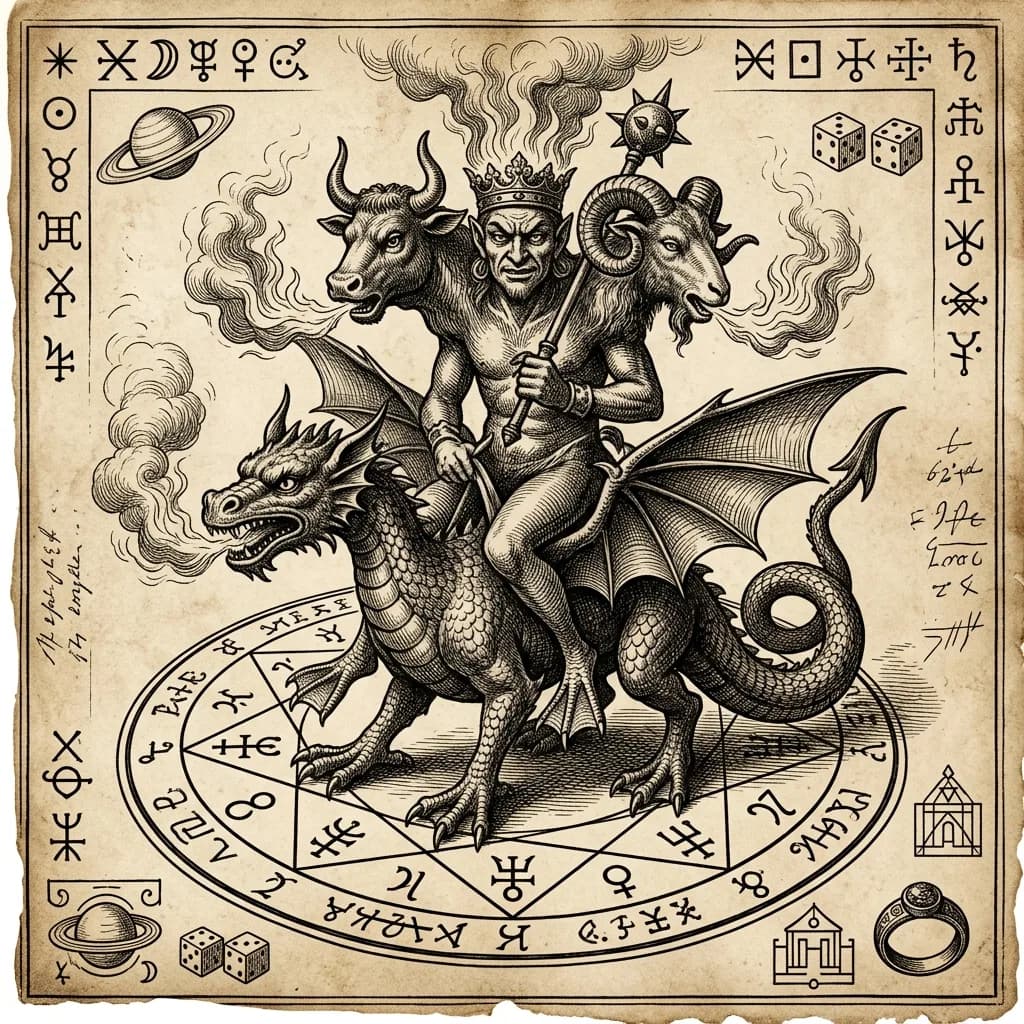
Asmodeus
KingSpirit #32 of the Ars Goetia · 72 legions
Description
Asmodai holds the rank of King and commands seventy-two legions of spirits, placed explicitly under Amaymon. He appears with three heads: the first like a bull, the second like a man, the third like a ram. He rides upon an infernal dragon and has the feet of a goose. He breathes fire. He teaches arithmetic, astronomy, geomancy, and all the handicrafts. He gives the Ring of Virtues. He is the distributor and protector of gaming. His Persian root is Aeshma Daeva - wrath and disordered force, passion operating without constraint. His defining behavioral signature from the Testament of Solomon: he plots against newlyweds, killing Sarah's seven husbands on the wedding night before each Marriage can be consummated.
Symbolic interpretation
The capacity to teach arithmetic, astronomy, geomancy, and all handicrafts is the capacity to make hidden structure legible. Arithmetic is the grammar of quantity - the underlying logic by which one thing relates to another in countable, measurable terms. Astronomy maps the positions and movements of bodies whose influence operates at vast remove from the observer. Geomancy reads pattern in the earth itself, in the random scatter of material, extracting signal from apparent noise. Handicrafts are the direct translation of mental schema into physical form - the hand knowing what the mind has grasped. What this constellation of teachings produces in those who receive it is a perceptual reorganization: the person who once saw chaos begins to see law, structure, and exploitable regularity. That reorganization is consequential because it transfers power - the person who perceives the underlying order of a system is positioned to operate within it more effectively than anyone who cannot. Knowledge here is not merely informational; it is instrumental, converting the world from opaque to navigable.
The Ring of Virtues is a concentration device. A ring is a closed form - it binds, seals, and holds. "Virtues" in the classical sense are not moral qualities but operative powers, the capacities latent in substances, stars, or beings that can be channeled and directed. To give the Ring of Virtues is to provide a tool that locks in and activates those capacities, making them available for directed use. What the recipient experiences is an amplification of agency - not the acquisition of new powers from outside, but the consolidation and activation of powers already present in latent form. The consequence is a shift in what the person can do with what they already are. The ring does not create virtue; it makes virtue operative.
Gaming - as a domain over which Asmodeus acts as both distributor and protector - is the structured arena of risk, chance, and competition. To distribute gaming is to spread the conditions under which outcomes are uncertain but pursued intensely, where the investment of desire and calculation meets the unpredictability of the random. To protect gaming is to maintain those conditions against disruption, to ensure the space of contest persists. What this power produces is the cultivation of a particular psychological state: heightened engagement with uncertainty, the suspension of normal consequence-calculation, the elevation of outcome to paramount importance. That state is addictive by structure - it recruits the same mechanisms that drive desire and attach them to processes whose resolution is deliberately unpredictable. Asmodeus does not merely enable gambling; he governs the psychological territory in which desire is made most volatile.
The plot against newlyweds - the killing of seven successive husbands before consummation - is not random violence but targeted interference at the precise moment of relational completion. The wedding night is structurally the threshold between promise and fulfillment, between contracted union and its physical, legal, and emotional sealing. Asmodeus intervenes at that specific threshold, not before it and not after it, but exactly at the point of crossing. This defines his power as the disruption of completion in the relational domain: desire is cultivated, commitment is made, the approach to fulfillment is executed - and then the fulfillment itself is severed. What this produces in its targets is a specific and devastating experience: the repeated approach to wholeness followed by its annihilation. The seven repetitions are not incidental. They make the pattern systematic, demonstrating that what operates here is not chance but a structural force that specifically targets the seal of union.
The fire-breathing is the externalization of an internal condition. Fire does not merely damage; it consumes and transforms, reducing what it touches to a different state. Breathing fire makes Asmodeus a vector of that transformation - whatever he directs his breath toward is changed by contact, not merely struck. This maps directly onto the Persian root of Aeshma Daeva: wrath as disordered force, passion without constraint. Fire breathed is passion externalized without filter, without restraint, without the mediation that keeps force proportional to object. What those who encounter this capacity experience is exposure to energy that does not calibrate itself to them - it acts on its own terms and at its own intensity, indifferent to what the target can withstand. The effect is overwhelming by nature, not by accident.
The three-headed form - bull, man, ram - read together describe a single faculty operating across three registers of force. The bull is brute generative power: material, sexual, the force of the body at full extension. The ram is directed charge, the same energy as the bull but aimed, angular, compressed into penetration. The man is reflective intelligence, the capacity to observe, calculate, and act with intention. Mounted on an infernal dragon - a creature of the underworld that moves through earth and fire - with the feet of a goose, Asmodeus combines terrestrial grounding with the goose's traditional association with watchfulness and traversal. The dragon elevates him while the goose's feet keep him in contact with the ground. The complete image is a figure whose intelligence, animal force, and directed will are all simultaneously active, moving through the world on a vehicle of underworld power while remaining in practical contact with the surface. This is not a chaotic appearance - it is a portrait of integrated, multiply-sourced force operating with full presence across all registers at once.
Archetype
Asmodeus derives as Taurus - Fixed Earth - and the case is visible in the structural mechanics of every power attributed to him. The Earth element follows from Diffuse expression combined with Individual orientation: his operation runs without a declared front door, entering the specific person's life through accumulated conditions rather than announced confrontation, embedding itself in the texture of a particular bond or a particular mind before its presence can be named. This is the medium - not fire's direct confrontation, not air's systemic reach, but the slow penetrative pressure of material that surrounds and holds. The fixity is equally specific: Asmodeus does not initiate new states or translate between them. He holds. The plot against newlyweds is not a disruption that creates something new - it is the perpetuation of incompletion, the holding open of the threshold so that consummation never closes it. Seven husbands are killed not to start a new condition but to prevent one from consolidating. That is Fixed mechanism operating at the relational seal: the force does not move; it holds the door open by force indefinitely. The Ring of Virtues operates by the same posture - it locks in what is already latent, fixing operative power in place so it cannot dissipate. Gaming governance holds the psychological territory of volatile desire in suspension, protecting the conditions of that state against resolution. Even the teaching function - arithmetic, astronomy, geomancy - produces perceptual structures that once formed do not flex; the person who has learned to see underlying order does not un-see it. The Receptive direction confirms that the mechanism draws inward rather than distributing outward: each operation creates a center toward which the target flows - toward the ring, toward the game, toward the structure Asmodeus holds in place around the specific person. The Fixed Earth operator holds specific individuals inside structures they cannot identify as structures because the medium is ambient and the temporal posture is maintenance rather than motion.
In popular culture
Asmodeus appears as a demonic antagonist in Solomon Kane, published by Paradox Entertainment, in which the titular character must battle against him directly. He also appears as a boss character in The Binding of Isaac: Rebirth, published by Nicalis, where players must defeat him in combat.
Testament of Solomon
Asmodeus, known as Asmodaios in the Testament of Solomon, is a demon who boasts of his ability to cause strife between married couples and to incite lust. Solomon binds Asmodeus with the help of the angel Raphael and commands him to hew stones for the construction of the Temple.