Library
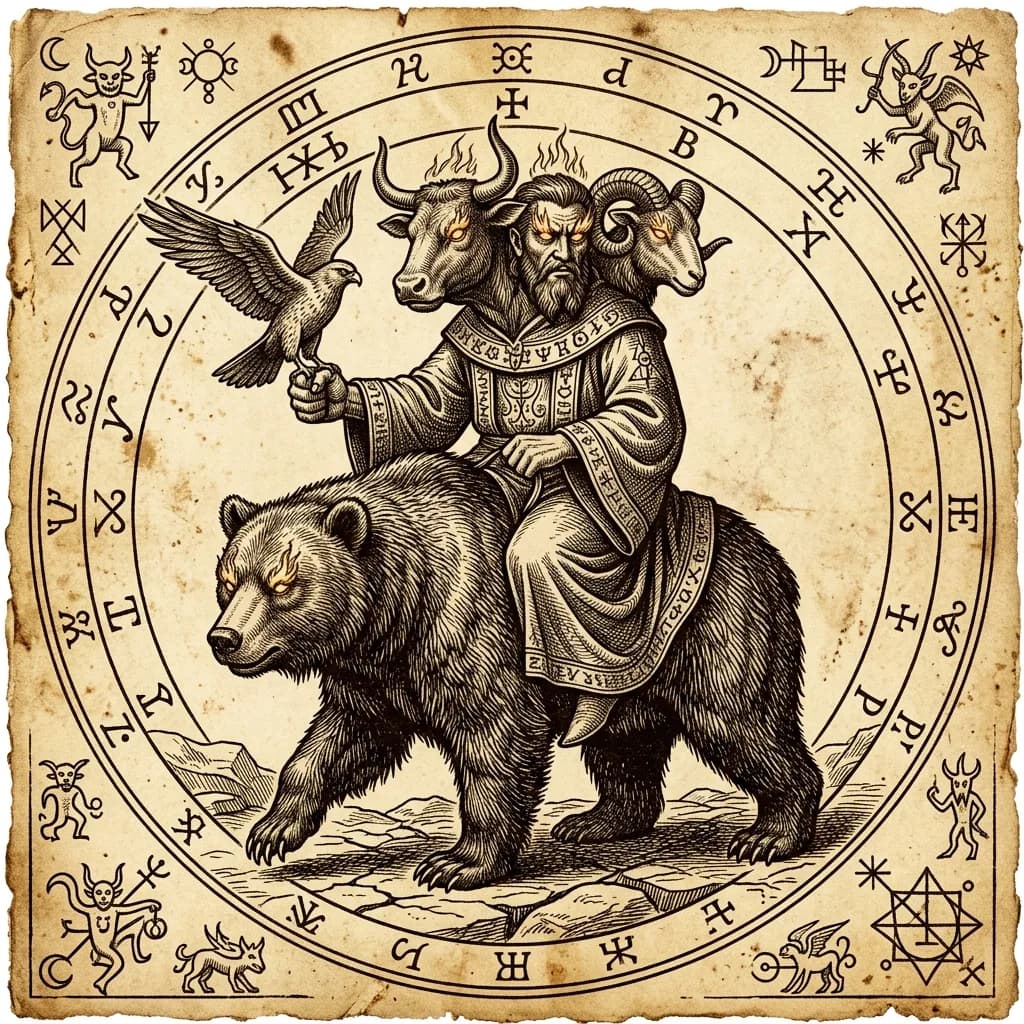
Balam
KingSpirit #51 of the Ars Goetia · 40 legions
Description
Balam is a mighty King of Hell, numbered fifty-first in the Ars Goetia. He appears with three heads - the first a bull's, the second a man's, the third a ram's. He rides a bear and carries a hawk upon his fist. His eyes are flaming. He speaks with a hoarse voice. He telleth of things past, present, and to come. He maketh men to go invisible. He giveth wit. He commands forty legions of spirits.
Symbolic interpretation
The power to tell of things past, present, and to come is total temporal perception - not prophecy in the sense of inspired guessing, but structural access to time as a unified field. Balam perceives all three registers of time simultaneously rather than moving through them sequentially as human consciousness does. The operative mechanism is the collapse of temporal distance: past, present, and future are not arranged in sequence for Balam but laid out as a single readable surface. What this produces in those who receive this knowledge is a fundamental reorganization of the relationship between action and consequence. A person who knows what has been, what is, and what will be cannot be surprised, manipulated through false urgency, or deceived by appearances of inevitability. They act from certainty rather than probability, and that shift in epistemic ground is irreversible once established.
The power to make men go invisible is the capacity to remove a person from the perception of others - not through physical concealment, but through severance from social visibility. The operative mechanism is attentional: Balam removes the hooks by which others register and track a person's presence. To be invisible is not to be absent but to be unregistered, which is a more radical condition. What this produces is freedom from surveillance, consequence, and social gravity. A person others cannot perceive cannot be held accountable, positioned, targeted, or anticipated. This is not merely tactical concealment - it is the structural elimination of the condition by which power over a person is maintained, since all social power begins with the capacity to see and locate its subject.
The power to give wit is the conferral of intelligence as an active instrument - not the accumulation of information, but the capacity to process, connect, and deploy it with speed and precision. Wit is specifically the quick form of intelligence: the ability to read a situation instantly and respond at the point where response is still effective. The operative mechanism is cognitive acceleration and compression - Balam sharpens the interval between perception and understanding to near-zero. What this produces in the recipient is social and strategic dominance in real-time conditions. Wit is the faculty that wins arguments, navigates traps, and disarms opposition before it consolidates. To give wit is to change the rate at which a person thinks relative to those around them, and that differential is decisive.
Balam's three heads - bull, man, and ram - are not decorative variation but a structural description of three distinct modes of knowing and being that operate simultaneously within a single entity. The bull's head is Earth-fixed, patient, material, and enduring: it reads the physical world and the long accumulations of history. The man's head is the rational faculty - analytical, linguistic, capable of abstraction and social modeling. The ram's head is impulsive, initiating, and penetrating: it reads momentum and acts into the future before others have perceived it. That all three operate at once means Balam does not choose between these orientations. He bears, grounds, and accelerates simultaneously. The bear he rides is a mount of enormous physical power combined with intelligence and apparent passivity that conceals readiness - a vehicle that is itself a warning about underestimation. The hawk on his fist is a precision hunting instrument held in control: far sight, dive speed, and the discipline to strike exactly when commanded. The flaming eyes locate Balam's gaze as a source of heat and light - what Balam looks at, he illuminates and scorches. The hoarse voice carries the quality of something used to great and prolonged effect: authority worn rough by exercise, not ceremony.
Archetype
Balam's derived sign is Taurus, the product of Fixed modality operating through Earth - and both are demonstrable in the specific mechanics of his three powers rather than in surface imagery. The Earth element emerges from the combination of Diffuse expression and Individual orientation: Balam does not announce his operation or confront a target openly, and each instance of his work lands on a specific person rather than running through a system indiscriminately. The power to make men go invisible is the clearest demonstration of Diffuse operation - there is no declared act, no visible intervention, only the quiet severance of attentional hooks by which others track a person; the target becomes unregistered without any confrontation having occurred. The Individual orientation is equally visible: each invisibility operation, each conferral of wit, each temporal disclosure is targeted at a specific recipient, not broadcast into a population. These two axes together place Balam in Earth as his operative medium - he works through accumulation, ambient structural change, and conditions that settle rather than strike. The Fixed modality appears in what his powers actually do once applied: they do not initiate new states so much as lock in conditions that persist. Wit, once given, is a standing cognitive acceleration that does not expire. Invisibility, once conferred, is a sustained removal from social registration, not a momentary event. Total temporal perception - past, present, and future as a single readable surface - is the most Fixed operation of all: it establishes a permanent epistemic ground from which the recipient cannot be dislodged by surprise, urgency, or false inevitability. Balam does not break open new conditions; he installs durable ones. The derived sign Taurus names the operator whose force enters without declaration, lands on specific targets, and then holds - the permanence of the conferral is the mechanism, not its initiation.
In popular culture
Balam has no significant pop culture presence.