Library
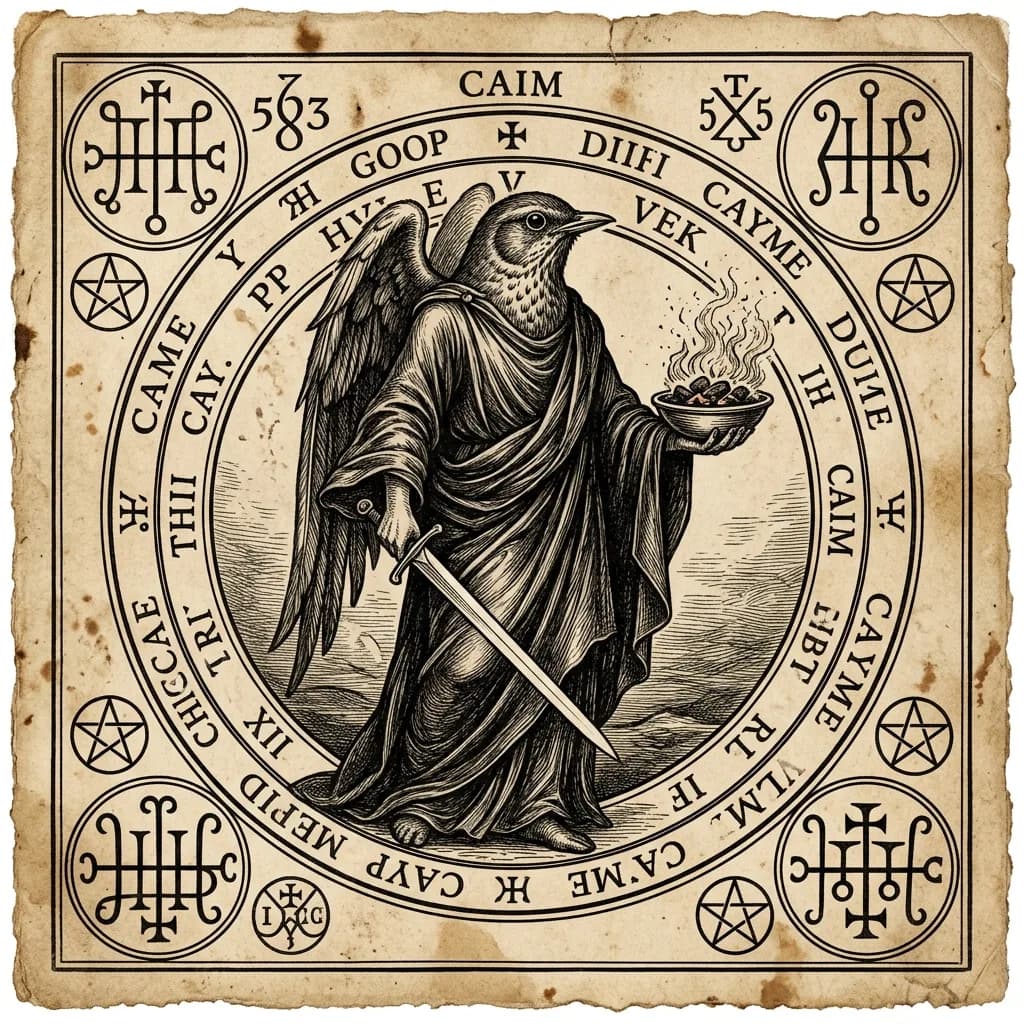
Caim
PresidentSpirit #53 of the Ars Goetia · 30 legions
Description
Caim is a President of Hell commanding thirty legions of spirits. He appears first as a thrush - the most sophisticated mimicking songbird, whose song is genuinely complex, genuinely beautiful, and sounds like it contains more meaning than it does - and at the command of the conjurer takes the form of a man carrying a sharp bright sword. He giveth answers in burning coals or ashes. He is a good disputer. He giveth to any man the understanding of all birds, of bullocks, of dogs, and of the noise of waters - the signal of every creature and every living system. He maketh men able to speak with knowledge in all manner of things. He was of the Order of Angels before his fall.
Symbolic interpretation
Giveth answers in burning coals or ashes. This power is the capacity to read signal from residue - to extract meaningful information from what has already been consumed, transformed, or destroyed. The operative mechanism is pyromantic: the medium is not raw material but the aftermath of combustion, and combustion is a process of irreversible change. What remains in the ash is not the original substance but its structural skeleton, the arrangement of what survived the fire. Caim reads that arrangement. What this produces in the person receiving such answers is a confrontation with the permanent: the fire has already happened, the transformation is already complete, and the information delivered through that medium carries the same quality of finality. There is no negotiating with ash. The answer arrives with the authority of something that cannot be undone.
Is a good disputer. Disputation is not mere argumentation - it is the formal capacity to hold a position under structured adversarial pressure and to dismantle opposing positions through logical sequence. The mechanism here is dialectical: Caim does not overwhelm through volume or force but through the precise identification of weak joints in a constructed argument. This is an analytical instrument that operates on the internal structure of claims rather than on the emotions of the person making them. What this produces in opponents is the experience of watching their own reasoning collapse from within - not refuted from outside but unraveled from its own premises. The consequence is epistemic: the person who is well-disputed does not simply lose the argument, they lose confidence in the architecture of how they were thinking.
Giveth the understanding of all birds, bullocks, dogs, and noise of waters. This power is the grant of semiotic access to non-human signal systems - the complete grammar of animal communication and environmental sound. The operative mechanism is translation without language: Caim does not teach a spoken code but opens the capacity to read meaning directly from behavioral and acoustic patterns that most humans register as noise. Birds signal territorial boundary, predation, weather, and hierarchy through vocal complexity; cattle communicate stress, hierarchy, and physiological state through posture and sound; dogs signal intent and emotional valence through a layered system of vocalization and movement; and the noise of waters encodes information about terrain, depth, weather, and the state of a watershed. What the person granted this understanding gains is total environmental literacy - the ability to read a landscape and its inhabitants as a continuous text. This is intelligence gathered without interlocutor, without trust, and without the possibility of deception.
Maketh men able to speak with knowledge in all manner of things. This power is the installation of credible fluency - not expertise in a narrow field but the capacity to speak with apparent knowledge across every domain. The mechanism operates on the output rather than the input: it is not that Caim fills the person with information, but that he calibrates how knowledge is delivered so that it registers as authoritative. The consequence for those who encounter such a speaker is persuasion through confidence and apparent comprehensiveness. What makes this capacity particularly consequential is its breadth: a speaker who can address any subject with the same quality of fluency cannot be cornered or exposed by shifting the topic. Every domain becomes equally navigable, and every audience becomes equally susceptible to the impression of mastery.
Appearance - the thrush, then the man with the sword. The thrush is not a decorative detail. It is chosen specifically because the thrush is the songbird whose call is most complex, most beautiful, and most convincingly meaningful - and yet that call is a mimetic construction, an acoustic performance optimized through evolutionary pressure to sound like it means more than it does. Caim's initial form announces his operating principle: he presents the most sophisticated surface of communication before the content beneath it is evaluated. The transition to the form of a man carrying a sharp bright sword is not a contradiction of this but its completion. The sword is bright - visible, gleaming, unambiguous - and sharp, which means it cuts cleanly and without hesitation. Once the mimetic surface has been accepted and the conjurer has acknowledged Caim's presence, the mode shifts from beautiful ambiguity to precise, illuminating severance. The sword is what disputation looks like in physical form: it does not bludgeon, it divides. Together, the two forms describe the full arc of Caim's operation - first the songbird that makes you lean in, then the blade that separates what is true from what only sounded true.
Archetype
Caim's derived sign is Gemini, produced by the intersection of Mutable modality and Air element. The Air element itself derives from Direct expression operating at Collective orientation: Caim's powers are named and addressable - pyromantic answers in ash, the grammar of animal signal, the capacity for universal fluency - each a specific, locatable act rather than an ambient atmospheric effect, yet each runs on whoever occupies the relevant position in the system, not on a targeted individual. The person who receives the ash-reading, the animal-literate, the universally fluent speaker is whoever stands at the point of operation; the mechanism does not care who that person is. This combination - a front door that opens onto a system rather than a person - produces Air. The Mutable modality is visible in how every one of Caim's powers operates as reading and translation rather than initiation or preservation: he does not create new signal, he decodes existing signal - ash is residue of combustion already complete, animal calls are already in the air, disputation works by moving through an argument's existing structure to locate its failures. He does not hold a position or break open a new state; he reads the terrain. The Generative direction completes the picture: Caim distributes the decoded signal outward, installing fluency and comprehension in the recipient rather than drawing information back toward a center. The specific mechanical consequence is that his most operative power - making men able to speak with knowledge in all manner of things - is not content delivery but calibration of output across every domain simultaneously, which is precisely what a Mutable Air operator does: it runs through all available channels at once, translating continuously, never fixing on one territory.