Library
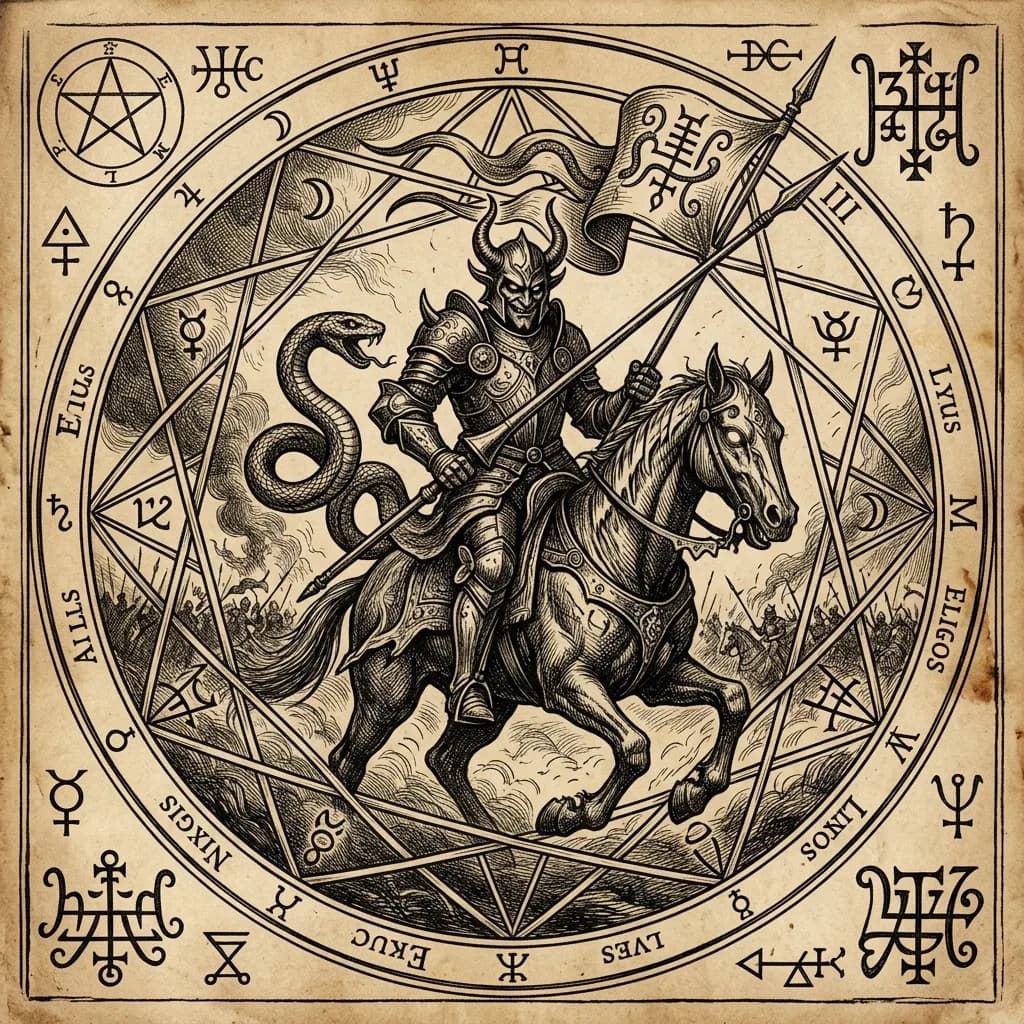
Eligos
DukeSpirit #15 of the Ars Goetia · 60 legions
Description
Eligos is the 15th Spirit of the Ars Goetia, a Duke of Hell who commands sixty legions of spirits. He appears as a good knight bearing a lance, an ensign, and a serpent. He discovers hidden things. He knows the future of wars and how soldiers should meet. He excites the love of lords and great persons toward a suppliant.
Symbolic interpretation
The power to discover hidden things is a structural capacity for penetrating concealment - it is the ability to locate what has been deliberately obscured, what lies beneath surfaces, and what others have an interest in keeping buried. The operative mechanism is not divination in the passive sense but active intelligence-gathering: the capacity to move through layers of deception, silence, and misdirection and return with the concealed fact intact. What this produces in those who benefit from it is orientation. People lost in uncertainty, operating on incomplete information, or surrounded by deliberate obscuration gain the ability to act with clarity. The chain of effect is direct: concealment creates disadvantage; removing concealment restores the conditions for competent action.
The knowledge of the future of wars and how soldiers should meet is strategic cognition at its most consequential level. This is not prophecy in the oracular sense - it is applied foresight about the structure and outcome of organized conflict, including the disposition, timing, and method by which forces should engage. The operative mechanism is pattern recognition operating at a scale beyond individual perception: the ability to read the full shape of an unfolding conflict and derive from it correct tactical and strategic decisions. What this produces in commanders and operators who receive it is the elimination of fatal error. Military failure is overwhelmingly a product of misjudgment about what will happen next; this power removes that uncertainty and replaces it with prescient competence, giving those who possess it a decisive and reproducible advantage over those who do not.
The power to excite the love of lords and great persons toward a suppliant is a capacity for restructuring the affective and social disposition of authority figures. It is not persuasion through argument, nor the cultivation of personal rapport over time - it is a direct alteration in how powerful individuals perceive and feel toward someone who previously had no standing with them. The operative mechanism works on the emotional and social architecture of hierarchical relationships: specifically, the gap between the powerful and those who need access to power. What this produces is a radical compression of that gap. The suppliant - who by definition begins from a position of lesser standing - finds themselves the object of favor, warmth, and patronage from exactly those figures whose goodwill matters most. This is consequential because access to powerful allies determines survival and advancement in any competitive social or political environment, and this power delivers that access without requiring years of cultivation or exchange.
Eligos appears as a good knight bearing a lance, an ensign, and a serpent. The figure of the knight signals legitimate martial authority - not a beast or a chaos-agent, but someone operating within institutional power structures, trained, ranked, and recognizable as such. The lance is a weapon of direct engagement at distance: it strikes before contact is made, which maps precisely onto Eligos's capacity for foresight and preemptive strategic knowledge. The ensign - a banner or flag - is a symbol of allegiance and identification, the device by which forces orient themselves in a field of confusion; it signals that Eligos functions as a point of clarity and alignment within chaotic conditions. The serpent completes the triad by introducing the element of concealed knowledge: the serpent in nearly every tradition is the creature that knows what is hidden, that moves through unseen places, and that grants dangerous illumination. Together these three objects describe a single unified mechanism - a figure of established power, oriented toward decisive engagement, carrying the hidden knowledge that makes such engagement successful.
Archetype
Eligos derives as Cardinal Air, yielding Libra as the operative sign. The Cardinal modality is visible in the founding gesture at the core of each power: Eligos does not maintain existing states of knowledge or relationship but breaks open new ones. The suppliant begins with no standing before lords and great persons; Eligos initiates the condition of favor where none previously existed. The commander operates without foresight; Eligos initiates the condition of prescient clarity. Each operation is a rupture - a before and after with nothing gradual bridging them. The Air element, derived from Direct expression acting on a Collective orientation, identifies the medium precisely: Eligos works through the structured field of social and political legibility - rank, allegiance, the banner that tells forces how to orient - and his powers operate on whoever occupies the relevant positions within that field. The lance and ensign are not personal objects; they are instruments of directional signal across an open field, which is Air operating directly. The serpent maps onto Domain: the hidden fact extracted and returned is a Knowledge operation, and it is Generative - the intelligence flows outward from Eligos toward the beneficiary, restructuring their epistemic and social position. What distinguishes Libra from Aries as the operative sign is that the initiating force here is not raw disruption but the insertion of a corrective alignment into an existing system of imbalance: the suppliant lacks access, the commander lacks foresight, the hidden thing distorts the available field - and Eligos's Cardinal Air mechanism restores the structural conditions for correct action, which means the initiation is always relational, always calibrated against an existing asymmetry it moves to resolve.