Library
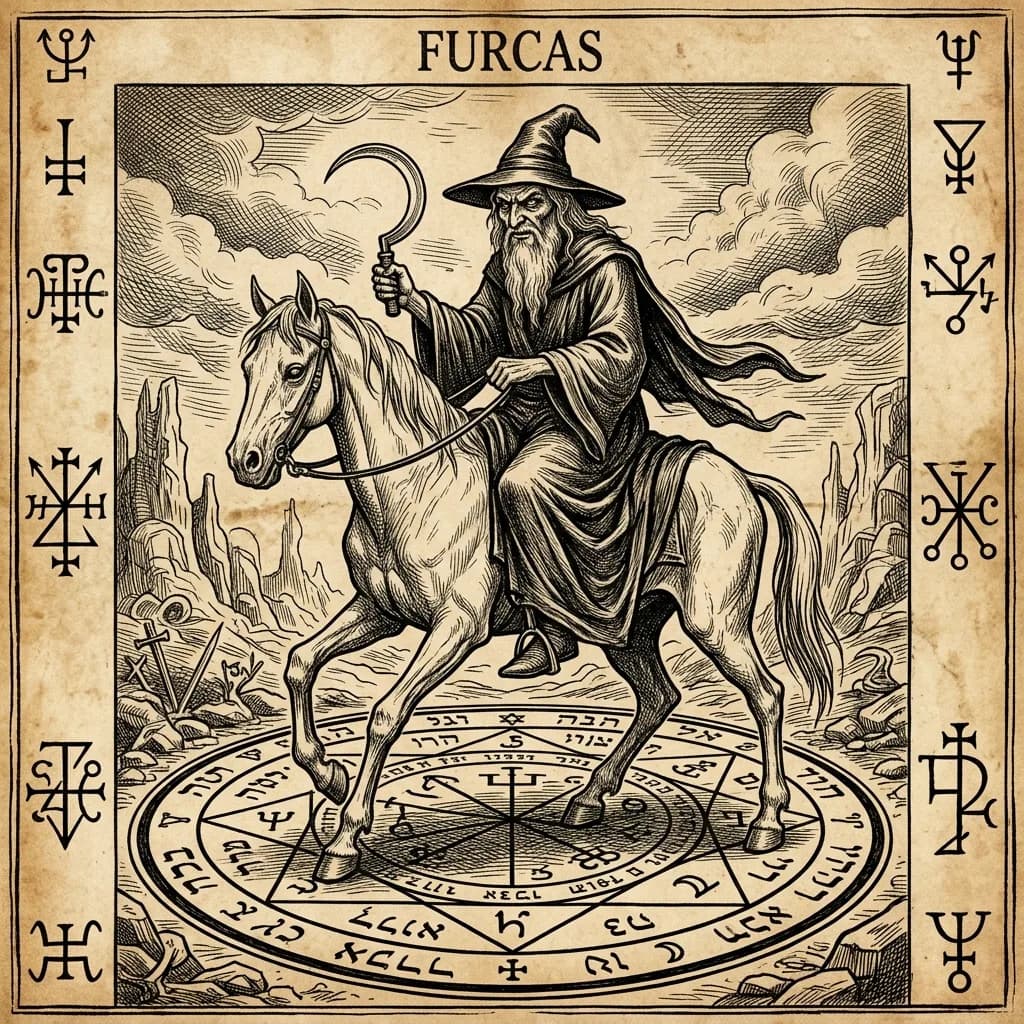
Furcas
KnightSpirit #50 of the Ars Goetia · 20 legions
Description
Furcas is a Knight of Hell and the sole Knight among the seventy-two spirits of the Goetia. He appears as a cruel old man with a long beard, riding a pale horse, carrying a sharp sickle. He teaches philosophy, astronomy, rhetoric, logic, chiromancy, and pyromancy. He gives true answers. He commands twenty legions of spirits.
Symbolic interpretation
Teaching philosophy is the transmission of structured frameworks for interrogating existence, causality, value, and meaning. As a structural capacity, this is not the transfer of facts but the installation of a method - a set of tools by which the mind can take any phenomenon and subject it to rigorous first-principles examination. What this produces in the recipient is a fundamental reorientation: the person who receives philosophical instruction no longer accepts appearances as terminal but presses always toward underlying structure. The consequence is irreversible. Once a mind learns to ask what a thing is rather than merely what it looks like, that habit cannot be unlearned.
Teaching astronomy is the imparting of systematic knowledge about celestial bodies, their movements, their periodicities, and their relationships to one another and to Earth. The operative mechanism here is scale: astronomy forces the mind to situate itself within an order of magnitude it cannot inhabit bodily, training attention on patterns that unfold across decades and centuries. What this produces in a person is temporal humility combined with predictive confidence - the astronomer learns that vast cycles are knowable, that the heavens are not chaos but law made visible over time, and this reorganizes how the recipient understands regularity, causation, and their own position in time.
Teaching rhetoric is the instruction in the architecture of persuasion - how language is constructed to move a listener from one mental state to another. The structural capacity here is control over the interface between speaker and audience: rhetoric is knowledge of which emotional, logical, and stylistic mechanisms produce agreement, conviction, or action in a listener. What this produces in the recipient is power over social reality, because language that is properly constructed shapes what others believe to be true and what they feel compelled to do. Rhetoric does not merely describe the world; it reorganizes the interior states of those who hear it.
Teaching logic is the installation of formal rules governing valid inference - the conditions under which one statement necessarily follows from others. As a structural capacity, logic is the grammar of correct reasoning: it specifies not what to think about but how the relationship between thoughts must be organized for conclusions to hold. What this produces in a person is the ability to detect contradiction, identify fallacy, and construct arguments that cannot be dismantled without attacking the premises themselves. A logically trained mind does not just reason better; it becomes resistant to manipulation that depends on informal error.
Teaching chiromancy is the instruction in palmistry - the reading of character, fate, and disposition from the lines and formations of the hand. As a structural capacity, this is diagnostic interpretation applied to the body as a text: chiromancy posits that the physical substrate encodes information about the person's nature and trajectory, and teaches the reader to decode that information systematically. What this produces in the practitioner is a mode of attention that treats the visible body as already saturated with meaning - a capacity to read a person's structure before they have spoken, which functions as a kind of accelerated intimacy or penetrating assessment.
Teaching pyromancy is the instruction in divination by fire - the reading of patterns in flame, smoke, and combustion to derive knowledge of hidden or future matters. The operative mechanism is the disciplined interpretation of a volatile and formless medium: fire does not hold still, does not repeat exactly, and cannot be controlled precisely, which means the pyromancer must develop a sensitivity to transient pattern and a confidence in reading signal from noise. What this produces is a practitioner capable of making decisive interpretations under conditions of radical uncertainty - someone who acts and pronounces when the evidence is unstable, which is a capacity with consequences wherever certainty is impossible but decisions must still be made.
Giving true answers is the most direct and consequential of Furcas's powers. As a structural capacity, this is not knowledge of specific facts but the commitment to accuracy as such - the operative mechanism is that Furcas's outputs correspond to reality rather than to what the questioner wishes or fears to hear. What this produces in those who receive his answers is a confrontation with actuality, stripped of the consoling distortions that normally filter information through desire and anxiety. True answers are consequential precisely because most information humans exchange is shaped by social and emotional pressures; an entity that bypasses these pressures entirely delivers something most human relationships structurally cannot.
The appearance of a cruel old man with a long beard, riding a pale horse and carrying a sharp sickle is not an aesthetic description but a functional diagram of the spirit's character and mechanism. The cruelty of the old man signals that the knowledge Furcas transmits is not delivered with pastoral gentleness - it is exact, unsparing, and indifferent to whether the recipient finds it welcome. The long beard marks accumulated time and the authority of age, but the cruelty ensures this is not wisdom softened by compassion. The pale horse is the mount of death in established symbolic tradition, marking Furcas as an entity that operates at the boundary between the living and what lies beyond - his knowledge is not of comfortable surfaces but of terminal structures. The sharp sickle is the instrument of harvest and severance: it cuts cleanly, separates what is ripe from what sustains it, and leaves nothing incomplete. Together, these attributes describe a teacher whose method is precise cutting - he removes illusion, sentiment, and evasion, and what remains is accurate.
Archetype
The derived sign is Virgo, the product of Mutable modality operating through Earth - Diffuse expression acting on Individual targets. The Earth element emerges from the Diffuse-Individual combination: Furcas's transmissions carry no declaration, no announced confrontation. Philosophy, logic, rhetoric, chiromancy, pyromancy - none of these arrive as a single event that can be contested or refused. They accumulate inside the recipient as reorganized cognitive structure, settling into the substrate of how a person processes reality. There is no moment when the student can locate the point of change; the alteration has already distributed itself through the individual's epistemic apparatus before it becomes visible as change. This is Earth operating as medium: not a broadcast, not an atmosphere, but a slow mineral deposition that hardens into permanent formation. The Mutable posture is visible in the mechanism's primary function: Furcas does not initiate a new state in the world, and he does not hold a territory - he reads the terrain of a mind and passes through it, translating between what the mind currently is and what it becomes capable of. His six teaching domains are all analytic bridging operations: philosophy bridges appearance to underlying structure; astronomy bridges lived timescale to cosmic periodicity; rhetoric bridges interior intent to exterior effect; logic bridges premises to necessary conclusions; chiromancy bridges visible body to encoded character; pyromancy bridges volatile pattern to actionable interpretation. Each is a reading discipline - a Mutable act, not a founding or a consolidating one. The direction is Generative: Furcas distributes outward, installing method into recipients rather than drawing anything toward himself. The Virgo signature is not declared by resemblance to an archetype but produced by the intersection of these mechanisms: a Mutable force operating through diffuse, individually targeted, earth-medium transmission, moving generatively outward through the domain of Knowledge. The specific mechanical claim this produces is that Furcas's power is not located in the content of any single answer or lesson, but in the cumulative structural reorientation of the individual mind - and that reorientation, once installed, operates independently of Furcas's further presence.
In popular culture
Furcas has no significant pop culture presence.