Library
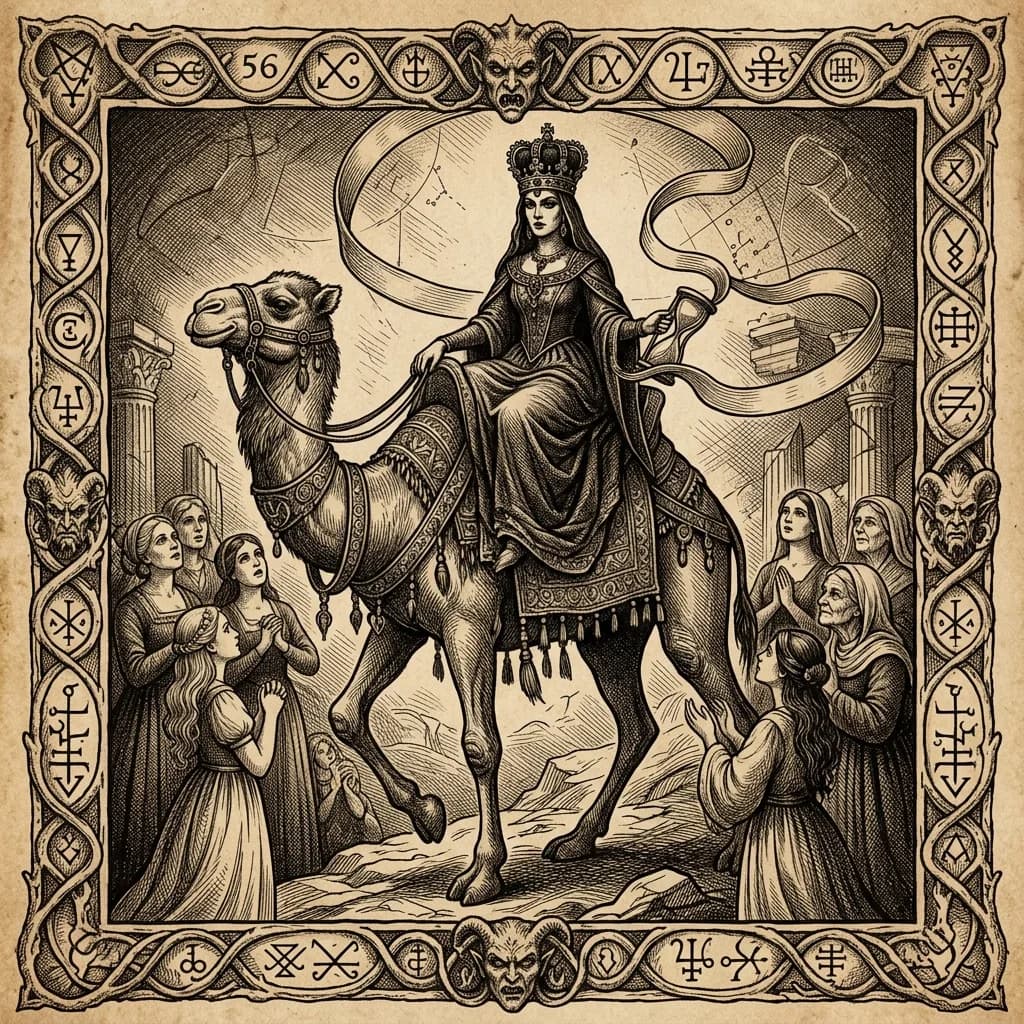
Gremory
DukeSpirit #56 of the Ars Goetia · 26 legions
Description
Gremory is a Duke of Hell who commands twenty-six legions of spirits. She appears as a beautiful woman wearing a duchess's crown, riding a great camel. She tells of things past, present, and to come. She procures the love of women, both young and old.
Symbolic interpretation
The power to tell of things past, present, and to come is the structural capacity to hold all three temporal registers simultaneously and read across them without distortion. Most cognition is anchored in a single frame - present experience, or memory, or anticipation - and that anchoring creates blind spots. Gremory's prophetic faculty operates outside this constraint. The mechanism is not prediction in the probabilistic sense, but rather the reading of temporal coherence: patterns that persist across time reveal themselves as patterns precisely because they are visible from a position that spans all three registers. What the target experiences when this power acts on them is a sudden, often disorienting clarity about their own situation - they receive information about their past they had suppressed or misread, their present they had rationalized, and their future they had refused to see. The consequence is that evasion becomes structurally impossible. The person can no longer claim not to know.
The power to procure the love of women, both young and old, is the capacity to operate on desire itself - not to simulate attractiveness or to manipulate surface behavior, but to access and activate the deep structures through which women form attachment. The distinction between young and old is not incidental; it signals that this power cuts across the developmental stages of female desire, from the formative attachments of youth to the more guarded and experience-hardened affections of age. The mechanism is therefore not charm, which works only on those already susceptible, but something that bypasses individual history and preference entirely. What the target experiences is genuine feeling - the love produced is not experienced as imposed but as arising from within. This is the operative consequence: the person who has been drawn toward someone by this power has no phenomenological access to the intervention. They believe they are acting freely.
Gremory appears as a beautiful woman wearing a duchess's crown, riding a great camel. Each element of this form is a functional signal. The beauty is not ornamental - it is the appearance of the power to procure love wearing its own face, signaling that the mechanism of attraction is the mechanism of revelation. The duchess's crown establishes that this is nobility of the second order: not sovereign but governing, not absolute but authoritative. She holds domain within a structure she did not create but rules effectively. The great camel is the most precisely functional element: the camel is the animal of long traversal, capable of sustaining itself across distances that exhaust other creatures, carrying weight across arid and unmarked terrain. As a mount it communicates that Gremory's range is vast and her domain is one without obvious landmarks - the temporal expanse she sees across and the hidden interior terrain of feminine desire are both territories that resist ordinary navigation. She crosses them without difficulty.
Archetype
Gremory's derived sign is Capricorn, the product of Cardinal modality operating through Earth. The Earth element follows from the axis combination of Diffuse expression and Individual orientation: the mechanism has no declared point of entry and operates on a specific person, meaning it works through accumulation within a bounded target rather than through any nameable confrontation. This is precisely how both of Gremory's primary powers function. The love she procures does not announce itself as intervention - the target has no phenomenological access to the operative moment, no front door to identify or refuse. The feeling arises as though native to the person, accumulating within their interior until it presents as their own desire. The prophetic capacity works identically: past, present, and future do not arrive as revelation but as a sudden, ambient coherence - the target finds that evasion is no longer structurally available to them, not because something was declared, but because the terrain of their own situation has become inescapably legible. The Cardinal modality sits precisely here: both operations break open a new state that did not previously exist. Before Gremory acts, the target is enclosed - in their attachment history, in their rationalized present, in their preferred blindness about the future. After, that enclosure is gone. This is not maintenance of an existing condition and not adaptive translation between states; it is the initiation of an irreversible opening. The duchess's crown confirms the governance structure: authority exercised within territory that already exists, breaking ground within it rather than holding it in stasis. Capricorn names the operator that initiates through accumulation - the force that establishes new conditions not by declaration but by making the prior state unsustainable from within.
In popular culture
Gremory has no significant pop culture presence.