Library
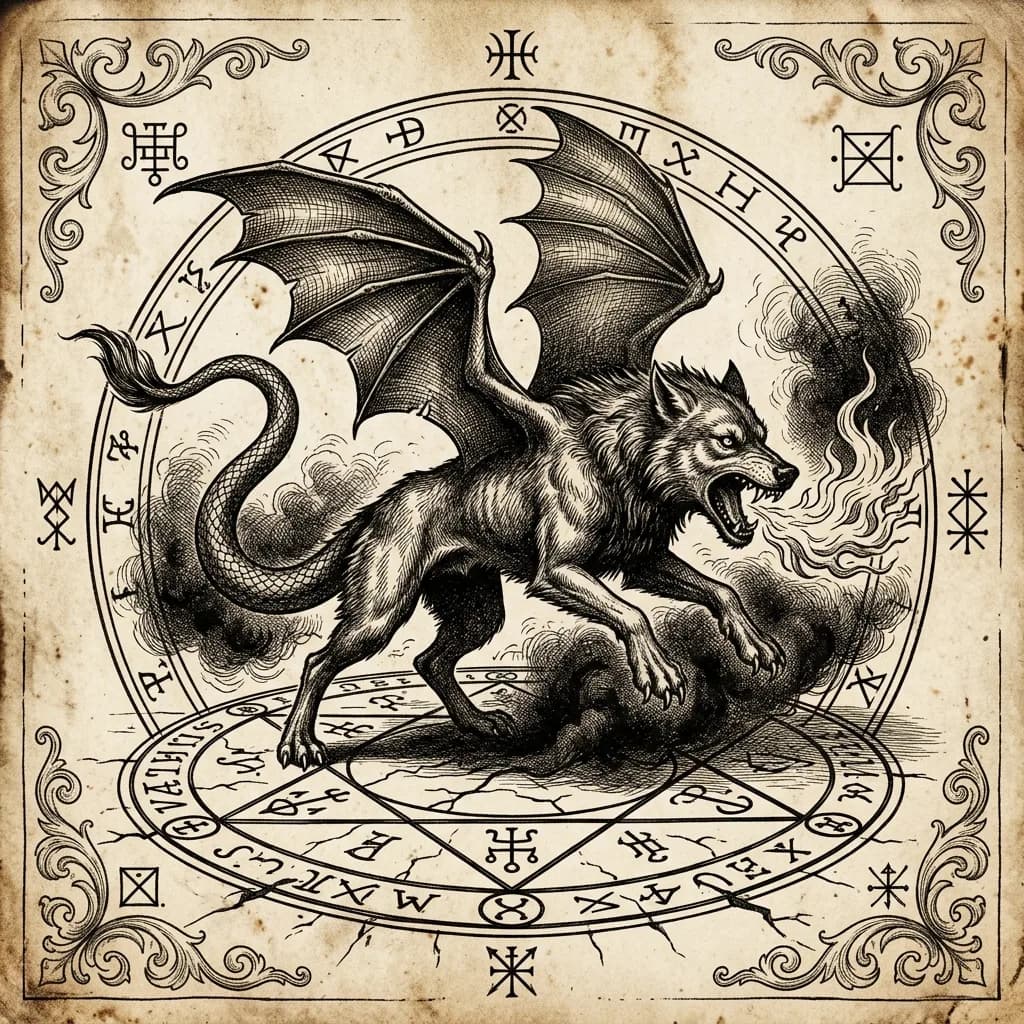
Marchosias
MarquisSpirit #35 of the Ars Goetia · 30 legions
Description
Marchosias is a mighty Marquis of Hell, thirty-fifth in the Goetic sequence, commanding thirty legions of spirits. He appears as a wolf with griffin's wings and a serpent's tail, vomiting fire. Upon command he takes human form. He gives true answers. He is very faithful to the conjurer. He was of the Order of Dominations before his fall. He hopes to return to the seventh throne after twelve hundred years. He is a strong fighter.
Symbolic interpretation
Gives true answers. The capacity to give true answers is not simply an informational service - it is a structural relationship to reality in which the spirit operates outside the incentive to deceive. Most intelligences, human or otherwise, shape their outputs according to self-interest, social pressure, or the desire to be believed rather than to be accurate. A spirit that gives true answers has severed that link. The mechanism is one of epistemic alignment: the spirit's output tracks the actual state of affairs rather than the desired or convenient state. What this produces in the person who receives it is exposure - the removal of comfortable distortions. True answers do not comfort; they orient. The person who asks and receives a true answer is repositioned relative to reality, often against their preferences, and is thereby made capable of acting effectively where they were previously acting on illusion.
Very faithful to the conjurer. Faithfulness to the conjurer is not loyalty in the sentimental sense - it is structural reliability, a consistent orientation of the spirit's will toward the conjurer's interest rather than toward any competing principle. The mechanism here is one of stable allegiance: the spirit does not defect, does not reinterpret its mandate opportunistically, and does not serve a hidden agenda alongside the explicit one. This quality is consequential because the greatest danger in working with a powerful spirit is not that it lacks ability but that it pursues its own ends beneath the surface of compliance. Faithfulness eliminates that threat. The conjurer who works with Marchosias can build on the relationship without constant defensive calculation - the ground does not shift underfoot, and the intelligence deployed on their behalf remains pointed in the direction it was aimed.
Takes human form upon command. The ability to assume human form upon command is a capacity for radical adaptation - specifically, the ability to shed overwhelming presence and become legible, approachable, and navigable within human registers of perception and interaction. The mechanism is one of deliberate constraint: a being that is naturally expressed as a compound creature of fire, wolf, serpent, and wing chooses to compress itself into a form that does not overwhelm the senses or demand interpretation. What this produces is access. The conjurer can engage the spirit directly, conversationally, without the mediation required by terrible appearances. This is not weakness - it is the capacity of genuine power to modulate itself without losing its nature. The form changes; the authority does not.
Strong fighter. To be a strong fighter is to possess command of force in direct conflict - the capacity to bring superior energy to bear against resistance and to prevail. The mechanism is one of concentrated will applied through the body or through marshaled legions: the thirty spirits under Marchosias's command are not ambassadors or advisors but combatants. What this capacity produces in those who employ it is decisive resolution of contests that cannot be resolved through intelligence, negotiation, or patience alone. Some problems are obstacles of force; they yield only to greater force. Marchosias represents the principle that knowing the truth and remaining faithful to one's ally are insufficient without the ability to clear the field when clearing the field is what is required.
Vomiting fire. Fire expelled from the body as a primary mode of expression is not aggression as such - it is the conversion of internal state into environmental force. The mechanism is one of projection: what burns inside the spirit is made external, made to act on the world, made to consume or illuminate whatever it contacts. Fire does not negotiate with its targets; it transforms them absolutely. What this capacity signals about Marchosias is that his power is not contained - it radiates outward. This is not a spirit of inward contemplation or subtle influence. His nature produces effects at a distance and in volume, reshaping the conditions around him rather than merely operating within them.
Appearance: wolf with griffin's wings and a serpent's tail. The wolf is a predator that operates through sustained pursuit, pack intelligence, and territorial command - it is not the apex predator of raw strength but of persistence, tracking, and coordinated force. The griffin's wings add vertical reach and the capacity for sudden elevation, combining the earthbound predation of the lion with the aerial command of the eagle - the ability to operate across registers, to see from above and strike from below. The serpent's tail is the chthonic element: the principle of transformation, of cyclical renewal, of the creature that sheds its skin and continues. Read together, these three composites describe a being that pursues on the ground, commands from the air, and renews from the earth - one whose power is not concentrated in a single mode but distributed across three registers of operation simultaneously. The fire-vomiting is not incidental to this form; it marks the point of emission, the front end, the direction of output. This is a spirit whose whole architecture is oriented toward forward projection of force.
Archetype
Marchosias derives as Aries - Cardinal Fire - and the case for that derivation is built directly from the operational mechanics, not from surface affect. The element is Fire because the operation is Direct and Individual: when Marchosias acts, there is a specific target and a locatable act. He gives true answers to a specific conjurer, fights on behalf of that conjurer against specific opponents, and projects force outward in a named direction - there is always a front door, always a particular person receiving the output. No ambient accumulation, no structural drift through a system: each instance is a targeted delivery of force to an identified recipient. That yields Fire. The modality is Cardinal because Marchosias does not hold an existing state or read terrain - he breaks open a new one. A true answer repositions the conjurer relative to reality; it does not preserve where they were. A strong fighter does not maintain a standoff; he resolves it by initiating a new condition - victory where contest existed. The faithfulness to the conjurer is not the Fixed principle of doctrine-keeping but the Cardinal principle of sustained initiative redirected reliably toward a new object each time. The appearance confirms this: the wolf pursues, the wings elevate, the fire expels forward. The whole apparatus is aimed outward and set in motion. Aries names the operator that results when a force initiates new conditions through targeted, direct, individual operations - and the specific mechanical claim that follows is this: Marchosias does not stabilize situations or translate between them; he ends them and starts different ones.