Library
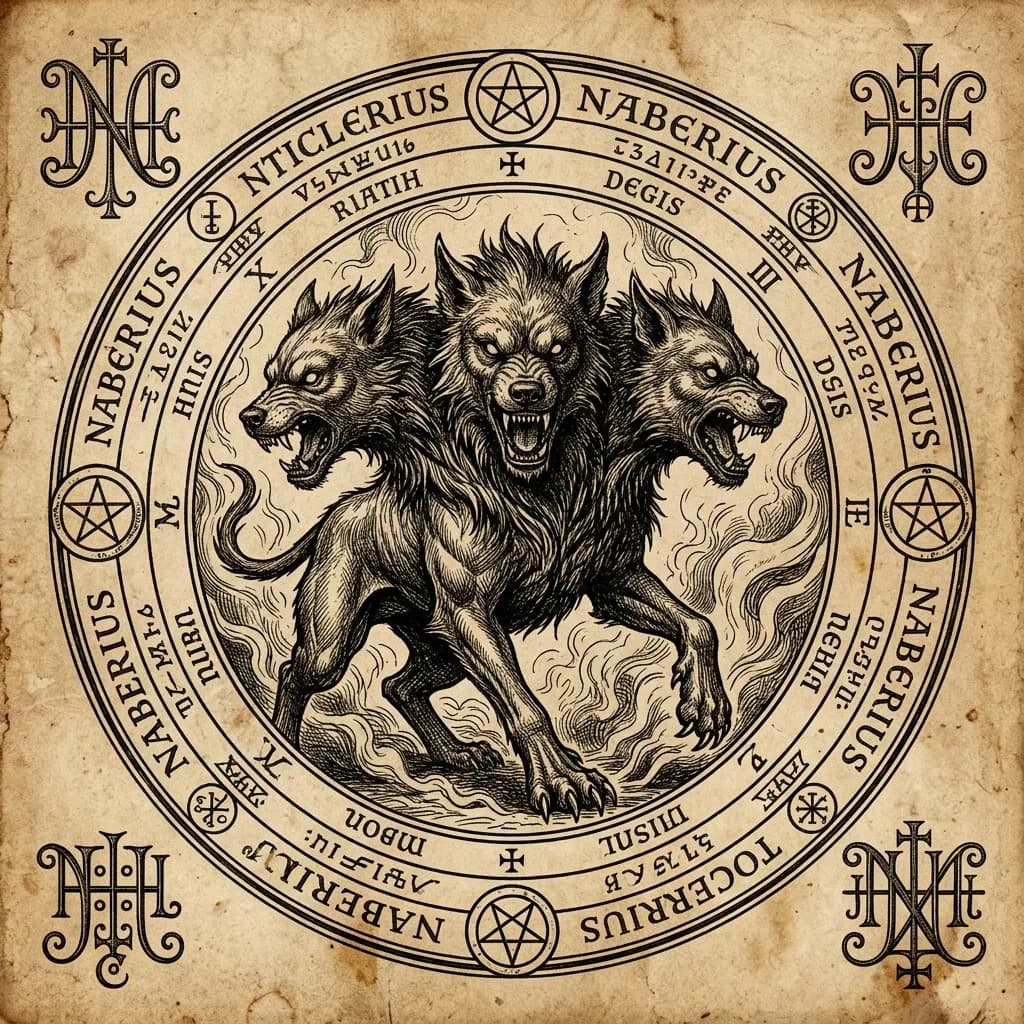
Naberius
MarquisSpirit #24 of the Ars Goetia · 19 legions
Description
Naberius is the Most Valiant Marquis of Hell, commanding nineteen legions of spirits. He appears as a three-headed dog or as a raven with a raucous voice. He maketh men cunning in all arts and sciences, but especially in the art of rhetoric. He restoreth lost dignities and honours. He was of the Order of Virtues before his fall.
Symbolic interpretation
The power to make men cunning in all arts and sciences, but especially rhetoric, is not a general elevation of intelligence. It is the installation of a specific operative capacity: the ability to shape how knowledge is received by others. Cunning is not the same as mastery - it is the strategic deployment of what one knows, the calibration of expression to effect. The particular emphasis on rhetoric reveals the structural priority. All arts and sciences become subordinate instruments once one commands how discourse works. The person on whom this power acts gains the ability to move through any field of knowledge not merely as a practitioner but as a persuader - someone whose command of a subject is wedded to command of the room. The consequence is that expertise becomes leverage. Knowledge that would otherwise remain inert, the private possession of the one who holds it, becomes a social force. This is power that compounds: every art mastered feeds into the rhetorical arsenal, and rhetoric in turn amplifies the authority of every art.
The restoration of lost dignities and honours operates on a different axis - not forward into new capacity, but backward into recovery. A dignity or honour, once lost, does not simply disappear; it leaves a wound in social standing, a gap where recognition once was. The operative mechanism here is the reversal of reputational collapse. Naberius does not bestow new honours from nothing; he restores what existed and was forfeited or stripped away. This is a precise and consequential distinction. The person who receives this power is not elevated to a new station but returned to one they could legitimately claim. What this produces is the experience of reinstatement - of having one's former place in the social and symbolic order acknowledged once more. The weight of that experience is significant because lost honour carries stigma, and stigma has inertia. The restoration does not merely change external status; it retroactively reclassifies what was lost as temporary rather than permanent, rewriting the narrative of decline as one of interruption.
The appearance as a three-headed dog or raven with a raucous voice is not ornamental. The three-headed dog - unmistakably Cerberus by another name - is a guardian of thresholds, specifically of the boundary between states that are supposed to be permanent. Three heads do not indicate simple multiplicity; they indicate simultaneous attention in all directions, the inability to be approached unseen from any angle. A threshold guardian who operates across three domains of perception cannot be circumvented by misdirection. Applied to Naberius's powers, this describes the spirit's function with precision: rhetoric, dignity, and honour are all fundamentally about positioning at thresholds - between knowing and being heard, between fallen and restored, between inside and outside social legitimacy. The raven form with a raucous voice adds a further signal. The voice is not melodious or persuasive in its own sound; it is loud, harsh, and unavoidable. It does not seduce - it commands attention by force of presence. This is rhetoric understood not as elegance but as penetration: the voice that reaches across distance and cannot be ignored, that fills whatever space it enters. The two forms together describe a spirit whose mechanism is total coverage - seeing every approach and being heard in every corner.
Archetype
Naberius derives to Taurus through Fixed modality operating in an Earth medium, and both axes are visible in the actual mechanism. The Earth element follows from Diffuse expression meeting Individual orientation: Naberius does not announce its operation. There is no moment where the recipient notices cunning being installed, or where the precise point of dignitary restoration can be identified. The force operates through accumulation in a single person - saturation rather than event, the slow densification of capacity and standing rather than a discrete before-and-after. That is the Diffuse/Individual combination, and it produces Earth as medium: the force works through material that consolidates, that layers, that holds weight. The Fixed modality describes the temporal posture precisely. Naberius does not initiate new states - it holds and perpetuates existing ones. Rhetoric, as this spirit enables it, is not innovation; it is the capacity to keep a position, to sustain authority under challenge, to maintain ground already taken. The restoration of lost dignities is structurally the same operation: what is being restored is an existing claim, a prior status, a state that once held and must be made to hold again. Naberius is not a founder or a disruptor - it is a consolidator, a force that makes things stick. The three-headed form encodes this: a threshold guardian holds a state of separation against continuous pressure, maintaining a boundary that would otherwise erode. Fixed Earth as operator means the mechanism works by building density in the individual until the accumulated weight of their rhetorical capacity and restored standing becomes self-reinforcing - the force does not need to keep pushing because the consolidated structure now holds itself.