Library
Raum
EarlSpirit #40 of the Ars Goetia · 30 legions
Description
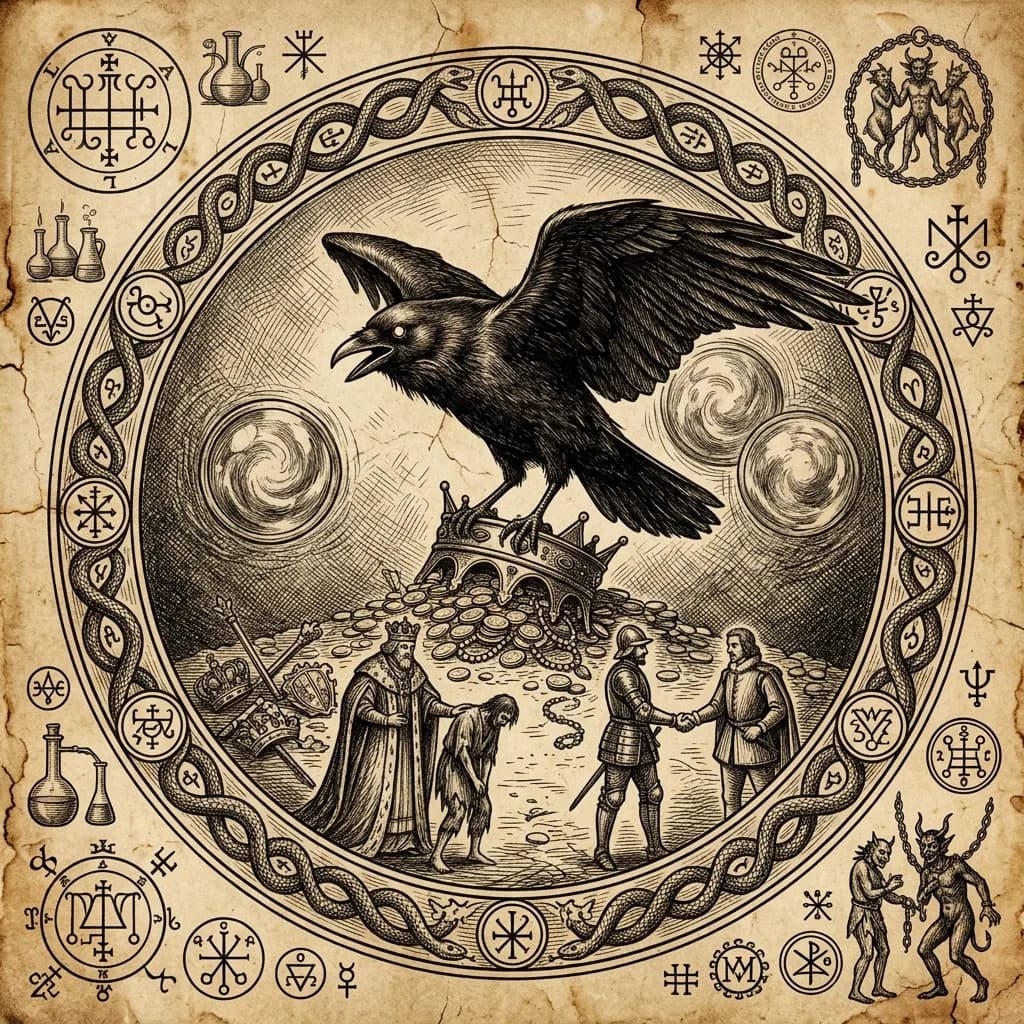
Raum is an Earl of Hell who commandeth thirty legions of spirits. He appeareth in the form of a crow. He stealeth treasures out of kings' houses and carrieth them to the conjurer. He destroyeth the dignities of men and lifteth up others. He causeth love between friends and foes. He telleth of things past, present, and to come.
Symbolic interpretation
The power to steal treasures out of kings' houses and carry them to the conjurer describes a specific mechanism of resource extraction from entrenched institutional power. The operative structure here is not simple theft but targeted redistribution: Raum operates within the architecture of concentrated wealth and authority, identifies what is most prized within it, and moves that value across a social boundary - from the sovereign's chamber to the summoner's hands. This is not random pillaging. It is selective penetration of protected domains. What this produces in the recipient is a sudden acquisition of leverage - material, symbolic, or informational - that would otherwise be structurally inaccessible. The person acted on does not earn their way into possession; they receive what cannot ordinarily be reached. That is consequential because power guarded by rank, walls, and legitimacy becomes porous in Raum's presence. The conjurer gains without conquest.
The power to destroy the dignities of men and lift up others describes control over the axis of social standing - the vertical dimension of how individuals are perceived, ranked, and accorded deference. The operative mechanism is not persuasion or reputation management but something more abrupt: the actual collapse of the symbolic infrastructure that holds a person's status in place. Dignity here means the accumulated recognition that allows someone to act with authority in a given sphere. Raum erases it in one direction and constructs it in another. What those acted on experience is the groundlessness of status - the person whose dignity is destroyed finds that their credentials no longer function, their authority is no longer acknowledged, and their social weight has vanished. Those lifted discover the opposite: sudden legibility, deference, access. This is consequential because rank is not merely decorative; it determines who can act and on what scale. Raum's power over this axis is power over the basic grammar of social reality.
The power to cause love between friends and foes identifies Raum as an operator of emotional and relational bonds across the most extreme possible range of existing disposition. The structural capacity here is not the generation of affection in neutral parties but the production of genuine attachment across the divide of enmity. This is a harder operation than simply intensifying warmth between allies. To cause love between foes means to override the logic of opposition, threat-recognition, and accumulated grievance that defines an enemy relationship, and replace it with the pull of connection. What those acted on experience is a dissolution of the relational framework that organized their previous stance toward another person - the enemy ceases to be perceived as a threat and begins to be experienced as something to protect or draw close. This is consequential because the bond formed across enmity is more durable and more surprising than any bond formed between those already predisposed to connection. Raum does not strengthen existing alliances; Raum generates them where they are least expected.
The power to tell of things past, present, and to come positions Raum as a holder of temporal knowledge in its full extent. The operative mechanism is omnidirectional information access across time: not prophecy alone, not historical recall alone, but simultaneous legibility of all three registers. What makes this a structural capacity rather than a skill is that Raum does not investigate or calculate - the knowledge is available to him as a condition of what he is. What those who receive this knowledge experience is a reorganization of their decision-making framework: past events acquire their actual causes rather than their apparent ones, the present moment becomes interpretable in full context, and the future loses the opacity that normally constrains action. This is consequential because the overwhelming majority of bad decisions derive from incomplete or misread information across time. Raum's testimony does not advise - it discloses.
The crow is Raum's native form, and it is not an arbitrary vehicle. The crow is a bird whose behavior in the material world already encodes the specific capacities attributed to this Earl. Crows are known for intelligence oriented toward acquisition - they observe, they wait, they extract objects of value from spaces that exclude other creatures. They operate at the edges of human habitation, traversing the boundary between the domestic and the wild without belonging to either. Their color is total absorption of light: the crow does not reflect - it takes in. As a form, the crow signals that Raum's mode of operation is not frontal or declared. He enters, takes, repositions, and withdraws. The crow's association with death and transition across cultures is not incidental here; it reinforces Raum's function as a mover between states - between high status and low, between enmity and love, between ignorance and temporal knowledge. The crow-form describes an intelligence that watches from above, identifies what is valuable, and moves it without permission.
Archetype
Raum derives to Gemini - Mutable Air - and both axes are demonstrable in the specific mechanics of his operation. The Air element emerges from the combination of Direct expression and Collective orientation: Raum's operations are nameable and locatable (the theft is a specific act, the destruction of dignity is a specific event, the caused love is a specific bond) while running on positional logic rather than personal targeting - he operates on whoever occupies the role of king, the role of the dignified man, the role of the foe. This is Air's medium: declared force applied across a social field defined by structure rather than by individual identity. The Mutable modality appears in what Raum actually does at each moment of operation. He does not initiate new orders - he reads existing ones and moves through them. The king's house already holds the treasure; Raum identifies the extraction path. The dignity is already in place; Raum locates the fracture point. The enmity already has its logic; Raum reads it well enough to reverse it. He does not break ground (Cardinal) or hold a line (Fixed) - he navigates existing structures with enough precision to reposition their contents. The temporal knowledge capacity confirms the Mutable posture most cleanly: the power to tell of things past, present, and to come is not generative or preserving - it is the capacity to read across all three registers simultaneously, which is exactly what a force that moves through states rather than creating or maintaining them would require. Raum's mechanism is one of informed traversal: he functions precisely because he reads the terrain better than anyone inside it.