Library
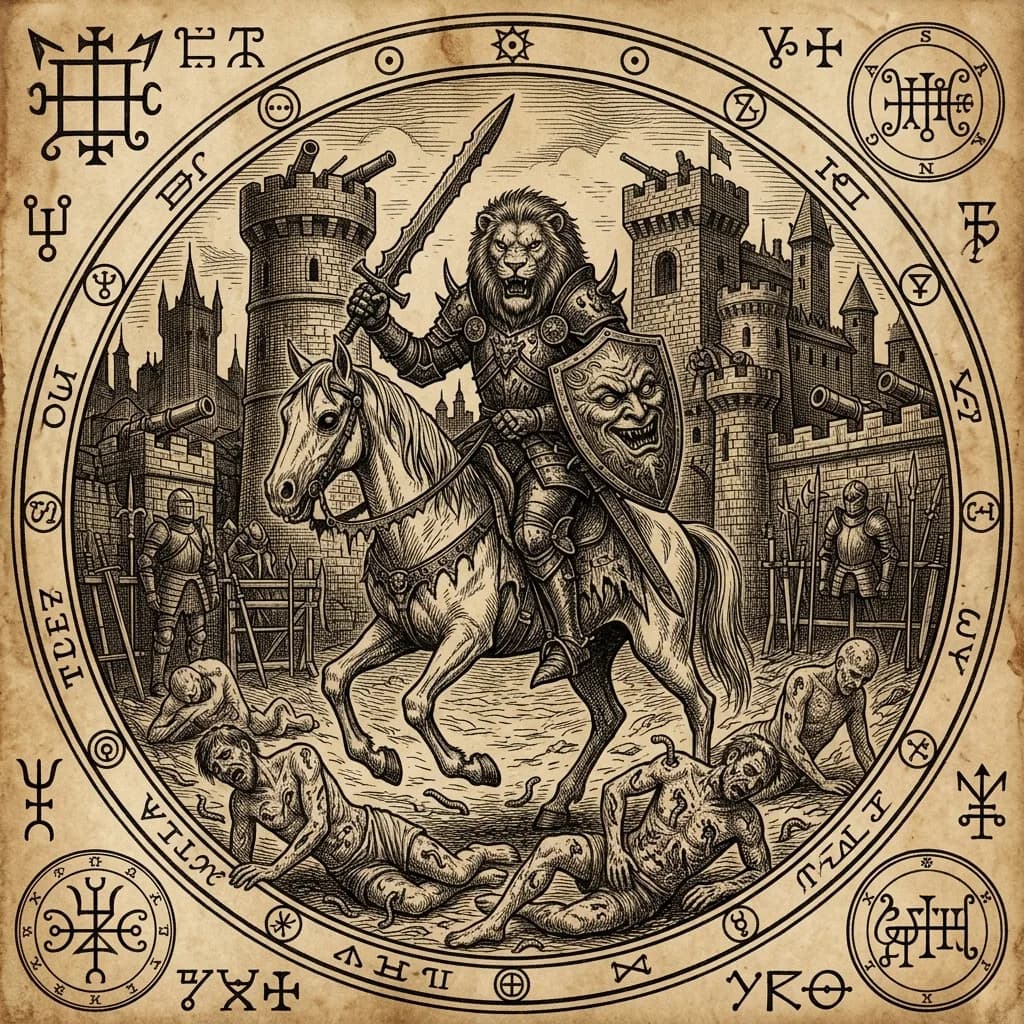
Sabnock
MarquisSpirit #43 of the Ars Goetia · 50 legions
Description
Sabnock is the 43rd Spirit and a Marquis of Hell. He appears as an armed soldier with a lion's head, riding a pale horse. He builds high towers, castles, and cities, and furnishes them with armour. He afflicts men for many days with wounds and putrefying sores filled with worms. He commands fifty legions of spirits.
Symbolic interpretation
The power to build high towers, castles, and cities - and to furnish them with armour - is the capacity for fortification as a total system. This is not construction in the neutral sense of placing stone on stone; it is the erection of defended enclosure, the transformation of open terrain into controlled and armoured space. The operative mechanism is the conversion of territory into hierarchy: towers assert vertical dominance, castles consolidate authority behind walls, cities organize population into administered units. Each structure is not merely habitable but armoured - meaning every built thing is simultaneously a weapon of position. What this produces in those who inhabit or encounter such structures is a doubled consciousness: the protected feel secured, the excluded feel the pressure of their exclusion as a material force. Fortified cities do not merely house people; they sort them by access, rank, and penetrability. The armour furnished within extends this logic inward - even the interior of these places is organized around readiness for conflict. The person inside a Sabnock-built world lives inside a permanent condition of defended vigilance.
The affliction of men with wounds and putrefying sores filled with worms, sustained over many days, is the power of prolonged biological corruption. The mechanism here is duration and invasion - it is not a killing blow but a slow occupation of the body by decay while the person remains alive to experience it. Worms within wounds are agents of breakdown that work from inside the flesh outward, reversing the logic of the fortress: where the first power builds armoured enclosures, this one opens the body and fills it with destructive presence. What the target experiences is the loss of bodily sovereignty over an extended timeline. Many days means the affliction outlasts immediate crisis and enters the register of endurance, exhaustion, and the psychological weight of a body that cannot heal itself. The putrefaction signals not just physical damage but categorical contamination - the wound becomes a site of rot, which carries the social force of uncleanness and isolation. The person so afflicted is not simply in pain; they are made to experience their own body as a compromised and failing enclosure, the precise inversion of the armoured tower.
The appearance of an armed soldier with a lion's head, riding a pale horse, encodes the structural logic of these two capacities in a single image. The soldier's arms and the lion's head together state the union of disciplined martial function with sovereign predatory force - the lion is not a domestic or herd animal but a creature of apex authority, whose head on a soldier's body means the chain of command runs from instinct and dominance, not from deliberation. The pale horse in Western symbolic tradition carries the specific resonance of pestilence and death - not the red horse of war or the black horse of famine, but the horse whose pallor names the colour of bloodless flesh. Sabnock rides this horse while bearing arms and wearing a lion's face: he is the figure who builds the fortified world and who also carries the disease that hollows it from within. The appearance does not present a contradiction but a complete system - construction and corruption are the same force operating in different directions, and Sabnock embodies both simultaneously.
Archetype
The derived sign is Cancer, produced by the combination of Cardinal modality and Water element. The Water element follows from Diffuse expression operating at Collective orientation: Sabnock's force enters without announcement and runs on whoever occupies the relevant position - resident, soldier, administrator - not on a named individual targeted by a specific act. There is no front door to the affliction of wounds and putrefying sores; it is ambient and sustained, a condition imposed over many days through occupation of the body by internal decay, which is precisely how a Diffuse mechanism operates. The Collective orientation is structural: Sabnock's fortified cities, towers, and castles are systems that process populations - they sort people by access and rank, they impose a logic of defended enclosure on whoever inhabits the territory, and the armour furnished within extends that logic to every interior. No individual is named; the force runs on whoever is inside the walls. Cardinal modality then identifies the temporal posture of this operation: Sabnock does not hold an existing condition or read between states - he breaks open new ones. The towers, castles, and cities are founded where none existed; the sores open flesh that was previously intact. Each act of construction and each act of putrefaction is an initiation of a new state. The Receptive direction confirms that this Cardinal force operates by drawing inward - the fortified enclosure pulls population toward a center, the wound draws worms and decay into the body, the armoured city creates a gravity that makes exclusion and inclusion felt as material forces. The resulting operator is Cancer: Cardinal Water, a force that initiates by enclosure, that creates new conditions through the establishment of defended perimeters into which things flow and within which they are held - and the worm-filled wound is mechanically the same operation as the armoured tower, both being new enclosures that contain and process what enters them.