Library
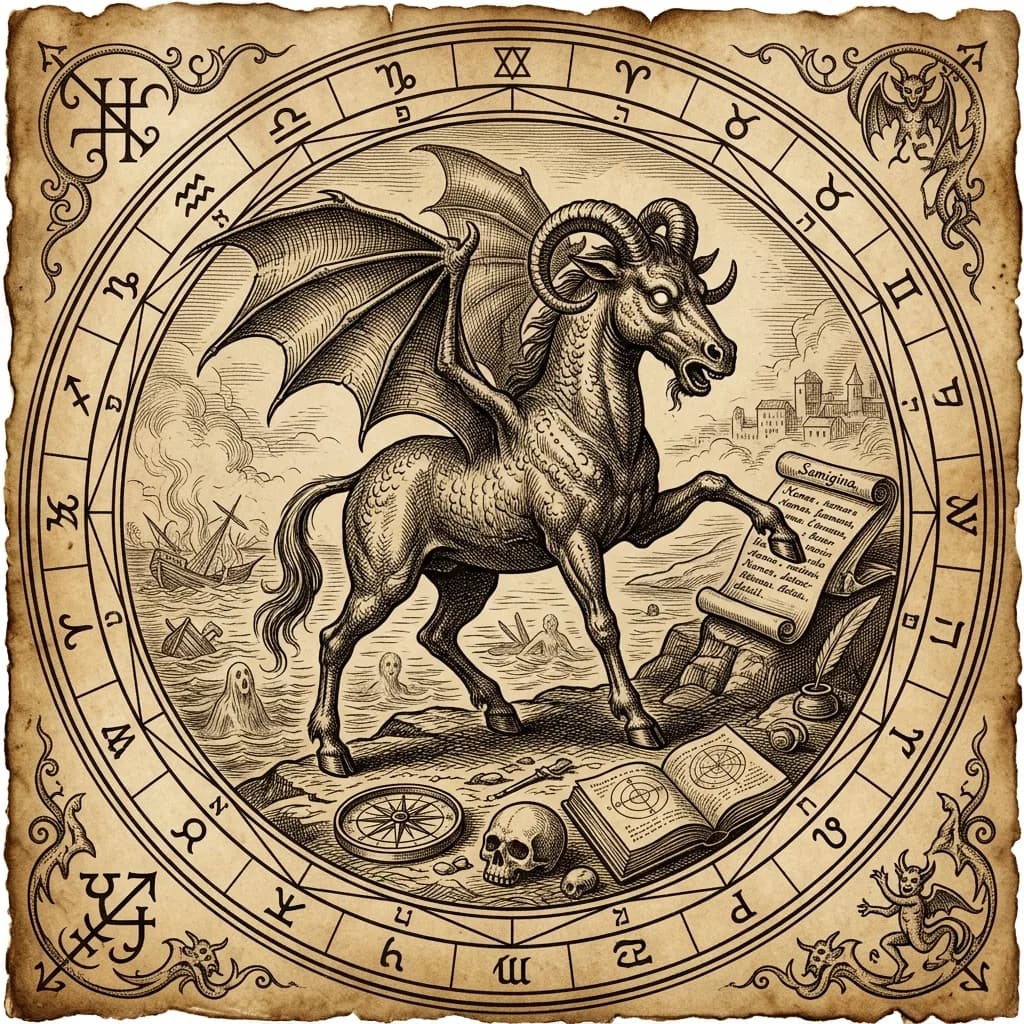
Samigina
MarquisSpirit #4 of the Ars Goetia · 30 legions
Description
Samigina is the 4th Spirit of the Ars Goetia, a Marquis of Hell who commands thirty legions of spirits. He appears as a small horse or ass and speaks with a hoarse voice. He teaches the liberal sciences. He gives account of certain souls that drowned in the sea, and of others who died in sin.
Symbolic interpretation
The teaching of the liberal sciences is not merely instruction in academic subjects - it is the transmission of the foundational grammar of rational civilization. The liberal arts in their classical formulation - grammar, rhetoric, logic, arithmetic, geometry, music, astronomy - constitute the structural equipment by which the mind orders reality, argues coherently, and measures the world. To possess this capacity is to hold the master key to formal knowledge systems: not a single discipline but the architecture underlying all disciplines. What this produces in those who receive it is the capacity to think rigorously across domains, to move from raw perception to articulated understanding. This is consequential because it is not transferable knowledge about specific things but knowledge about how to know - the difference between giving a person a fact and giving them the mechanism to generate and evaluate facts indefinitely.
The giving of account of souls drowned in the sea and of others who died in sin is a form of access to records otherwise sealed by death. The operative mechanism here is communication across the boundary that ordinarily makes the dead unavailable as witnesses or sources of information. Samigina does not resurrect these souls - he renders them accountable, meaning he extracts testimony from those who passed without record, without witness, without resolution. Drowning at sea represents the category of death that leaves no trace, no body, no documentation; death in sin represents those whose final state was spiritually unresolved. What this capacity produces in those who employ it is a form of closure or intelligence: knowledge about what happened to the disappeared, the unretrievable, the damned. This is consequential because human systems of knowledge, law, grief, and judgment are all structured around the problem of those who vanish without account - and Samigina's power directly addresses that gap.
The appearance as a small horse or ass carries precise functional meaning. The horse and ass are both beasts of burden and conveyance - they carry weight across distances. The smallness of the form is significant: this is not a war horse or a beast of spectacle, but a compact, workaday animal whose value lies entirely in utility and endurance. The ass in particular is the classical symbol of patient, plodding labor - the animal that carries without complaint, that moves steadily through difficult terrain. That Samigina appears in this form signals that his operation is not dramatic or imposing; it is methodical, reliable, and built for the long work of transmission. The hoarse voice reinforces this: a voice worn by use, roughened by repeated speaking, suggests a spirit that has been talking for a very long time, carrying knowledge across distances both geographical and metaphysical, including across the distance between the living and the dead.
Archetype
The derived sign is Scorpio, produced by Fixed modality operating through Water - and both are legible in the precise mechanism of Samigina's operation. The Water element arises from Diffuse expression combined with Collective orientation: Samigina does not confront a specific target with a declared act, but instead permeates the epistemic field - the liberal sciences are not a single intervention but an atmospheric restructuring of how any occupant of the system processes reality. There is no front door to contest; the grammar of rational thought simply becomes available, ambient, already inside the recipient before the transmission is consciously located. This is Water's medium: force that surrounds and saturates rather than strikes. The Fixed modality then names the temporal posture of that saturation - Samigina does not initiate a new epistemic order, nor does he translate between states. He holds. The liberal arts are a doctrine that already exists; his function is perpetuation, the transmission and maintenance of a standing architecture of knowledge. The same holding function appears in his access to the dead: he does not open a new channel to the afterlife so much as he sustains an existing accountability across the boundary of death, keeping records available that ordinary systems cannot preserve. Fixed Water does not flow forward or transform - it holds its depth, maintains its pressure, and makes available what has settled to the bottom. The specific mechanical claim this produces: Samigina's power over the dead is not necromantic generation but archival retrieval - a Fixed operation that preserves testimony in a medium (Water) that carries it without declaring it.
In popular culture
Samigina has no significant popular culture presence.