Library
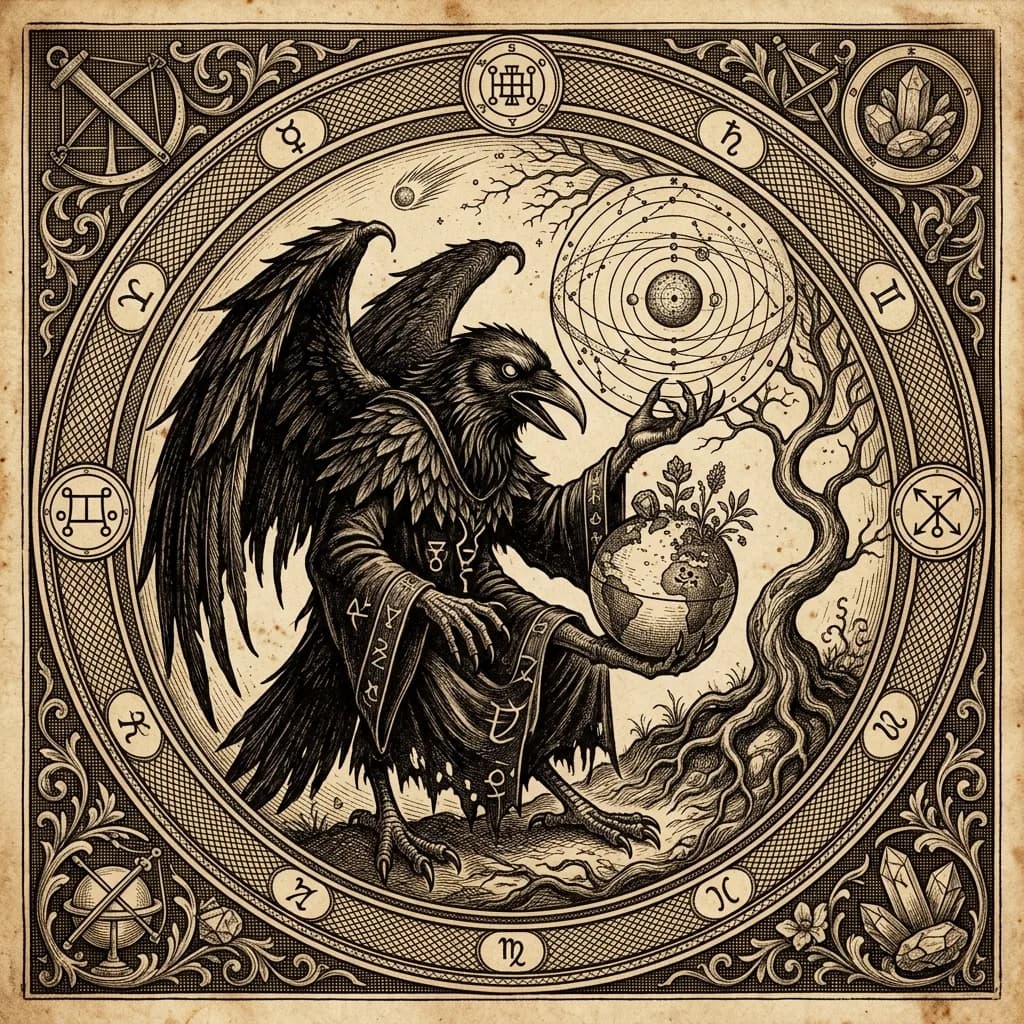
Stolas
PrinceSpirit #36 of the Ars Goetia · 26 legions
Description
Stolas is the 36th spirit, a great Prince. He appears first as a great raven. Upon command, he takes the form of a man. He teaches the art of astronomy. He teaches the virtues of herbs and precious stones. He governs 26 legions of spirits.
Symbolic interpretation
The teaching of astronomy is the transmission of a structured map of celestial mechanics - not stargazing, but the capacity to read the sky as a system of relationships, cycles, and positions that govern timing, navigation, and the long arcs of natural order. To possess this ability is to hold the framework by which humanity orients itself in time and space, the grid against which all terrestrial events are measured and predicted. What this produces in the recipient is a radical reorientation of scale: the person who understands astronomical principles ceases to operate solely within immediate human duration and begins to perceive cycles far exceeding a single life. That shift in temporal awareness reorganizes how decisions are made, how patterns are recognized, and how urgency is calibrated. The knowledge is fundamentally disorienting before it becomes useful - it places the human at an accurate but humbling coordinate in a vastly larger system.
The teaching of the virtues of herbs and precious stones is the transmission of occult pharmacology and mineral correspondence - the operative knowledge of what specific materials do to living systems and to subtle energetic conditions. This is not decorative botany or gem classification; it is a functional doctrine of material causality, asserting that particular substances carry particular effects that can be reliably applied. The mechanism is specificity: each herb and each stone is assigned a discrete virtue, a concrete capacity for action. What the recipient gains is agency over material intervention - the ability to select the right substance for a given condition, whether that condition is medical, ritual, or relational. This knowledge collapses the boundary between the physical and the operative, treating the natural world as a catalogue of tools with determinable functions. The consequence is practical power: the practitioner who knows the virtues of materials can intervene in situations where those without such knowledge are helpless.
The initial form of a great raven is not incidental staging but a precise functional signal about Stolas's nature. The raven is the animal most consistently associated across traditions with knowledge acquired at a distance - with messages traversing between the living and the dead, between the visible and the hidden. A great raven, specifically, is a raven with authority, one that commands rather than merely scavenges. The form declares that Stolas's mode of operation is surveillance and transmission: he sees from altitude, moves between realms, and carries information across boundaries. The raven does not acquire knowledge through proximity or intimacy - it observes from above and descends with what it has gathered. This maps directly onto astronomy, which is precisely the acquisition of knowledge by sustained observation of distant objects, and onto the classification of natural virtues, which requires the same detached, systematic inventory. The commanded transformation into a man does not contradict the raven nature but reveals its complement: Stolas can speak in human register, translate what he has seen from altitude into communicable doctrine. He bridges the inhuman scope of his knowledge with the human-scale capacity for instruction.
Archetype
The derived sign for Stolas is Aquarius, the product of Fixed modality and Air element. Air emerges here from the combination of Direct expression and Collective orientation: Stolas's teaching operation has a nameable front door - specific disciplines, specific doctrines, astronomy and the virtues of herbs and stones - and it runs on whoever occupies the position of student, not on any particular individual. The knowledge transmitted is systematized and portable, a grid that any recipient can inherit and apply, which is precisely the mechanism of Direct-Collective force: you can locate the instruction, but it installs itself into a collective capacity rather than targeting a personal bond. The Fixed modality is where most readings of Stolas go wrong, because he appears as a teacher and teachers feel Mutable. But Stolas does not bridge or translate between states - he holds a doctrine in place. Astronomy is not exploratory here; it is a structured map of celestial mechanics transmitted as an intact system. The virtues of herbs and precious stones are not discovered in the session - they are a pre-existing catalogue, each substance assigned a discrete function, delivered as received corpus. The Receptive direction confirms this: Stolas draws students toward the body of knowledge he holds rather than generating novel inquiry outward. The mechanism is preservation and transmission of a fixed epistemic structure, not the creative movement of a Mutable force. The result is an operator that locks a knowledge system into place across whatever population encounters it - which is precisely what Fixed Air does.
In popular culture
Stolas appears as a major character in Helluva Boss, an animated series created by Vivziepop. In this portrayal, he is depicted as a demon prince whose complex relationship with the protagonist Blitzo drives significant portions of the main storyline. The adaptation retains his aristocratic rank and avian visual design while repositioning him within a comedic-dramatic Hell-bureaucracy narrative, making him one of the more recognizable demonic figures in contemporary animated media.