Library
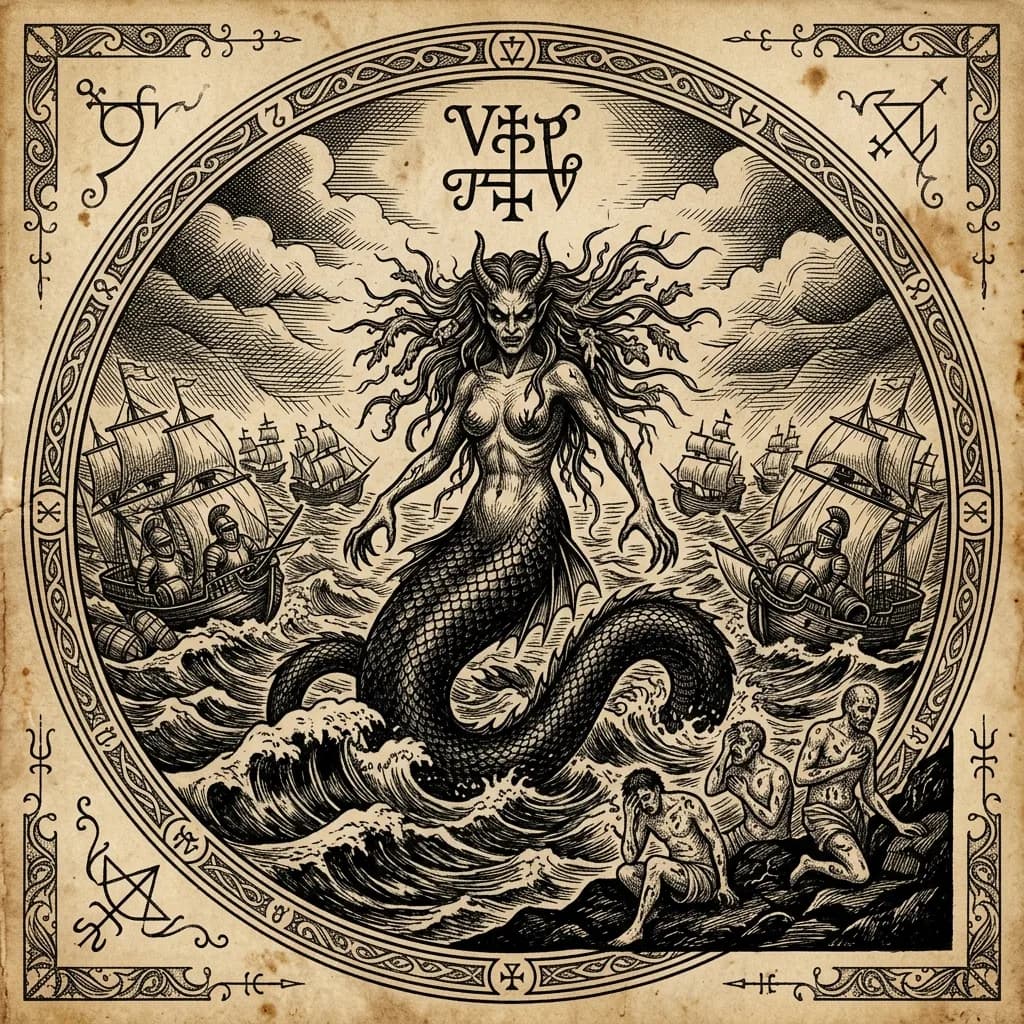
Vepar
DukeSpirit #42 of the Ars Goetia · 29 legions
Description
Vepar is the 42nd Spirit, a Duke of Hell, commanding twenty-nine legions of spirits. She appears as a mermaid. She governs the waters and ships laden with armour. At the request of the exorcist she causes the sea to be stormy and to appear full of ships. She afflicts men for three days with wounds and putrefying sores full of worms from which they die - unless she is commanded otherwise.
Symbolic interpretation
Vepar's appearance as a mermaid is not ornamental - it encodes the precise nature of her operational logic. The mermaid is a creature of threshold, belonging neither fully to land nor sea, to the human nor the wholly inhuman. This dual nature describes a spirit that operates at the boundary between navigable and hostile, between medium and obstacle. The sea is the mermaid's domain, and she does not merely inhabit it - she is its governing intelligence. What appears calm and traversable she can render treacherous at will. Her form signals that the domain she controls is one humanity enters at her sufferance, never by right. The mermaid also carries an ancient association with fatal attraction: she draws ships toward danger rather than away from it. Vepar's appearance, then, is a declaration of jurisdiction over the space between departure and arrival, where human agency is weakest.
The governance of waters and ships laden with armour defines Vepar as a power over logistical force - specifically, over the movement of military capacity across open, hostile terrain. To govern armoured ships is not merely to control transport; it is to control whether martial power reaches its destination at all. The operative mechanism here is command over the medium through which force projects itself. An army on land is dangerous; an army at sea is dependent, vulnerable, stripped of the ground beneath it. Vepar holds authority over that interval of maximum vulnerability. For those subject to this power, it means that the projection of strength - the act of moving organized violence from one place to another - is not under their control, but hers. Campaigns dissolve before they arrive. Military ambition becomes contingent on a force that operates beneath the surface of every crossing.
The capacity to cause the sea to appear full of ships operates as deliberate strategic deception at a collective scale. The mechanism is the manipulation of perceived threat: she fills the horizon with phantom fleets, manufacturing the appearance of overwhelming hostile force where none exists, or none of that magnitude. This is not illusion for its own sake - it is the production of strategic paralysis. An observer who sees the sea crowded with armoured ships cannot distinguish real from conjured, and so cannot act. The target experiences the full psychological weight of imminent military catastrophe without the means to verify it. Decisions made under that pressure - retreat, surrender, abandonment of position - carry real consequences even after the phantoms disperse. The damage inflicted by perceived encirclement is structural, not merely emotional.
The affliction of wounds and putrefying sores full of worms that kill over three days describes a process of systemic biological corruption operating on a specific timeline. The mechanism is decay accelerated and made internal - the body turned against itself through infestation, putrefaction working from the wound inward. Three days is a precise duration: long enough for the victim to understand what is happening, too short for meaningful intervention in premodern conditions. The worms are not incidental; they signal that the corruption is alive, self-sustaining, feeding. What the target experiences is not merely pain but visible, uncontrollable dissolution - a body becoming something other than itself while still inhabited. The conditional clause - unless she is commanded otherwise - is critical: it establishes that Vepar retains sovereign discretion over the outcome. The affliction is not automatic destruction but leverage. She can kill, and she can stop. That reversibility is the source of her power over the exorcist as much as the victim.
Archetype
Vepar derives to Libra - Cardinal Air - and the case rests on locating the modality and element precisely in her operative mechanism, not in her subject matter. Air emerges from the Direct à — Collective derivation: her force operates through a named, locatable act (the conjuration of phantom fleets, the deliberate roughening of seas) that runs on whoever occupies the relevant position in the system - any fleet crossing her waters, any force attempting to project military power across that interval. The target is not a specific person but a function: whatever organized force attempts transit. That is the Air medium - a force that moves through open, shared, traversable space and strikes at the structural capacity of collective actors to coordinate and project. The Cardinal modality is visible in every description of what Vepar does: she initiates new states that did not previously exist. The calm sea becomes storm. The empty horizon becomes a fleet. The intact body becomes a site of accelerating decay. None of these are holding operations or translations of existing conditions - each is a rupture, a founded crisis, a break that opens a new state the target must now navigate. She does not sustain pressure over time; she creates the precipitating event. The phantom fleet does not besiege - it appears, and the paralysis it generates is a consequence of that inaugural moment of apparition. The wounds do not simmer; they are inflicted on a clock that starts at Vepar's command. Cardinal force initiates and then the consequences run. Libra is the sign derived from Cardinal Air, naming an operator that breaks open new states through direct intervention into collective, shared-medium systems - which is precisely what Vepar does when she transforms navigable water into the mechanism by which military ambition is interrupted before it can arrive.