Library
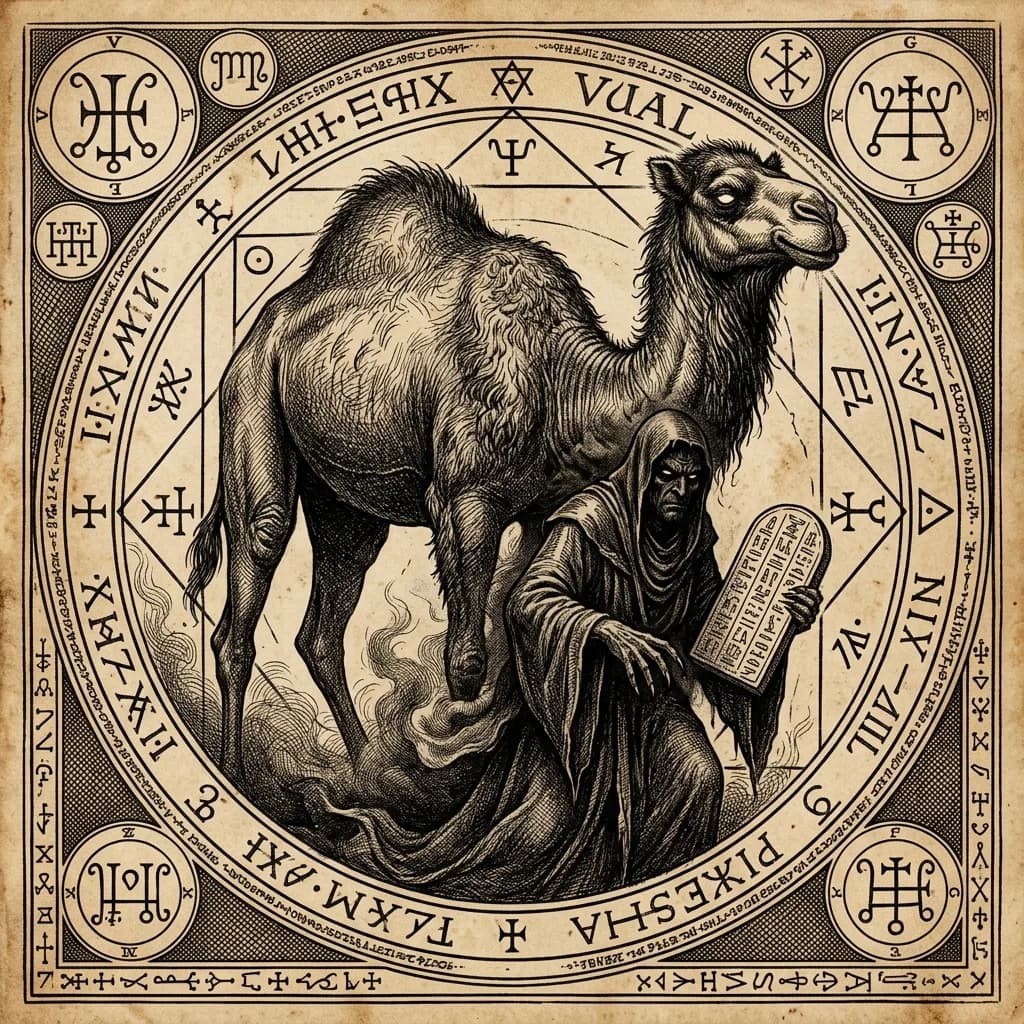
Vual
DukeSpirit #47 of the Ars Goetia · 37 legions
Description
Vual is the 47th Spirit, a Duke of Hell who commands thirty-seven legions of spirits. He appears first as a large dromedary camel and takes human form when commanded. He speaks in the Egyptian tongue. He procures the love of women. He gives the love of friends and foes. He causes enmity between friends and foes. He tells of things past, present, and to come.
Symbolic interpretation
To speak in the Egyptian tongue is to operate in the language of a civilization whose written and spoken codes were, for medieval European demonologists, the archetype of hidden knowledge - a tongue at once ancient, prestigious, and inaccessible to the uninitiated. This power is not merely linguistic fluency. It is the capacity to communicate through a register that carries the full weight of priestly authority and esoteric transmission. The Egyptian tongue, in this context, names a mode of speech that moves through symbol, ritual formula, and encoded meaning rather than through ordinary semantic exchange. The person who encounters this power does not simply hear words - they are confronted with a form of address whose authority rests on its opacity, its distance from the vernacular, and its association with a civilization whose gods and magic were understood as genuinely operative. The effect on the recipient is one of dislocation: ordinary defenses drop because ordinary interpretive frameworks no longer apply.
To procure the love of women is a specific directional force - not the emergence of love from within the beloved, but its installation through external agency. The operative mechanism here is procurement: the arrangement of conditions that produce an affective outcome in another person without that person's deliberate consent or self-generated desire being the proximate cause. This is a power of induction, not seduction. The structural capacity it describes is the ability to override the ordinary processes by which attachment forms - time, shared experience, mutual recognition - and substitute a result-state directly. What the target experiences is love that feels entirely genuine from the inside while having been externally engineered. This is consequential because it renders the beloved's inner life an artifact of an outside intervention, severing the relationship between authentic desire and its apparent object.
The power to give the love of friends and foes operates on a broader spectrum than the procurement of romantic love, and its scope reveals something fundamentally different in kind. Where the previous capacity targets erotic or intimate attachment in women, this one spans the full range of social relations - from those already aligned to those actively opposed. The operative mechanism is the conversion of relational valence: hostility becomes affection, indifference becomes loyalty, rivalry becomes devotion. What this produces is a social environment around the operator that has been systematically reoriented toward goodwill, regardless of the prior disposition of each party. The target of this power does not experience it as change - they experience their new affection as natural and pre-existing. The consequence is that the operator moves through a social world that has been quietly restructured to support them, while no one in that world perceives the restructuring.
That Vual also causes enmity between friends and foes is the exact inversion of the previous capacity, and its inclusion alongside the power to give love reveals the full architecture of the ability. This is not a contradictory power - it is the same mechanism operating in reverse, and its presence confirms that what Vual controls is relational valence itself, not any fixed directional charge within it. The capacity to produce enmity between those who were previously aligned - whether as friends or as mutual enemies - is the power to dissolve social bonds and generate friction, suspicion, and hostility where none existed. What the target experiences is the organic emergence of distrust, grievance, or contempt toward someone they previously held in a different register. The consequence is the controlled disintegration of alliance networks, which is a precise tool of social warfare. Taken together with the capacity to generate love, these two powers describe a complete sovereignty over the affective fabric of social life.
To tell of things past, present, and to come is the power of temporal omniscience - not prophecy in the sense of inspired guessing, but access to the full timeline as a simultaneous object of knowledge. The structural capacity is the collapse of temporal sequence into a readable totality. What normally functions as before, now, and after - the three distinct epistemic positions from which human beings construct meaning and agency - becomes, for Vual, a single simultaneous field. The person who receives intelligence from this power gains not prediction but disclosure: they are told what already is true at any point on the temporal axis. The consequence is the elimination of uncertainty as a strategic condition. Decisions, negotiations, and relationships are all structured by incomplete knowledge about past causes and future outcomes; access to Vual's temporal sight removes that incompleteness and produces a position of radical informational advantage.
The dromedary camel as initial form is a precise functional signal, not a decorative choice. The dromedary is the creature of sustained traverse - adapted not to speed or spectacle but to endurance across hostile, featureless, and disorienting terrain. It carries its resource internally, making it independent of external provisioning over long distances. Read as a functional description of Vual's operative mode, the camel form signals a spirit whose domain is the long crossing: the sustained navigation of social, emotional, and temporal distances that would exhaust or disorient ordinary agents. The camel is also the animal of commerce and cultural exchange across desert routes - the original vehicle of contact between civilizations, including those of the Near East and Egypt. Vual's camel form thus encodes in a single image both his powers of relational traversal and his connection to the Egyptian tongue and the distant, archaic sources of his authority. That he assumes human form only when commanded indicates that the default state is instrumental and traveling, while the human form is a performed accommodation - a shape taken on for the purpose of the encounter, not the spirit's native register.
Archetype
Vual's derived sign is Sagittarius - Mutable Fire - and both axes are visible in the precise structure of his operation rather than in his surface appearance. The Fire element follows from the Direct à — Individual derivation: each of Vual's interventions is a targeted act with a locatable point of application - love is procured in a specific woman, enmity is installed between specific persons, temporal intelligence is disclosed to a specific operator. There is always a named target and a discrete outcome; nothing about the mechanism is ambient or systemic. The Mutable modality is equally specific to his function: Vual does not initiate new emotional states from nothing, nor does he lock existing states into permanent configurations. He reads the current relational valence between parties and translates it - converting hostility into affection, friendship into enmity, temporal opacity into readable disclosure. This is not disruption and not preservation; it is the movement through a terrain of existing conditions to produce a new reading of them. The dromedary form encodes this exactly: an instrument of traverse, not conquest or fortification. The power to speak in the Egyptian tongue operates by the same mechanism - it does not establish a new communicative order, it moves through the gap between the target's interpretive framework and an anterior one, producing dislocation through translation rather than through force. Mutable Fire describes an operator whose medium is the targeted individual encounter (Fire) and whose posture is the adaptive reading of that encounter's existing structure (Mutable), which is precisely why Vual's love-procurement bypasses the ordinary temporal sequence of attachment rather than either founding or sustaining it.