Library
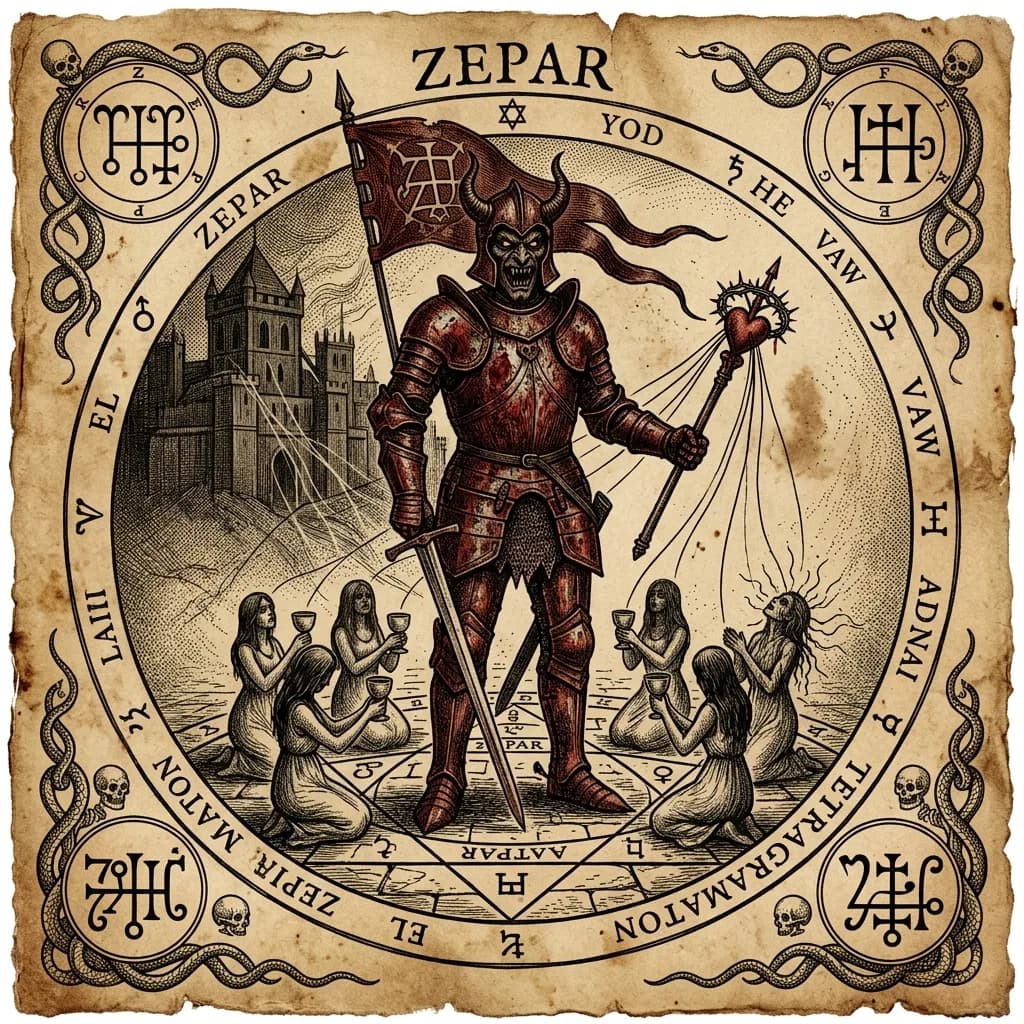
Zepar
DukeSpirit #16 of the Ars Goetia · 26 legions
Description
Zepar is the sixteenth spirit of the Ars Goetia, ranked as a Duke of Hell commanding twenty-six legions of spirits. He appears as a soldier dressed in red apparel and armour. He causes women to love men. He makes women barren.
Symbolic interpretation
The power to cause women to love men is the capacity to manufacture desire - not to attract through merit or circumstance, but to install an affective state in another person by external compulsion. The operative mechanism is the override of autonomous feeling: the target does not arrive at love through any natural process of encounter, recognition, or choice. The feeling is placed there. What this produces in the person it acts on is a love that has no organic root - it is real in its phenomenology, fully experienced as genuine, yet structurally counterfeit. The target cannot distinguish it from love freely formed. This is consequential because it severs the connection between a person's interior life and the conditions that actually produced it, creating a devotion that serves the purposes of the compeller rather than the flourishing of the one who feels it. The target is bound by something they believe is themselves.
The power to make women barren operates as the annihilation of generative potential. The mechanism is not destruction in any violent sense but rather the sealing-off of a capacity - the foreclosure of a future that might otherwise have unfolded. What Zepar performs here is a kind of ontological subtraction: he removes from the field of what is possible something that was structurally present. The consequence for the person acted upon is not simply the absence of children, but the permanent closing of a door. Unlike grief over a loss that occurred, barrenness imposes a grief over what will never occur, a negation rather than an event. Paired with the first power, this creates a pairing of considerable brutality: desire is inflamed and locked into place, while the generative culmination of that desire is simultaneously blocked. The victim is bound to love without being able to create through that love.
The appearance of a soldier in red apparel and armour reads as a precise functional signature. Red is the color of blood, of fire, of heated iron - and of the passions that Zepar commands. He does not appear as a seducer, a lover, or a healer; he appears armed and militarized, which identifies the mechanism of his operation correctly. What he does to love is not cultivation but conquest. The armour signals that his approach is aggressive and directed, not ambient or diffuse. He is a figure of targeted action, not influence through presence. The soldier's uniform also speaks to rank and mandate: Zepar acts under orders, executes a function, operates through force-discipline rather than persuasion. The combination of military form with erotic and reproductive power maps the archetype precisely - desire as a weapon, deployment of affection as a form of occupation.
Archetype
The derived sign is Leo, produced by the Fixed modality operating through Fire - the element generated by Direct expression acting on the Individual. The Fire designation is earned mechanically: Zepar's operation has a front door. There is a specific target, a specific act, a specific override of a specific person's affective state. Nothing ambient or structural is doing the work - the intervention is locatable, contestable in principle if not in practice, a named act performed on a named person. That is Direct. The scale is equally precise: Zepar does not reshape the conditions under which love becomes likely across a population; he installs a state in a particular person. Each operation is a singular targeted event, however many may run simultaneously. That is Individual. Direct plus Individual yields Fire. The Fixed modality then names the posture of that fire: Zepar does not initiate a new emotional trajectory and step back, nor does he read and adapt through a person's existing condition. He holds. The manufactured desire does not evolve, does not develop through encounter, does not respond to changing circumstances - it is installed and maintained, a state perpetuated against what would otherwise be the organic motion of feeling. The barrenness power confirms this: it is not a disruption that creates a new condition to develop, nor a reading of existing conditions, but a sealing, a lock, a permanent hold against a door that will not open again. Fixed Fire names an operator whose mechanism is not flame-as-ignition but flame-as-sustained-burn - the held state, the occupied territory, the desire that does not resolve because it was never allowed to be anything other than what Zepar placed there. The receptive direction completes the structure: what Zepar produces flows toward the compeller, accumulating devotion in a center defined by the one who commissioned the operation rather than by the one experiencing it.