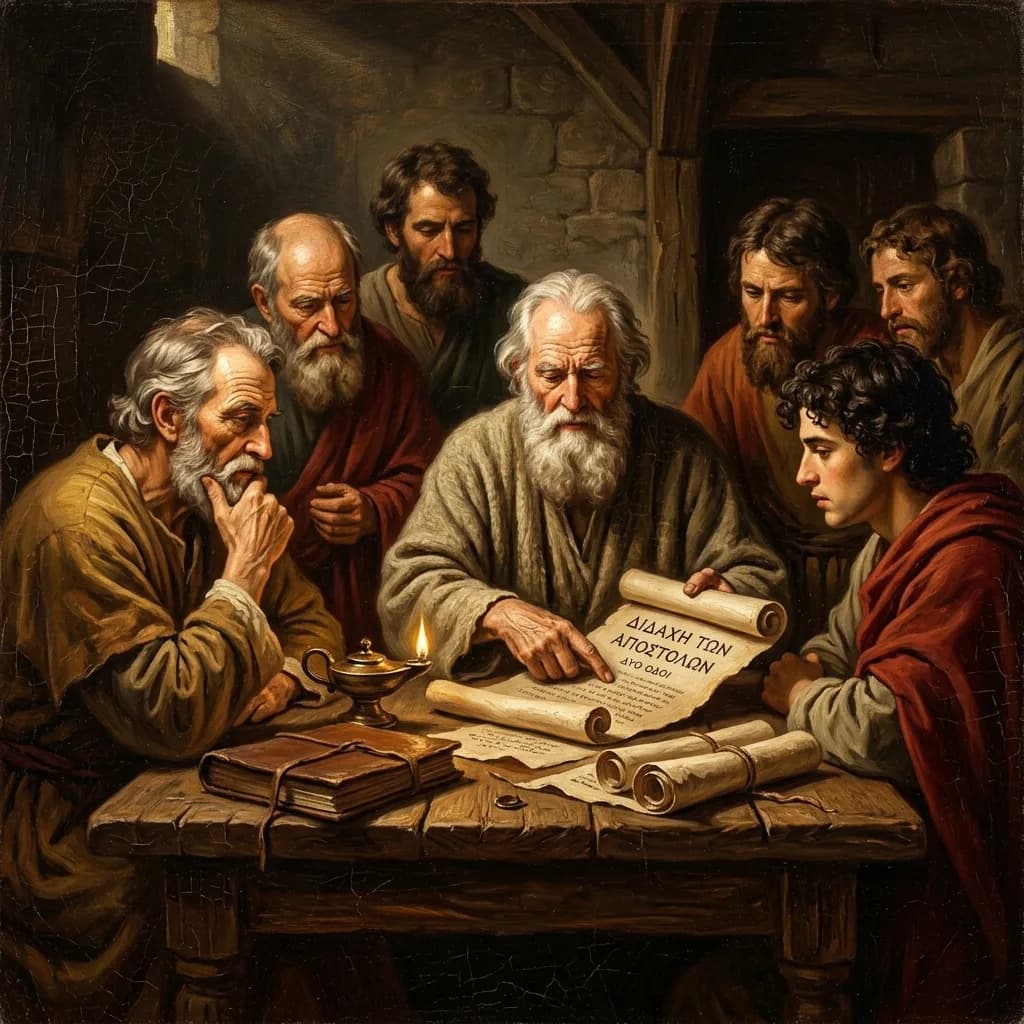
The Didache
Church history · Updated August 15, 2026
Overview
The Didache, one of the earliest Christian texts, was nearly included in the New Testament but was left out. Composed in the late first or early second century, the Didache, also known as "The Teaching of the Twelve Apostles," offered a practical guide for early Christian communities. Covering a range of topics from ethics to rituals like baptism and the Eucharist, as well as church organization, it never made it into the New Testament canon. The reasons for its exclusion remain speculative, but it may have been due to its practical focus rather than theological depth, which was a key consideration for the early church leaders when assembling the New Testament.
Early Christian decision-making is illustrated by The Didache's near-inclusion in the New Testament. As the early church sought to establish a unified set of scriptures, leaders like Bishop Athanasius of Alexandria considered various texts for inclusion. The Didache was valued for its guidance on Christian living, but it lacked the apostolic authorship or direct connection to Christ's life that many other books in the New Testament possessed. By the fourth century, when the canon was more formally established, leaders set it aside in favor of texts that were more theologically oriented and widely accepted across different Christian communities. The Didache thus remained influential but on the periphery of the canonical scriptures.
Today, the Didache is a crucial historical document that reveals the practices and beliefs of early Christians. Its rediscovery in 1873 by Philotheos Bryennios in a library in Constantinople revived interest in this ancient manuscript. Scholars now study it to understand the diversity and development of early Christian thought and practice. Although it never achieved canonical status, the Didache continues to be a valuable resource for understanding the early church's efforts to define its identity and practices in a rapidly changing world.
The Didache, one of the earliest Christian texts, was almost included in the New Testament but was ultimately left out.
Common questions
- What is the Didache?
- The Didache, also known as 'The Teaching of the Twelve Apostles,' is one of the earliest Christian texts. It serves as a practical guide for early Christian communities, covering topics like ethics, rituals, and church organization.
- Who wrote the Didache?
- The authorship of the Didache is unknown, but it is attributed to the teachings of the Twelve Apostles.
- When was the Didache written?
- The Didache was composed in the late first or early second century.
- What is the purpose of the Didache?
- The purpose of the Didache is to provide guidance on Christian living, including ethical behavior, rituals, and church organization for early Christian communities.
- How does the Didache relate to early Christianity?
- The Didache offers insights into the practices and beliefs of early Christians, serving as a crucial historical document that reflects the diversity and development of early Christian thought and practice.
- What teachings are included in the Didache?
- The Didache includes teachings on ethics, rituals like baptism and the Eucharist, and guidelines for church organization and leadership.
- Why is the Didache important to Christian history?
- The Didache is important because it provides a window into the practices and beliefs of early Christians, helping scholars understand the early church's efforts to define its identity and practices.
- How does the Didache address baptism?
- The Didache provides instructions on how to perform baptism, emphasizing the use of running water and offering flexibility in the method if running water is unavailable.
- Is the Didache considered part of the Bible?
- No, the Didache is not part of the Bible. It was considered for inclusion but was ultimately left out of the New Testament canon.
- How does the Didache guide Christian ethics?
- The Didache provides ethical teachings that emphasize living a moral life, including instructions on how to treat others and warnings against sinful behaviors.
- What does the Didache say about church leadership?
- The Didache offers guidance on church leadership, advising communities on how to appoint bishops and deacons and emphasizing the importance of their character and conduct.
- How was the Didache discovered?
- The Didache was rediscovered in 1873 by Philotheos Bryennios in a library in Constantinople, reviving interest in this ancient manuscript.
- What influence did the Didache have on early Christian communities?
- The Didache influenced early Christian communities by providing practical guidance on living a Christian life, performing rituals, and organizing the church, helping to shape early Christian practices.
- What are the main differences between the Didache and other early Christian texts?
- The Didache differs from other early Christian texts in its practical focus on community guidelines and rituals, whereas other texts often emphasize theological teachings and apostolic authorship.