John 20:24-29 · John · Updated April 25, 2026
Doubting Thomas
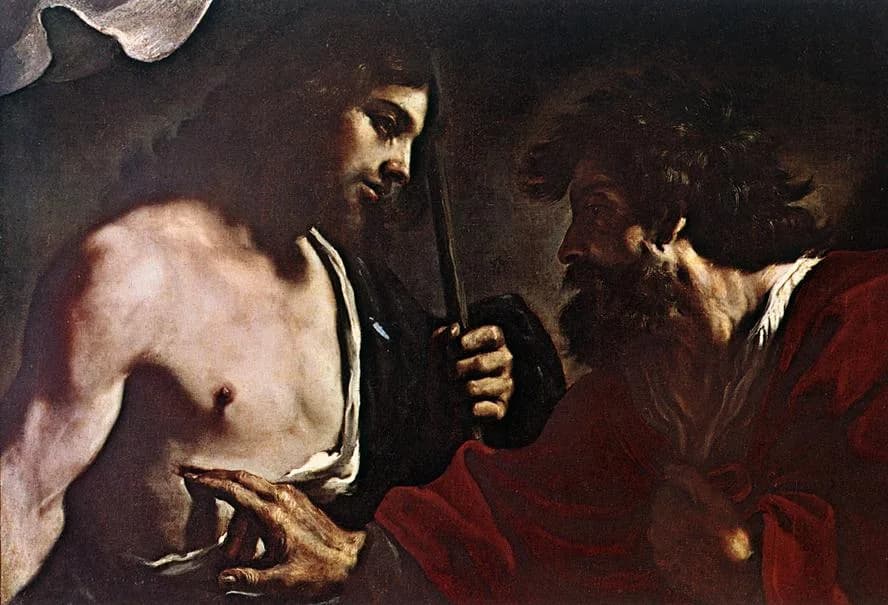
Thomas, one of the twelve disciples, was not present when Jesus first appeared to the others after His resurrection. When told about the appearance, Thomas expressed doubt and insisted on physical proof. Eight days later, Jesus appeared again and invited Thomas to touch His wounds, leading Thomas to believe and proclaim Jesus as his Lord and God.
Summary
The passage from the Gospel of John focuses on Thomas, one of Jesus’ twelve disciples, and his encounter with the resurrected Jesus. It addresses doubt and belief among Jesus' followers after his resurrection. Prior to this event, Jesus had appeared to the other disciples, but Thomas was not present (John 20:24). When the disciples told Thomas they had seen the Lord, he expressed skepticism and insisted that he needed to see and touch Jesus' wounds to believe (John 20:25).
Eight days later, the disciples gathered again, this time with Thomas among them. Despite the doors being shut, Jesus appeared in their midst and greeted them with peace (John 20:26). Jesus then addressed Thomas directly, inviting him to touch his wounds and encouraging him to believe rather than doubt (John 20:27). Thomas responded by acknowledging Jesus as "My Lord and my God" (John 20:28).
Jesus tells Thomas that he believes because he has seen, but those who believe without seeing are blessed (John 20:29). The passage emphasizes the virtue of faith without physical evidence. The primary conclusion of the passage in John 20:24-29 is that faith is a virtue that transcends the need for physical evidence. Thomas, one of Jesus' disciples, has an encounter that illustrates the shift from doubt to belief through direct experience. This moment captures Jesus' teaching that those who can believe without seeing are blessed (John 20:29). The narrative not only addresses the individual transformation of Thomas but also establishes a broader spiritual principle for all believers: faith without physical Confirmation is of great value.
Chiastic structure
ⓘJohn 20:24-25
“Except I shall see in his hands the print of the nails... I will not [believe].”
John 20:27
“Reach hither thy finger, and behold my hands... be not faithless, but believing.”
John 20:28-29
“Thomas answered... My Lord and my God... thou hast seen me, thou hast [believed].”
Both A and A' deal with the theme of belief based on seeing. In A, Thomas does not see and thus does not believe. In A', Thomas sees and believes, highlighting the transformation.
Interpretation and theological stakes
Continue reading with a Scholar plan
Upgrade to Scholar