Ruth 2-4 · Ruth · Updated April 25, 2026
Ruth & Boaz
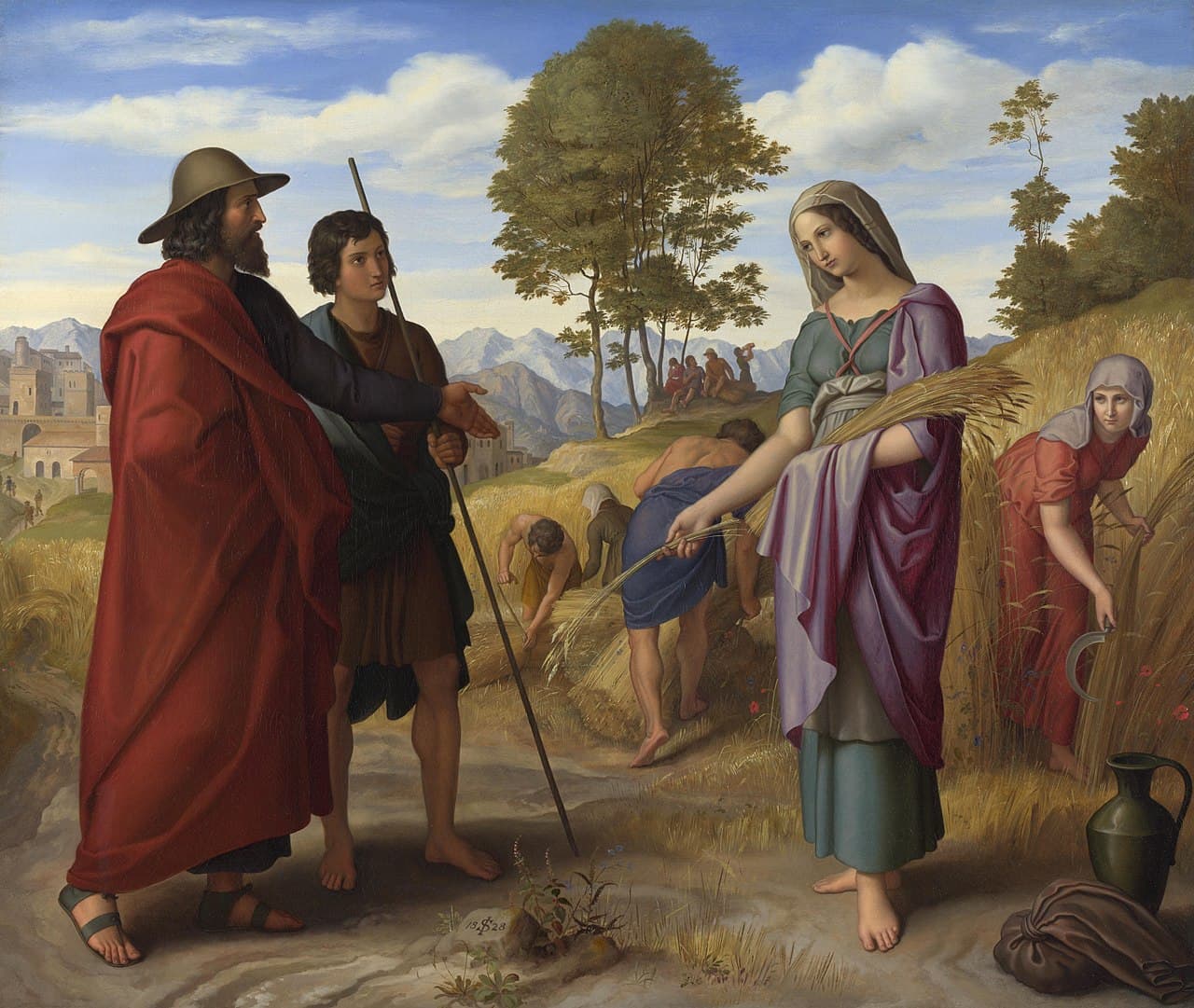
Ruth, a Moabitess, gleans in the fields of Boaz, a wealthy kinsman of Naomi's late husband. Boaz shows kindness to Ruth and eventually marries her, redeeming her and Naomi's family line. Ruth and Boaz have a son named Obed, who becomes the grandfather of David.
Summary
The passage from Ruth 2-4 is a key narrative in the Book of Ruth, detailing the union of Ruth and Boaz during the time of the judges in Bethlehem. Ruth, a Moabite widow, has returned with her mother-in-law, Naomi, to Bethlehem after the death of her husband, Mahlon. Naomi, who is also widowed, instructs Ruth to glean in the fields to gather food. Ruth happens to glean in the field of Boaz, a wealthy relative of Naomi's late husband, Elimelech (Ruth 2:3). Boaz notices Ruth and learns of her loyalty to Naomi, expressing kindness and protection towards her (Ruth 2:11).
Ruth continues to glean in Boaz's fields throughout the harvest season. Naomi devises a plan for Ruth to seek Boaz as a kinsman-redeemer, a relative who has the obligation to marry a widow to preserve the family line. Following Naomi's instructions, Ruth approaches Boaz at the threshing floor, uncovering his feet and lying down. When Boaz awakens, Ruth requests that he spread his garment over her, symbolizing his role as her redeemer (Ruth 3:9). Boaz acknowledges her request but mentions there is another kinsman closer in relation who must be consulted first. Boaz assures Ruth that he will resolve the matter promptly.
Boaz goes to the city gate to meet the closer kinsman and gathers ten elders as witnesses. He explains Naomi's situation and the need to redeem Elimelech's land, which includes marrying Ruth to maintain the family name. The closer kinsman declines, fearing it might endanger his own inheritance, allowing Boaz to step in as the redeemer (Ruth 4:10). Boaz marries Ruth, and they have a son named Obed, who becomes the grandfather of King David (Ruth 4:17). The passage concludes with the community blessing Naomi and acknowledging the significance of Ruth's loyalty and the continuation of Elimelech's lineage through Obed. The passage of Ruth 2-4 establishes the theme of loyalty and redemption. Ruth’s unwavering loyalty to Naomi leads her to glean in the fields of Boaz, a relative of Naomi's late husband. Boaz, recognizing Ruth's dedication and virtue, engages in the cultural practice of becoming a kinsman-redeemer, thereby restoring Naomi's family line. This narrative shows how personal devotion and adherence to social customs lead to communal blessings and the continuation of the family lineage, which links to the lineage of King David (Ruth 4:17).
Chiastic structure
ⓘRuth 2:20
“The man is near of kin unto us, one of our next kinsmen.”
Ruth 3:9
“Spread therefore thy skirt over thine handmaid; for thou art a near kinsman.”
Ruth 4:14
“Blessed be the LORD, which hath not left thee this day without a kinsman.”
Both A and A' highlight Boaz's role in providing for and redeeming Ruth and Naomi, culminating in the restoration of Naomi's family line.
Interpretation and theological stakes
Continue reading with a Scholar plan
Upgrade to Scholar