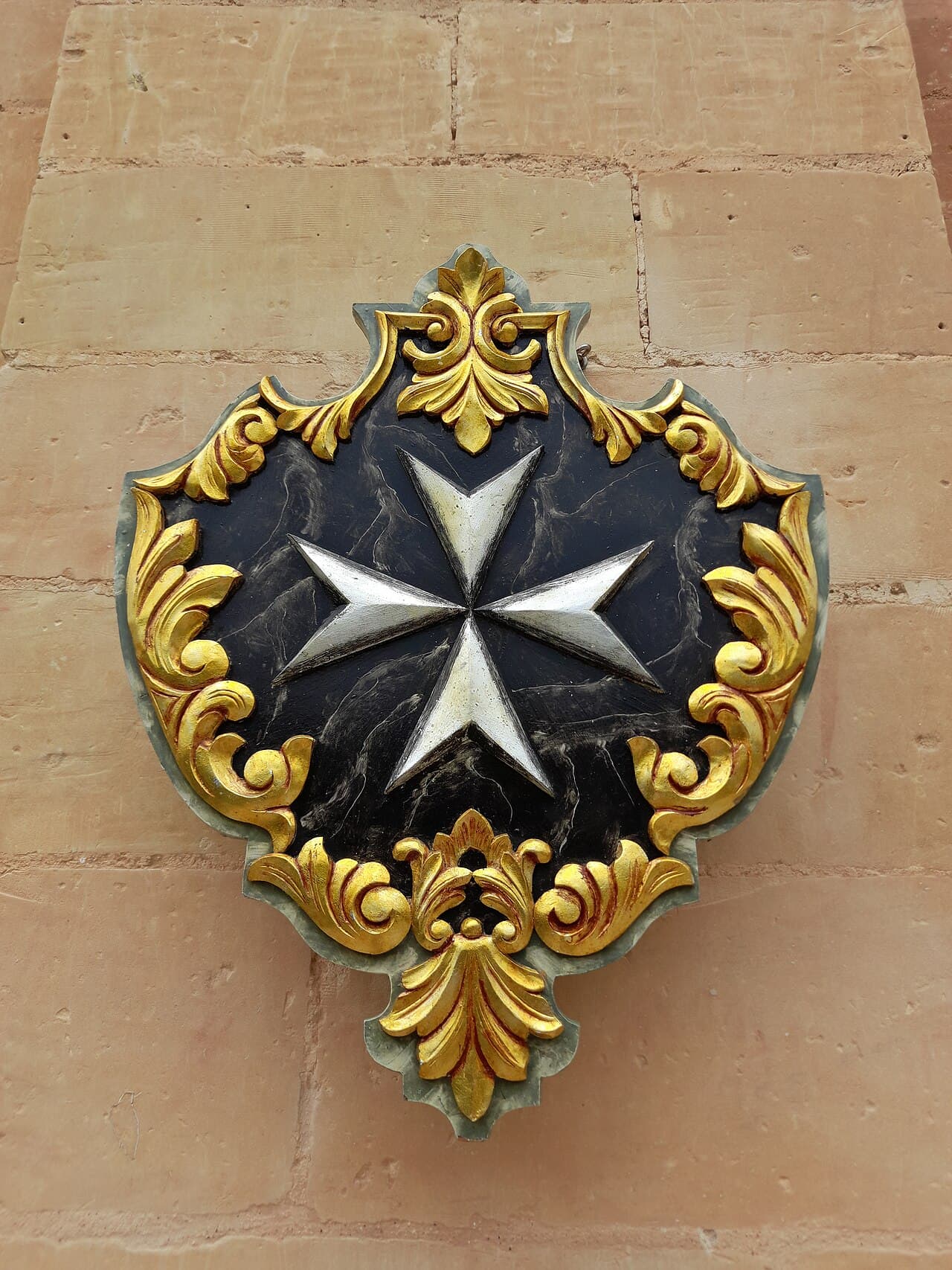
The Maltese Cross
Secret Societies · Updated August 15, 2026
Overview
The Maltese Cross as a distinct heraldic form did not exist during The Crusades; it developed in the 16th century, centuries after The Knights Hospitaller's founding, and most computer fonts render its Unicode code point as an entirely different cross patte. The Knights Hospitaller built their original hospital in Jerusalem around 1099 to serve sick pilgrims, and the cross eventually became their enduring signature. For a Christian reader, separating the historical facts from later myths strips away romantic legend to reveal a raw, biblical mandate of medical charity at work in the brutal medieval world.
The Order of St. John began with merchants from Amalfi funding a medical facility in the Holy City, a fact that gave the symbol its alternate name, the Amalfi cross. The specific eight-pointed heraldic design did not appear until the 1500s, when the order operated from Malta after surviving the collapse of the Crusader States. Its eight points represent the eight obligations of Christian charity: to live in truth, have faith, repent sins, give proof of humility, love justice, be merciful, be sincere, and endure persecution. Over the centuries, secular powers completely disconnected from the Hospitallers adopted the design for their own military awards. King Frederick I of Prussia slapped the shape onto his Pour le Mrite in 1740, the Polish White Eagle order used it in 1709, and the Bavarian Military Merit Order followed suit in 1866.
Scripture anchors the Hospitaller mission in direct, uncompromising commands. Christ identifies Himself directly with the destitute in Matthew 25:35-40, declaring that feeding the hungry and tending the sick is literal service to Him. James 2:14-17 reinforces this absolute standard, stating that faith without tangible works is dead. The Hospitallers embodied this dual vocation of military defense and hospital care, fulfilling Galatians 6:2's call to bear one another's burdens. A Bible reader should recognize the cross, despite its later heraldic evolution, as a marker of genuine faith expressed through concrete mercy. Christ treats this specific care for the sick and poor as a salvific criterion, not mere emblematic piety.
The eight points of the cross are widely believed to be an ancient Crusader-era symbol with fixed Beatitude correspondences, but this attribution was retroactively applied long after the 16th-century development of the heraldic form. Modern audiences buy into a fabricated medieval history for a shape created hundreds of years after the actual fighting ended. Even modern technology perpetuates a visual fraud regarding the emblem. Unicode code point U+2720 officially carries the name "Maltese cross," yet most computer fonts render this code as a cross patte, a visually different heraldic form with flared, rounded arms.
The Maltese cross as a distinct heraldic form did not exist during the Crusades; it developed in the 16th century, centuries after the Knights Hospitaller's founding, and most computer fonts render its Unicode code point as an entirely different cross pattée.