Bible study / Biblical figures / Daniel

Old Testament

Daniel

Babylonian and Persian exile (c. 605-535 BC)

faithfulness under persecutionapocalyptic visionprayerdivine sovereigntySon of Man

The Story of Daniel

Daniel, an Israelite of noble lineage, finds himself uprooted from Jerusalem around 605 BC during the Babylonian conquest led by Nebuchadnezzar II. The young Daniel, along with other promising Israelites, is taken to Babylon to be groomed for service in the king's court, as recounted in Daniel 1:1-7. Within this foreign empire, he navigates a world of political intrigue and shifting allegiances, marked by the constant tension between his faith and the demands of Babylonian society. The inciting rupture occurs when Daniel resolves not to defile himself with the royal provisions (Daniel 1:8), setting the stage for a life characterized by steadfast devotion amidst adversity.

Daniel's ability to interpret dreams quickly elevates his status in Nebuchadnezzar's court. The turning point comes when he interprets a perplexing dream of Nebuchadnezzar's, revealing a divine vision of successive empires (Daniel 2:1-49). This earns him favor and a high court position. Meanwhile, Daniel's companions, Shadrach, Meshach, and Abednego, face their own trial when they refuse to worship a golden idol, leading to their miraculous survival from a fiery furnace (Daniel 3:19-30). Throughout these events, Daniel's unwavering faith and insight into divine mysteries continue to distinguish him in a land of idol worship and political ambition.

The narrative reaches a critical juncture during the reign of Darius the Mede. Daniel's habit of praying three times a day (Daniel 6:10) becomes a target for his rivals, who manipulate Darius into issuing a decree that traps Daniel. Consequently, Daniel is thrown into a lions' den — a punishment for his defiance of earthly authority. Yet, in a dramatic reversal, the lions leave him unharmed, underscoring the divine protection over Daniel and leading to the king's recognition of Daniel's God as supreme (Daniel 6:16-23). The very decree intended to silence Daniel ultimately highlights the limitations of royal edicts and the enduring power of faith.

The resolution of Daniel's story extends beyond the lions' den. His apocalyptic visions, notably the vision of "one like a son of man" coming with the clouds of heaven (Daniel 7:13), offer a prophetic glimpse into future events and divine sovereignty. These visions echo throughout the New Testament, referenced in texts like Matthew 24:15 and Mark 13:14, where Jesus himself alludes to Daniel's prophecies. Daniel's life and visions thus reverberate through history, weaving a narrative of faith and divine revelation that transcends his time and place.

Who Was Daniel

In the tapestry of Daniel's life, the Hebrew word "חָכְמָה" (chokmah), meaning "wisdom," threads through his narrative, illuminating his actions and decisions. This wisdom manifests in Daniel 1:17, where it's noted that God grants him knowledge and skill in all literature and wisdom, alongside the unique ability to interpret dreams. Daniel's chokmah is not passive; it actively shapes his journey from an exiled Israelite youth to a revered figure in the courts of Babylon and Persia. This wisdom is evident as he navigates the complexities of foreign rule, interpreting dreams for kings Nebuchadnezzar and Belshazzar and offering insights into divine plans. Daniel's chokmah is a practical wisdom that enables him to uphold his faith, even as he serves in secular, often hostile, environments.
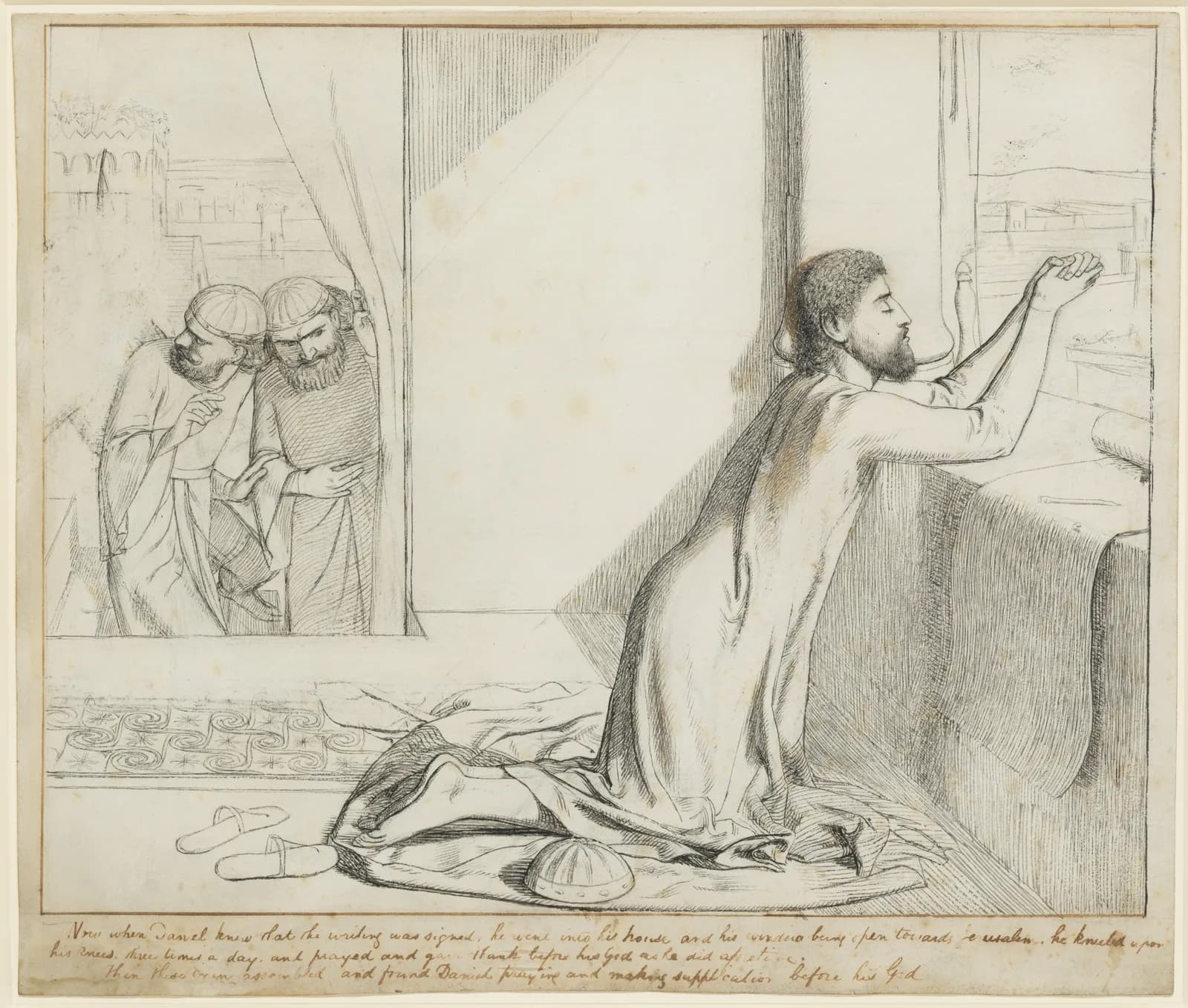
Daniel's life is marked by crucial decisions that reveal his deep commitment to his faith. One of the earliest occurs when he refuses the king's food and wine, choosing instead to adhere to his dietary laws (Daniel 1:8). This act underscores his dedication to God's commandments over cultural assimilation. Later, in interpreting Nebuchadnezzar's troubling dream, Daniel demonstrates reliance not on his own abilities, but on divine wisdom (Daniel 2:17-23). The contrast with Nebuchadnezzar, a king reliant on earthly power and pride, sharpens the understanding of Daniel's choices. Whereas Nebuchadnezzar seeks to impose his will, Daniel seeks divine insight, trusting in God's sovereignty. Most notably, Daniel's decision to continue praying despite a royal decree forbidding it (Daniel 6:10) highlights his prioritization of faith over personal safety. This act of defiance, for which he is thrown into a lions' den under King Darius, is an ultimate testament to his unwavering devotion.

Popular readings of Daniel often reduce him to a mere recipient of divine visions, overlooking his active role as a decision-maker and interpreter. This simplification misses the agency and wisdom Daniel exercises in each phase of his life. Rather than being a passive vessel, Daniel actively seeks understanding, prays for revelation, and courageously stands by his convictions. His story is often told as one of miraculous survival and prophetic vision, yet the text reveals a nuanced portrait of a man whose chokmah guides him through perilous waters and foreign courts. Daniel's life is not merely about what he sees, but what he chooses to do with what he understands, a distinction that deepens his legacy beyond simple narratives of divine intervention.

The Significance of Daniel

The Book of Daniel argues that God's sovereignty, or מַלְכוּת אֱלֹהִים (Malkhut Elohim), extends over all earthly kingdoms. This is vividly demonstrated through God's ability to deliver Daniel from the lion's den and reveal future events through apocalyptic visions. Central to this narrative is the assertion that God controls history and empires, as underscored in Daniel 2:21, where it is declared that God "changes times and seasons; he deposes kings and raises up others." The book's apocalyptic visions, such as the vision of four great beasts in Daniel 7, underscore the ultimate victory of God's kingdom over human dominions, culminating in the arrival of "one like a son of man" who is given eternal authority (Daniel 7:13).

Several key themes emerge from Daniel's story, reflecting theological points about faith and divine power. One prominent theme is faithfulness under persecution. Daniel 6:10 exemplifies this when Daniel continues his practice of praying three times a day despite a royal decree prohibiting prayer to anyone but King Darius. This act of defiance underscores his unwavering dedication to God, even when faced with the threat of death. Another theme is apocalyptic vision, which unfolds through Daniel's dreams and visions that predict the rise and fall of empires and the eventual establishment of God's eternal kingdom (Daniel 7:13-14). The Son of Man vision, in particular, serves as a prophetic pointer to a divine figure with everlasting dominion, a theme that resonates throughout the New Testament as Jesus refers to Himself using this title (Matthew 24:30). Additionally, Daniel's deliverance from the lion's den is viewed in Christian typology as a foreshadowing of Christ's resurrection, suggesting a parallel between Daniel's emergence unharmed and Christ's victory over death (Daniel 6:22).

While Daniel's story primarily focuses on God's dealings with Israel, it also touches on broader themes that intersect with the wider Biblical narrative. The vision of the Son of Man, for instance, has profound implications for the Messianic expectation, as it points to the figure who will be granted dominion over all nations. This intersection is highlighted when Jesus adopts the title "Son of Man" in the Gospels, drawing directly from Daniel's vision to assert His divine authority (Mark 14:62). Daniel's role as a court official in Babylon — serving kings like Nebuchadnezzar and Darius — places him at a unique intersection between the Jewish exilic experience and the Gentile world. His ability to interpret dreams and reveal God's will to these foreign rulers underscores the theme of divine sovereignty reaching beyond Israel's borders. The narrative concludes with a firm detail: Daniel's steadfastness in prayer, as he continues his routine of kneeling three times a day, a testament to his unwavering faith and the unchanging sovereignty of the God he serves (Daniel 6:10).

The Legacy of Daniel

In Jewish tradition, Daniel is a figure of considerable reverence, though not classified among the Nevi'im, or Prophets, in the Hebrew Bible. Instead, his story finds its place in the Ketuvim, the Writings, reflecting a nuanced understanding of his role. The Talmud, particularly in Sanhedrin 93a, highlights Daniel's wisdom and righteousness, portraying him as a paragon of piety and faithfulness during the Babylonian exile. His story is particularly resonant during the fast of the Tenth of Tevet, a day commemorating the siege of Jerusalem, where his example of steadfastness under duress is held up as inspiration. The Midrash expands on Daniel’s attributes, often framing him as a model for Jews living in diaspora, emphasizing the importance of maintaining faith and identity in foreign lands.

In Christian theology, Daniel has been interpreted through various lenses over the centuries. Early Church Fathers like Jerome and Augustine saw Daniel as a type of Christ, particularly in his apocalyptic visions which were thought to prefigure the coming of Jesus and the eschatological end times. Jerome's commentary on the book of Daniel connects the "Son of Man" reference in Daniel 7:13 with Christ, a typological reading that echoes through Christian eschatology. During the Reformation, figures like Martin Luther highlighted Daniel’s unwavering faith and divine insight, presenting him as a model for Christians facing persecution. The book’s emphasis on divine sovereignty and faithful prayer made it a touchstone for Protestant interpretations, particularly during Advent, when themes of hope and divine intervention are prominent.

Daniel’s influence extends beyond religious texts into broader cultural spheres. The phrase "the writing on the wall," originating from Daniel 5:5, has entered common parlance, symbolizing an ominous or inevitable fate. Artists like Rembrandt have drawn inspiration from Daniel's narrative, as seen in "Belshazzar's Feast," capturing the drama and divine judgment depicted in the text. In literature, George Eliot’s novel "Daniel Deronda" reflects on themes of identity and destiny, drawing indirect inspiration from Daniel's story of exile and revelation. In contemporary times, Daniel's narrative touches a chord with those navigating the complexities of maintaining integrity and faith in challenging environments, making his story relevant to discussions about personal and communal resilience in the face of adversity.