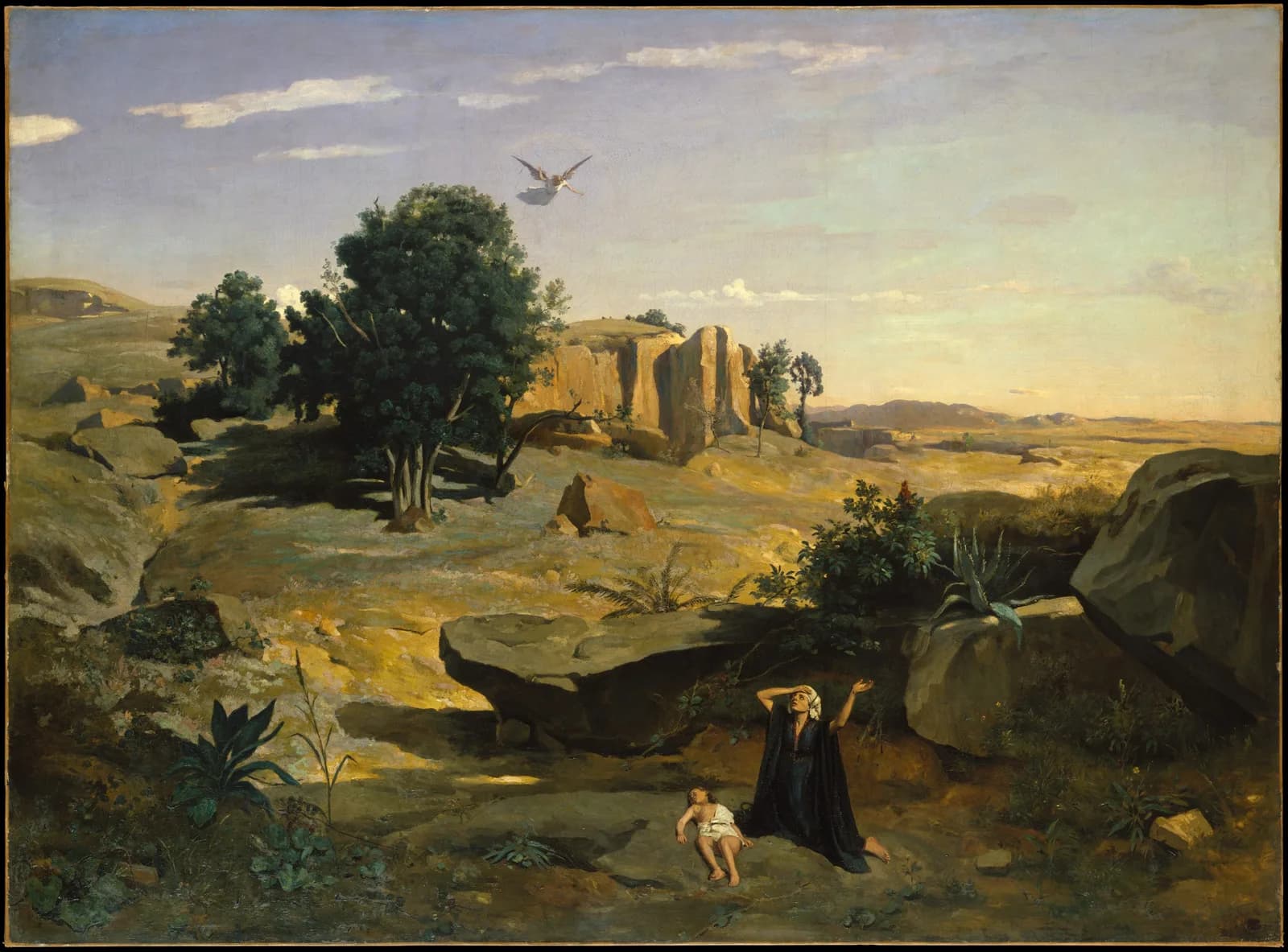
The Story of Hagar
Around 2000 BC, during the patriarchal period when tribal and familial clans roamed Canaan, Hagar emerges as a figure caught in the web of divine promise and human ambition. An Egyptian servant to Sarah, the wife of Abraham, Hagar's life is defined by her status and her relationships within this nomadic household. When Sarah remains childless, she offers Hagar to Abraham as a concubine, hoping to build a family through her (Genesis 16:1-2). This decision, intended to fulfill God's promise of descendants to Abraham, sets the stage for a complex interplay of power, jealousy, and divine intervention. When Hagar conceives, the household dynamic shifts, marking the beginning of her tumultuous journey.
Hagar's pregnancy incites Sarah's jealousy, leading to harsh treatment that forces Hagar to flee into the wilderness (Genesis 16:6). Here, Hagar encounters an angel of the Lord, a moment that alters the course of her life. The angel delivers a message of hope and promise, telling her that her descendants will be too numerous to count and instructing her to name her son Ishmael, meaning "God hears" (Genesis 16:10-11). In this encounter, Hagar becomes the first person in the Bible to receive a divine promise of numerous descendants, a blessing typically reserved for the patriarchs.
The situation changes following the birth of Isaac, Sarah's own son with Abraham. Sarah demands that Abraham expel Hagar and Ishmael, fearing for Isaac's inheritance (Genesis 21:14). This demand leads to Hagar and her son wandering in the desert of Beersheba, a perilous journey that places their survival at risk. In their moment of desperation, God hears the cries of Ishmael, and an angel once again intervenes, directing Hagar to a well of water (Genesis 21:17-19). This act of divine provision not only saves their lives but reaffirms God's promise to Hagar that Ishmael will become a great nation.
Hagar's story concludes with her and Ishmael's survival in the desert and Ishmael's eventual role as the progenitor of a great nation, as promised. Her narrative extends beyond the Old Testament, receiving mention in the New Testament as an allegory in Paul's letter to the Galatians (Galatians 4:24-25). This reference places Hagar within the broader theological discourse, highlighting the enduring impact of her story. Hagar's legacy is thus etched into the biblical narrative, illustrating the unexpected ways in which divine favor and human struggle intersect. The Hebrew word "רֹאִי" (Ro'i), meaning "seeing," captures the essence of Hagar's story. In Genesis 16:13, Hagar names God "El-Roi," acknowledging Him as "a God of seeing." This moment occurs after she flees into the wilderness to escape her harsh treatment by Sarah, her mistress. An angel of the Lord finds her by a spring and speaks to her, a divine encounter that highlights her resilience and perceptiveness. Hagar is not merely a passive recipient of divine intervention; she actively recognizes and names her experience of God's attentiveness. As an Egyptian servant in the household of Abraham and Sarah, Hagar occupies a precarious position, yet her story is marked by moments of agency and survival, particularly as the mother of Ishmael, Abraham's first son.