Christian Charity in the Modern World
Christian Charity · Updated August 15, 2026
Overview
In Matthew 25, Christ identifies Himself so completely with the poor and suffering that charitable acts toward the needy are treated as acts done directly to God Himself, making charity not merely kindness but a sacramental encounter with Christ. This claim stands at the center of Christian Charity in the Modern World, defining the entire enterprise of Christian mercy. For a Christian reader, understanding this concept matters because it separates biblical duty from optional goodwill. Christ does not ask His followers to be nice; He commands them to serve Him directly through the destitute, the alien, and the convict. Charity functions as the non-negotiable evidence of authentic faith.
The theological tradition treats charity as a supernatural virtue uniting love of God and love of neighbor into a single act. Thomas Aquinas defined charity as "the friendship of man for God" and held it as the most excellent of the virtues, teaching that this friendship extends necessarily to love of neighbor. The Catholic Church codifies this directly in its Catechism, defining charity as the theological virtue by which a person loves God above all things for His own sake, and loves his neighbor as himself for the love of God. Scripture and church history present this virtue as the visible proof of divine love operating within the believer. From the apostolic church's communal sharing in Acts 2 to the medieval establishment of hospitals, leprosaria, and orphanages by groups like the Franciscans and the Dominicans, charity has always served as the defining public mark of Christian authenticity. To withhold material help from a brother in need while professing love of God is, per 1 John 3:17, evidence that God's love does not actually dwell in that person.
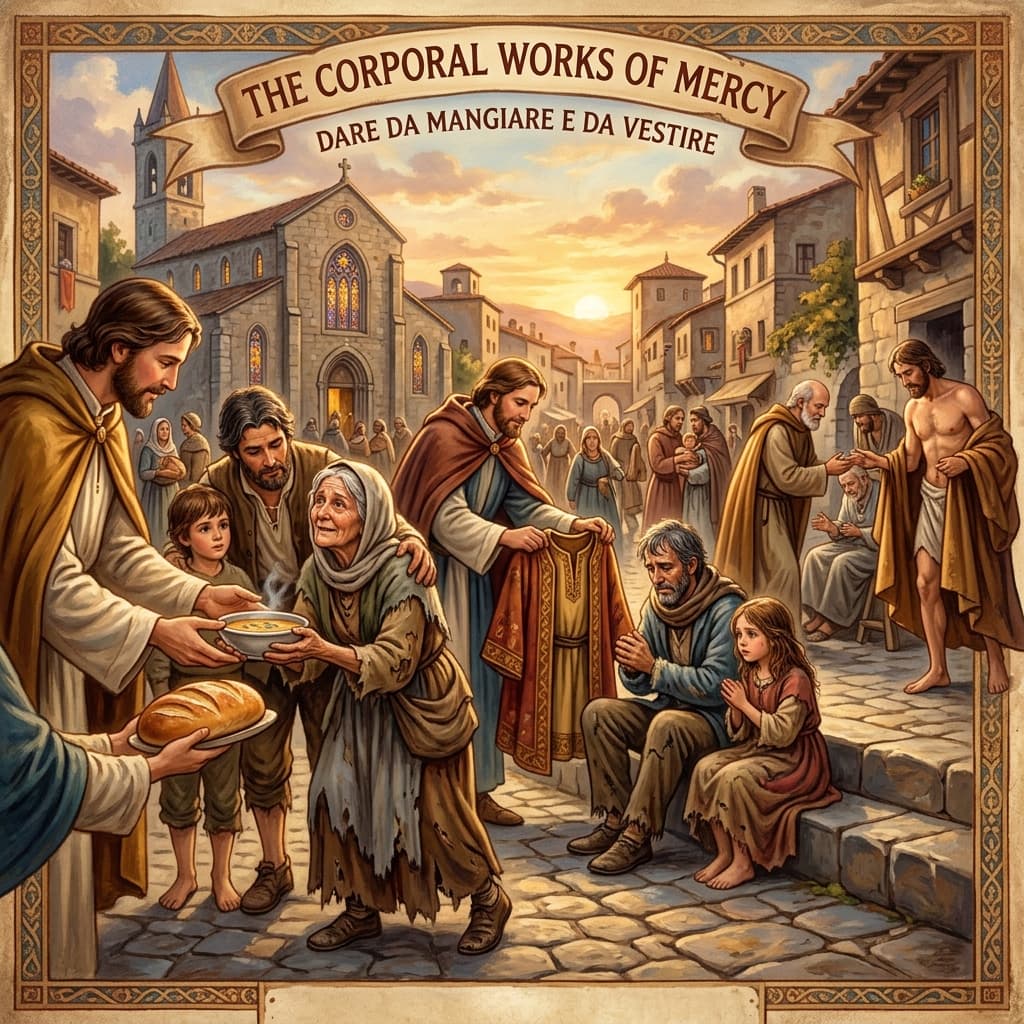
The biblical text is uncompromising on this point. Matthew 25:35-40 presents charitable works as the sole criterion of the Last Judgment, where Christ separates the righteous from the damned based on whether they fed the hungry, gave drink to the thirsty, sheltered strangers, clothed the naked, and visited the sick and imprisoned. Christ declares that any act done to the least of His brethren is done directly to Him. James 2:17 flatly states that faith without works is dead, making charitable action a necessary component of saving faith. This passage drove intense debates during The Reformation, with Catholic and Orthodox theology reading it as proof that charity constitutes faith rather than merely acting as its fruit. Galatians 6:2 frames bearing others' burdens as fulfilling the law of Christ, while Isaiah 58:6-7 and Proverbs 19:17 root this expectation in the Old Testament, where feeding the hungry and sheltering the poor are treated as true worship and even as lending to God Himself. A Bible reader must conclude that faith without concrete works of mercy is a fraud.
The most common misunderstanding equates Christian charity with generic humanitarian goodwill, when in fact the biblical and theological tradition defines it as a supernatural virtue whose first object is God Himself, with love of neighbor flowing from and ordered toward love of God. This distinction separates Christian charity from secular philanthropy entirely. A person can feed the hungry out of pure social sentiment, but Christian charity demands that the believer recognize Christ in the recipient. Organizations like the Salvation Army and the St. [[Vincent de Paul Society]] operate precisely on this theological foundation, treating every soup kitchen line and homeless shelter as a direct encounter with the divine.
In Matthew 25, Christ identifies Himself so completely with the poor and suffering that charitable acts toward the needy are treated as acts done directly to God Himself, making charity not merely kindness but a sacramental encounter with Christ.