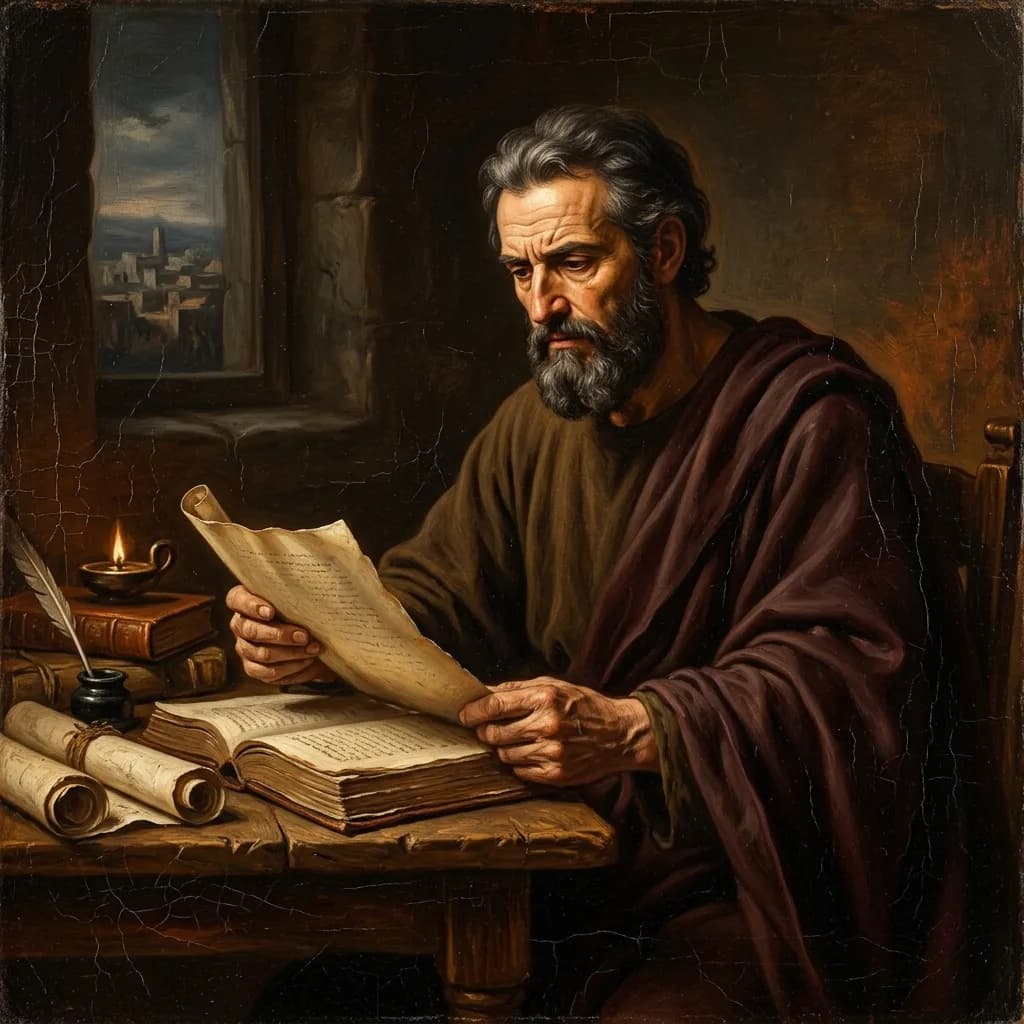
Aetius of Antioch
hereticNicene Era (4th C) · c. 313-367 CE · Updated April 9, 2026
Biography
Aetius of Antioch was a deacon and radical Arian theologian active in Antioch and Alexandria during the Nicene Era of the 4th century. He was known for advocating Anomoeanism, a theological position asserting that the Son is entirely unlike the Father in essence. This view set him apart in a time when the Christian Church grappled with defining the nature of Christ and the Trinity. His commitment to these ideas made him a notable figure in the early Church, despite the controversies that surrounded him.
Born around 313 CE, Aetius spent his life embroiled in theological disputes. He served as a deacon, a role of considerable influence within the early Church. His teachings, however, led to his condemnation at the Council of Constantinople in 360 CE. Aetius's views were considered too radical, earning him multiple exiles as church authorities sought to suppress his influence. Throughout his career, Aetius maintained that the Father could be understood through reason alone, a stance that challenged prevailing beliefs about divine mystery.
The Nicene Era was a time of intense theological debate. The Arian controversy, questioning the divinity of the Son, left room for interpretations like Anomoeanism. In this environment, Aetius's radical views gained both followers and opponents. The struggle to define orthodoxy was fierce, and figures like Aetius played pivotal roles. The Council of Constantinople's condemnation of his teachings underscored the deep divisions within the early Church. This period laid the groundwork for future theological development, highlighting the complexities of early Christian doctrine.
Is the Son's nature entirely unlike the Father's — and if God is fully knowable by human reason, what becomes of divine mystery?
The question
Aetius of Antioch believed deeply in the teachings of Lucian of Antioch. Lucian emphasized a radical interpretation of the Son's distinct nature from the Father. Aetius was convinced by Scripture and reason that the Son was entirely different from the Father. He saw a clear line between the created and the uncreated. His focus was on maintaining the transcendence of God. He wanted to preserve God's absolute uniqueness. For Aetius, the Son could not be of the same essence as the Father. He saw this as a logical necessity, a way to protect the true nature of God from being compromised.
If the Son's nature is entirely unlike the Father's, the Son is not divine in the same way. This creates a hierarchy. The Father is supreme, and the Son becomes a creation, not a co-equal. This stance shatters the traditional understanding of a unified Godhead. It leaves believers with a fragmented understanding of divine nature. The unity between Father and Son dissolves, challenging centuries of theological thought. The price is steep: it redefines the core relationship within the divine, altering the essence of the faith.
If God is fully knowable by human reason, divine mystery vanishes. Faith transforms into a purely rational exercise. Revelation and tradition lose their grip. The divine becomes subject to human intellect, stripped of awe and wonder. God turns into an object for intellectual study. What is left is a faith devoid of mystery and reliant on human logic alone. This costs the believer the sense of divine transcendence. It risks reducing the spiritual journey to a series of intellectual puzzles, devoid of deeper meaning and connection.
Aetius's rationalism and emphasis on the distinct nature of the Son trapped him. He could not reconcile this with the unity of the Godhead and the mystery of faith. The church could not abandon the coherence of divine unity or the profound mystery of faith. For ordinary believers, this debate shaped how they understood Christ and their relationship with God. It influenced prayer and worship. The nature of the Son affected how accessible Jesus felt in spiritual life. The debate wasn't just theological; it touched the core of how people related to their faith daily.
The teaching
Aetius of Antioch taught that the Son is entirely unlike the Father in essence. He claimed that the Son is of a different and lesser nature. For Aetius, the Father is the ultimate source, and the Son, being begotten, must differ fundamentally. Aetius rejected the idea that divine mystery shrouds God. He believed that human reason could pierce the veil, making God fully comprehensible.
Aetius built his case with both logic and scripture. He argued that because the Father is the source of all, any being begotten by Him, including the Son, must be of a separate nature. Aetius cited John 14:28, where Jesus says, "the Father is greater than I," to support his point. He also referenced Proverbs 8:22, interpreting it to mean the Son was the first of God's creations, thus distinct in essence. In 1 Corinthians 8:6, Aetius saw further evidence of the Father's unique status. He laid out these arguments in his treatise, "Syntagmation," using systematic reasoning to challenge the Nicene Creed's assertions.
Aetius’ teachings attracted those frustrated with the Nicene Creed's mysteries. Intellectuals and philosophers, seeking clarity and reason, found his arguments compelling. His ideas spread among those who valued a rational approach to faith, though they remained controversial. Aetius' teachings became a touchstone for a faction known as the Anomoeans, who insisted on the Son's dissimilarity to the Father. By the mid-fourth century, his influence had reached various parts of the Eastern Roman Empire, leaving a mark on theological debates of the time.
The counterargument
The case against Aetius of Antioch rested on a crucial point: his claim that the Son is entirely unlike the Father shatters the unity of the Godhead. This position contradicts the scriptural affirmation of the Son's divinity. Basil of Caesarea, a prominent bishop and theologian, articulated this decisive argument. In his treatise "Against Eunomius," he argued that the Son shares the same essence with the Father. By emphasizing the unity and co-equality within the Trinity, Basil highlighted how Aetius’s views undermined the core Christian understanding of the divine nature as unified and co-equal.
Aetius's interpretation of scripture further weakened his stance. He cited John 14:28, "The Father is greater than I," to argue for the Son's lesser nature. The orthodox response clarified that this passage refers to the Son's incarnate state, not His divine essence. Similarly, Aetius pointed to Proverbs 8:22, "The Lord created me at the beginning of his work," claiming it showed the Son was a created being. Orthodox interpreters countered that this verse metaphorically speaks of Wisdom, prefiguring Christ's incarnation, not His divine nature. Finally, he used Colossians 1:15, "the firstborn of all creation," as evidence of the Son's created status. The orthodox view held that "firstborn" signifies preeminence, not temporal creation. Aetius's claim that God is entirely knowable by reason alone contradicted Christian teachings on divine mystery, which affirm that God's essence transcends human comprehension.
The counter-argument against Aetius required a deeper exploration of the Trinity's mystery, a complex doctrine. While it reinforced the unity and equality within the Godhead, it left unresolved questions about how the distinct persons of The Trinity relate while maintaining unity. This challenge continued to shape theological debates. Despite these complexities, the rejection of Aetius's views solidified the orthodox understanding of The Trinity, which remains a foundational Christian doctrine to this day.
The resolution
In 360 CE, the Council of Constantinople convened at the behest of Emperor Constantius II. Bishops from across the empire gathered in the bustling city to grapple with a theological conundrum that had divided Christians: the relationship between the Father and the Son. Constantius, a leader who understood the power of unity, had a pragmatic goal. He aimed to stabilize his empire by resolving this theological dispute, which had spilled into political and social realms. By leaning towards the semi-Arian position, Constantius sought to create a middle ground that could unify disparate factions. This wasn't just about theology; it was about maintaining control and cohesion in a fractured empire.
The council's central debate focused on the contrasting views of the Anomoeans and the semi-Arians. Aetius led the Anomoeans, who claimed the Son was entirely unlike the Father. This stance clashed with the semi-Arians, who argued the Son was similar to the Father but not of the same essence. The words "anomoios" and "homoiousios" became battlegrounds, as their meanings shaped the understanding of the divine nature and Trinity. The council ultimately condemned the Anomoean position as heretical, marginalizing it in favor of the semi-Arian view. This decision rejected the notion that the Son was utterly dissimilar to the Father, aiming to consolidate a more moderate theological stance.
Yet, the Council of Constantinople did not put an end to the Arian controversy. The debates simmered and flared, with the Nicene Creed's affirmation of the Son's same essence with the Father still unresolved. This theological tug-of-war persisted, fueling further councils and divisions. The Anomoean movement, though condemned, continued to influence regions and discussions. It wasn't until the First Council of Constantinople in 381 CE that the Nicene Creed was fully reaffirmed, closing the chapter on this particular theological debate. Despite the 360 CE council's efforts, the question of essence continued to shape the church's history for years to come.
Legacy
After his condemnation at the Council of Constantinople in 360 CE, Aetius of Antioch faced exile multiple times. His radical views, particularly his belief that God's essence was entirely unlike anything else, positioned him at odds with the prevailing church authorities. Despite these setbacks, Aetius returned to Antioch, where he resumed teaching until his death in 367 CE. His presence remained a source of controversy, as he continued to challenge the theological status quo. Aetius's life was marked by a persistent clash with the church, which saw his teachings as a threat to their developing orthodoxy.
Aetius's ideas did not die with him. His disciple, Eunomius, took up the mantle and became a key figure in the Anomoean movement. This movement rejected the Nicene Creed's assertion of Christ's consubstantiality with the Father and instead promoted a stark understanding of God's nature as entirely distinct. Eunomius's influence helped the Anomoeans gain a foothold in parts of the Eastern Roman Empire, particularly in regions resistant to Nicene orthodoxy. Although the movement eventually waned, its challenge to mainstream Christian doctrine lingered, reflecting the enduring impact of Aetius's teachings.
Today, traces of Aetius's legacy appear in modern Unitarian and non-trinitarian Christian groups. These communities emphasize rational understanding over doctrinal mystery, echoing Aetius's insistence on human reason's capacity to grasp divine truths. Beyond religious circles, this approach finds resonance in secular philosophies that treat religious mysteries as subjects for rational inquiry. Aetius's legacy, therefore, persists not only in religious debate but also in broader philosophical discussions about the nature of understanding and belief.
Continue reading with a Scholar plan
Upgrade to ScholarCommon questions
- Why was Anomoeanism considered dangerous?
- Anomoeanism was considered dangerous because it challenged the core Christian doctrine of the Trinity by asserting that the Son was entirely unlike the Father. This undermined the unity and co-equality of the Trinity, threatening the theological foundation of the Church and potentially dividing the Christian community.
- What exactly did Aetius of Antioch teach?
- Aetius of Antioch taught that the Son was of a different and lesser nature than the Father, emphasizing that the Son was entirely unlike the Father in essence. He argued that the Father was knowable by reason alone, which contradicted the orthodox view of the Trinity as a mystery of faith.
- Why did Anomoeanism spread so widely?
- Anomoeanism spread widely due to the support of influential leaders like Eusebius of Nicomedia and the political backing of certain Roman emperors who favored Arianism. Its appeal also lay in its rational approach to understanding the divine, which resonated with some intellectual circles of the time.
- Who opposed Aetius of Antioch, and what was their argument?
- Aetius of Antioch was opposed by orthodox theologians like Athanasius of Alexandria, who argued that his teachings denied the co-equality and consubstantiality of the Son with the Father. They maintained that this view distorted the true nature of the Trinity and threatened the unity of the Church.
- Was Aetius of Antioch excommunicated, exiled, or executed?
- Aetius of Antioch was exiled multiple times due to his teachings and the controversies they sparked. He was not executed, but his views led to his condemnation and marginalization within the Church.
- Which council condemned Anomoeanism, and what did it decide?
- The Council of Constantinople in 360 CE condemned Anomoeanism. It decided that the Son was of the same essence as the Father, reaffirming the Nicene Creed and rejecting the Anomoean view that the Son was entirely unlike the Father.
- Did Aetius of Antioch ever recant?
- Aetius of Antioch did not recant his views. He remained steadfast in his beliefs despite condemnation and exile, continuing to advocate for Anomoeanism until his death.
- What is the difference between Anomoeanism and orthodox Christianity?
- The main difference is that Anomoeanism asserts that the Son is entirely unlike the Father in essence, while orthodox Christianity holds that the Father, Son, and Holy Spirit are of the same essence and co-equal. This distinction affects the understanding of the Trinity and the nature of Christ.
- Are there modern versions of Anomoeanism?
- Modern versions of Anomoeanism are not prevalent, as the doctrine was largely suppressed by the early Church. However, some modern groups may hold similar views that emphasize the distinctness and subordination of the Son to the Father.
- Is there anything Aetius of Antioch got right?
- Aetius of Antioch's emphasis on reason and logical analysis in theology highlighted the importance of intellectual engagement with faith. While his conclusions were deemed heretical, his approach encouraged deeper exploration of theological concepts.
- Why does Anomoeanism still matter today?
- Anomoeanism matters today as a historical example of the challenges in defining and maintaining doctrinal orthodoxy. It serves as a reminder of the complexities involved in theological debates and the importance of balancing reason and faith in religious discourse.
- Why did Aetius of Antioch sincerely believe his position was correct? What was he actually defending — and why did he see the alternatives as worse?
- Aetius of Antioch believed his position was correct because he valued a rational understanding of the divine, which he thought was more coherent and defensible. He was defending the idea that the divine nature could be comprehended through reason, seeing the alternatives as obscuring the truth with mystery and undermining the logical consistency of the faith.