Library
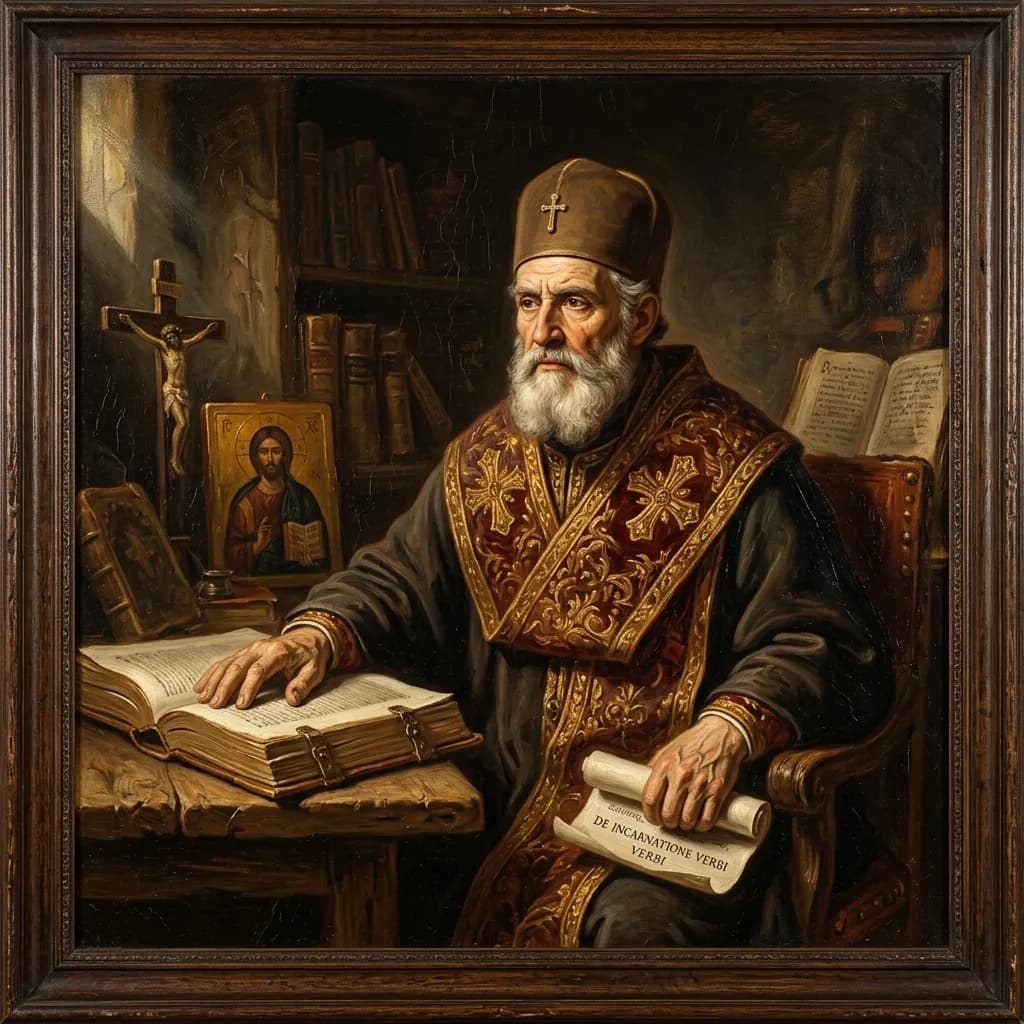
AI-generated illustration
Library
Nicene Era (4th C) · c. 310-390 CE · Updated April 9, 2026
Apollinaris of Laodicea was a 4th-century bishop in Laodicea, known for his role in the Nicene Era and his controversial theological position known as Apollinarianism. During a time when the Christian church faced intense debates over the nature of Christ, Apollinaris emerged as a significant figure. He worked alongside notable defenders of Nicene orthodoxy, such as his friend Athanasius, to uphold the creed established to unify Christian doctrine. Yet, his unique views on Christ's nature stirred controversy within the church.
Born around 310 CE, Apollinaris became the bishop of Laodicea, a city located in what is now modern-day Turkey. His intellectual pursuits led him to propose that Christ had a human body and soul but no human mind or spirit. Instead, he argued that the divine nature took the place of the human rational soul. This theological stance, aiming to emphasize the divinity of Christ, deviated from the emerging consensus. The First Council of Constantinople in 381 CE condemned his views, marking a significant moment in his career and the broader history of Christian theology.
The 4th century was a period of intense theological debate, particularly about the nature of Christ and the Trinity. The Nicene Creed, established in 325 CE, sought to address and unify these doctrinal disputes, but interpretations like Apollinarianism highlighted the complexities involved. The core question Apollinaris posed — whether Christ had a fully human mind and will — was crucial for understanding salvation and the incarnation. These debates were not just academic; they were believed to have eternal implications. The First Council of Constantinople's condemnation of Apollinarianism underscores the church's commitment to a vision of Christ as fully human and fully divine.
Did Christ have a fully human mind and will, or did his divine nature replace the human rational soul — and what does the answer mean for salvation?
Apollinaris of Laodicea watched the turmoil of the Arian controversy with a keen eye. The arguments over Christ's nature demanded clarity. He insisted on the unity of Christ's divine and human natures. To him, this was more than theological hair-splitting. It was about preserving the integrity of salvation. Apollinaris believed that if Christ were not wholly divine, the promise of salvation faltered. He feared that dividing Christ's natures risked a savior who could falter and fail. His conviction was genuine: Christ must be one undivided being, fully divine to ensure the Salvation of humanity.
If Christ possessed a fully human mind and will, then he carried the potential for sin and human frailty. This position required acknowledging that the divine and human natures in Christ were distinctly separate. Such a division suggested a Christ who could succumb to human weaknesses. It meant risking the divine perfection necessary for a savior. The assurance of a sinless, wholly divine Christ was at stake. This view compromised the divine nature with the imperfections of humanity, threatening the core of Salvation itself.
On the other hand, asserting that Christ's divine nature replaced the human rational soul meant safeguarding his divinity. In this view, Christ could not sin. He was untouched by human flaws. But this came at a significant cost. It denied Christ's full humanity. Without a human mind and will, Christ could not fully share in human experiences and suffering. This detachment risked making him distant and unrelatable to those he came to save. The completeness of human Salvation hung in the balance, as Christ's capacity to truly empathize with humanity was in question.
The trap lay in the commitment to uphold both Christ's full divinity and full humanity. The early church could not sacrifice either without undermining salvation. For ordinary believers, this debate shaped their relationship with Christ. It influenced their understanding of his empathy and power. In prayer and liturgy, they needed assurance that Christ was both intimately familiar with their struggles and divinely capable of saving them. The tension between divinity and humanity was not just theological; it was deeply personal and vital to their faith.
Apollinaris of Laodicea taught that Christ possessed a human body and soul but lacked a human mind or spirit. He proposed that Christ's divine nature replaced the human rational soul, meaning Christ did not have a fully human mind. This view challenged the idea that Christ was entirely human, suggesting instead a unique blend of humanity and divinity. Apollinaris's teaching aimed to protect the divine purity of Christ, ensuring that his nature remained untainted by human failings.
Apollinaris argued that if Christ had a human mind, it would open the door to sin and error, which would undermine his divine nature. He believed that a divine mind was essential for Christ to remain sinless and achieve salvation for humanity. In his treatise "On the Union in Christ of the Body with the Godhead," Apollinaris used scriptures like John 1:14 and Philippians 2:7 to support his position. He interpreted these passages to mean that while Christ took on human flesh, he did not take on a fallible human mind. Hebrews 4:15, he argued, confirmed that Christ's sinlessness came from a divine mind, which could not err.
Apollinaris's teaching resonated with those worried about preserving Christ's sinlessness and divine authority. His ideas spread among Christians who feared that a fully human mind in Christ might dilute his divinity and weaken salvation's power. Despite its appeal, the Church eventually rejected his teaching, favoring a Christology that affirmed both Christ's full humanity and divinity. Apollinaris's views, while influential, ultimately faced official condemnation at the First Council of Constantinople in 381 CE.
The decisive argument against Apollinaris of Laodicea centered on the necessity for Christ to possess a fully human mind to achieve full human redemption. Apollinaris taught that Christ had a divine mind and not a human one, suggesting an incomplete incarnation. Gregory of Nazianzus countered this by asserting that for salvation to be complete, Christ must assume all aspects of human nature, including the rational soul. Gregory encapsulated this in his famous saying, "what has not been assumed has not been healed," found in his Letter 101 to Cledonius the Priest. This argument effectively dismantled Apollinaris's position by highlighting that without a complete human nature, Christ could not fully redeem humanity.
Apollinaris relied on scriptural passages like John 1:14, Philippians 2:7, and Hebrews 2:14 to support his view. He interpreted these texts to mean that Christ's incarnation involved only a physical body, not a complete human nature. The orthodox response reinterpreted these scriptures to emphasize that the Word becoming flesh involved assuming a full human nature, not just a physical form. For instance, the term 'flesh' in John 1:14 was argued to signify the whole human being. Additionally, Philippians 2:7's reference to Christ 'emptying' himself was seen as a sign of his complete entry into human experience, including a rational soul. Hebrews 2:14 underscored Christ's full participation in human nature to defeat death. The trap in Apollinaris's argument lay in its internal contradiction: by denying Christ a human mind, he inadvertently suggested that Christ could not fully represent humanity as the 'second Adam,' undermining the completeness of salvation.
The orthodox counter-argument required further exploration of how Christ's divine and human natures coexist without confusion or division. This challenge sparked deeper theological debates on the nature of the hypostatic union, a complex concept that continues to intrigue theologians. Ultimately, the resolution of this debate laid the groundwork for future ecumenical councils, such as the Council of Chalcedon in 451, which further defined the doctrine of Christ's two natures. This development in thought marked a significant step in the history of Christian theology, shaping the foundations of orthodox Christology.
In 381 CE, the First Council of Constantinople convened at the behest of Emperor Theodosius I. He summoned 150 bishops from the Eastern Roman Empire to the city, seeking to resolve a critical theological debate and unify the empire under a single Christian doctrine. Theodosius, motivated by the need for religious and political unity, understood that diverging theological beliefs could destabilize his reign. The debate centered on the nature of Christ's humanity, specifically whether Christ possessed a fully human mind and will, or if his divine nature replaced his human rational soul. This question held immense significance, as it touched upon the very core of Christian belief and its implications for salvation.
The council witnessed a clash between the teachings of Apollinaris and those of his opponents, such as Gregory of Nazianzus. Apollinaris argued that Christ's divine Logos replaced the human rational soul, suggesting that Christ was not entirely human. Gregory and others countered that for Christ to heal and redeem humanity fully, he had to be fully human, including possessing a human mind and will. The phrase "what is not assumed is not healed" encapsulated their argument. The council ultimately condemned Apollinarianism as heretical, affirming that Christ was indeed fully human and fully divine. They expanded the Nicene Creed to explicitly state the full humanity and divinity of Christ, rejecting any notion that his divine nature supplanted his human soul.
Yet, the council did not end all Christological disputes. The debates over Christ's nature continued to simmer, leading to new controversies like Nestorianism and Monophysitism. These debates persisted, prompting further councils, such as the Council of Chalcedon in 451 CE, which sought to further define Christ's dual nature. Followers of Apollinaris did not vanish overnight; they continued spreading his teachings, keeping theological tensions alive. The controversy over Christ's nature would echo through the centuries, with some aspects remaining contentious among different Christian traditions even to this day.
After the First Council of Constantinople in 381 CE condemned Apollinaris of Laodicea, he lost his position as bishop and faced increasing isolation. Despite this, he continued to write and spread his teachings until his death around 390 CE. His ideas, which denied the full humanity of Christ by suggesting that the divine Logos took the place of the human mind in Jesus, struggled to find a foothold in the broader church. The condemnation marked a turning point, and his followers found themselves marginalized. As the church moved to affirm the full humanity and divinity of Christ, Apollinaris's influence waned.
Apollinarianism did not vanish overnight. It lingered among small sects in the Eastern Roman Empire, particularly in regions like Syria and Asia Minor. These groups formed separate communities, holding onto the belief that Christ's human nature was incomplete. Over time, these communities faced pressure from the mainstream church, which reinforced orthodox teachings through councils and creeds. As a result, the Apollinarian groups either assimilated into the larger Christian community or faded into obscurity. By the end of the 5th century, their presence had largely disappeared, absorbed into the broader tapestry of Christian theological evolution.
Today, echoes of Apollinarian thought appear in some fringe Christian groups that prioritize Christ's divinity over his humanity. This imbalance occasionally surfaces in theological discussions where the divine nature overshadows the human. Beyond theology, parallels emerge in secular debates about artificial intelligence and consciousness. The notion of a divine mind replacing human rationality finds a modern counterpart in discussions about integrating artificial intelligence into human-like forms. These debates explore the boundaries of human and non-human intelligence, reminiscent of the ancient struggle to define the nature of Christ.
Continue reading with a Scholar plan
Upgrade to ScholarAI-generated illustration