Library
Library
Reformation (15th-16th C) · c. 1466-1536 CE · Updated April 9, 2026
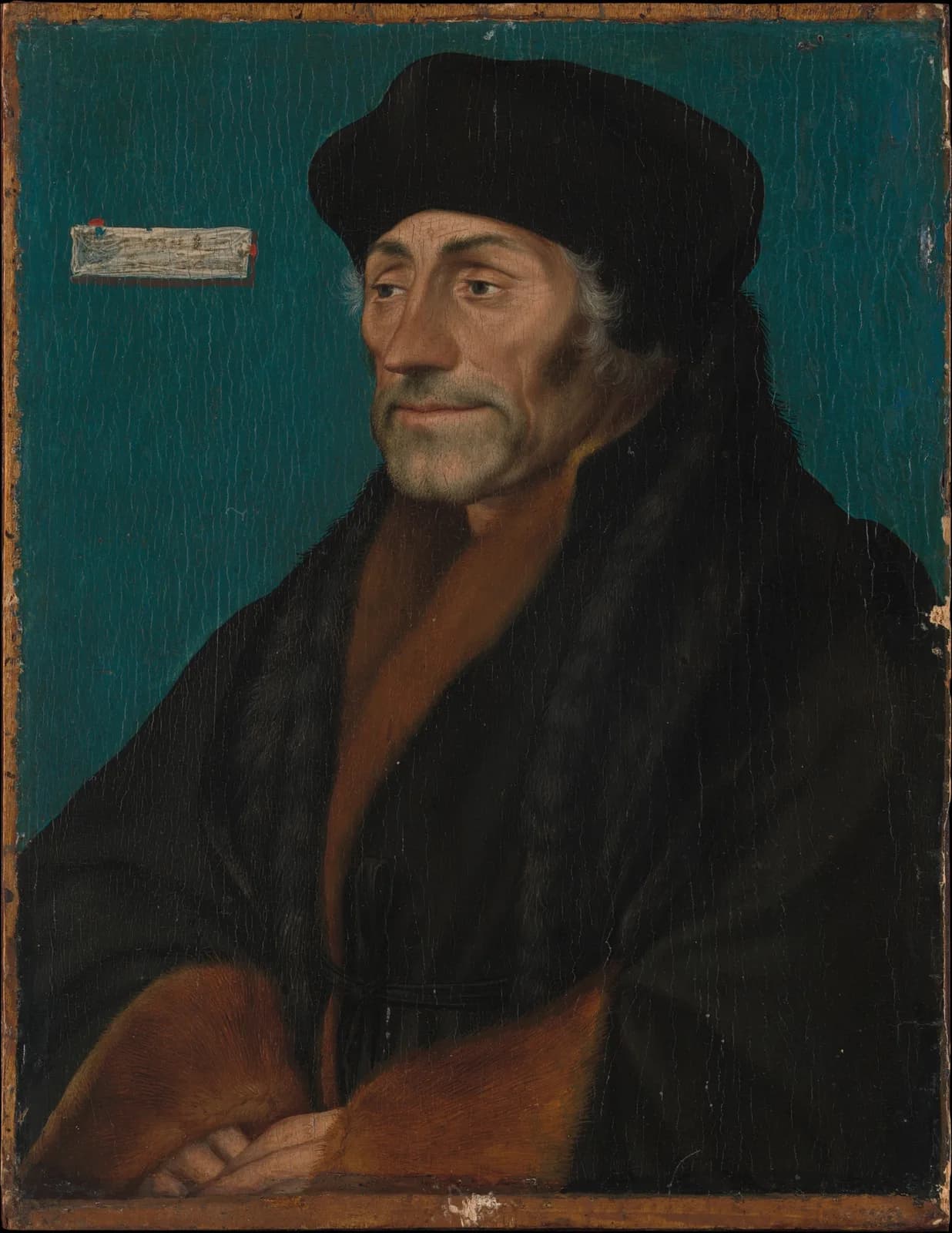
Erasmus of Rotterdam was a Dutch humanist scholar and Catholic priest, active in the early 16th century, known for his contributions to Christian humanism and his critical editions of the New Testament. Living in a time of religious turmoil, Erasmus became a leading intellectual figure, advocating for reform within the Catholic Church. His works, blending classical knowledge with Christian teachings, marked him as a pivotal thinker of the Renaissance and a precursor to the Reformation.
Born around 1466 in Rotterdam, Erasmus received his education at monastic schools, which shaped his later critique of ecclesiastical practices. In 1509, he penned "Praise of Folly," a biting satire that exposed the moral failings of the church and society, gaining him widespread recognition. His groundbreaking 1516 publication of the "Novum Instrumentum," the first printed Greek New Testament, revolutionized biblical scholarship by encouraging direct engagement with original texts. Erasmus's intellectual exchanges extended to a significant debate with Martin Luther in 1524 over free will, where Erasmus defended human choice against Luther's predestinarian stance. Despite his critique of church abuses, Erasmus refrained from joining the Protestant Reformation, advocating instead for internal reform.
Erasmus lived during a period of intense religious upheaval as the Catholic Church faced growing criticism for corruption. The rise of humanism, with its emphasis on returning to original biblical sources and individual piety, fueled demands for change. Erasmus's call for a "philosophy of Christ," which emphasized living according to Christ's teachings over strict dogma, resonated widely but also drew controversy. His refusal to break with the Catholic Church, despite advocating for reform, highlighted the complex religious landscape of his era. Erasmus died in 1536, leaving behind a legacy of scholarly works that continued to influence religious thought and reform movements.
Can the church be reformed from within through learning and moral appeal — or does systemic corruption require a revolutionary break?
Erasmus of Rotterdam faced a church in crisis. Corruption, ignorance, and dogma plagued the Catholic Church, leading him to ask: How can the church return to the essence of Christ's teachings? Unlike his contemporaries who called for radical reform or outright schism, Erasmus sought a different path. He envisioned a revitalized church that embraced education and moral integrity. His life's work revolved around the belief that understanding the original biblical texts could guide both individuals and institutions back to a more authentic Christian life.
Central to Erasmus's thought was the idea of Biblical Humanism. He claimed that returning to the original Greek and Hebrew scriptures would illuminate authentic Christian teachings. This approach challenged the church's reliance on the Latin Vulgate and aligned with the Renaissance spirit of returning to original sources. Another pivotal idea was his "Philosophy of Christ," which emphasized living according to Christ's teachings rather than rigid adherence to doctrine. This philosophy underscored a personal and ethical approach to faith. Erasmus also advocated for Irenic Theology, promoting peaceful dialogue over conflict amid the rising tensions of the Reformation.
Erasmus's contributions extended beyond these ideas. In 1524, he penned "The Freedom of the Will," directly challenging Martin Luther's views on predestination and affirming human capacity for choosing salvation. His sharp critique of church abuses, most famously in "The Praise of Folly" (1511), used satire to expose corruption and call for reform, stirring public opinion and setting the stage for later reformers. Despite his criticisms, Erasmus remained a committed Catholic, believing reform could occur from within rather than through division.
Erasmus's signature argument was his conviction that true reform hinged on education and a return to the original biblical texts. This perspective was compelling because it offered a peaceful solution that respected tradition while encouraging renewal. By advocating for a deep understanding of Christ's teachings in their original form, Erasmus provided a blueprint for moral and spiritual renewal without upheaval. His work laid the foundation for modern biblical scholarship and influenced the course of the Reformation, demonstrating that reform could be achieved through knowledge and integrity rather than radical change.
Before Erasmus of Rotterdam, Christian thought was a fortress of Scholasticism. Scholars synthesized Christian theology with Aristotelian philosophy, constructing a complex edifice of dialectical reasoning. The church's authority loomed unchallenged, with the Latin Vulgate standing as the uncontested biblical text. Few questioned this, and fewer still ventured into the murky waters of original biblical languages. The focus lay on maintaining doctrinal orthodoxy and ritual observance, leaving personal piety and moral reform in the shadows. Free will discussions were rare, resting on a bedrock of predestinarian views, which went largely unexamined.
Erasmus smashed through these barriers with a hammer of humanism. He published the first printed Greek New Testament, urging scholars to return to the original Greek and Hebrew texts for a truer understanding of scripture. This act spurred a seismic shift towards biblical humanism. Erasmus wielded satire like a scalpel in "Praise of Folly," exposing church abuses and corruption with sharp wit. His critique created a culture of questioning ecclesiastical authority. He advocated for moral reform through education, promoting the "philosophy of Christ," a blend of faith with intellectual and moral development. In his work "On Free Will," Erasmus challenged the predestinarian views, defending human free will's role in salvation, setting the stage for heated theological debates.
Erasmus's influence rippled through time, directly shaping the Protestant Reformation. Martin Luther and John Calvin built on his textual criticism, emphasizing the authority of scripture alone. His humanist approach laid a foundation for the Catholic Counter-Reformation's focus on education and internal reform. The debate on Free Will that Erasmus ignited continued to fuel theological discourse, influencing the contours of Christian thought for centuries. Without Erasmus, the Reformation's landscape would have looked vastly different. Today, his Greek New Testament remains a cornerstone for biblical scholarship, a testament to Erasmus's enduring legacy.
Erasmus of Rotterdam, a towering figure of the Renaissance, found himself in hot water for several reasons. His satirical work, "Praise of Folly," mocked the Church's practices and highlighted its contradictions. While he intended to spur reform and reflection, many traditionalists and Catholic authorities saw his satire as a direct challenge to the Church’s authority. This challenge inadvertently fueled the Protestant Reformation, which Erasmus did not even support. His defense of free will in "On Free Will" also fell flat. By trying to chart a middle course between the Reformers and the Church, he ended up pleasing no one. Both sides found his arguments weak, leaving him isolated in a theological no man's land. Furthermore, his decision to remain neutral during The Reformation frustrated many reformers who had hoped for his support. This neutrality was seen as a lack of commitment to necessary change, reducing his influence at a critical time. Lastly, Erasmus's corrections to the Greek New Testament called into question the accuracy of the Vulgate, the Church’s primary Bible. While his work was academically rigorous, it embarrassed and angered Catholic scholars who viewed it as undermining established teachings.
The harshest criticism of Erasmus centers on his satirical critiques, particularly in "Praise of Folly." This work, brimming with wit and sharp observations, unintentionally paved the way for the Protestant Reformation. Erasmus's barbed commentary on the Church’s failings resonated with reformers who sought drastic change. When the Reformation erupted, what began as an intellectual exercise contributed to religious upheaval and conflict across Europe. His failure to decisively align with reformers or traditionalists left him adrift. Both sides criticized him, viewing his attempts at moderation as weakness. In a period of stark religious divides, Erasmus's reluctance to take a firm stand only deepened the existing fractures, leading to a legacy of division rather than unity.
Some modern scholars argue that Erasmus's emphasis on education and moral reform was crucial for later developments in theology. They claim his critiques aimed to strengthen the Church, not weaken it. His commitment to peaceful theological discourse, or irenic theology, was a valuable attempt to bridge divides. Yet, this view does not erase the criticism that his works contributed to religious turmoil. While his efforts to correct the Greek New Testament were academically significant, they still caused embarrassment among those defending the Vulgate's authority. The criticisms against Erasmus remain largely intact. His satire and neutrality during the Reformation left lasting impacts that continue to be dissected and debated today.
After the condemnation of his work, Erasmus of Rotterdam continued to live and work across Europe, settling in cities like Basel and Freiburg. Despite sharp criticisms of the church, he remained a Catholic until his death in 1536. He never joined the Protestant Reformation, choosing instead to advocate for internal reform. His commitment to the church did not prevent him from forging relationships with leading reformers, but he held firm in his belief that the church could be changed from within rather than abandoned.
Erasmus's teachings left a lasting mark on Christian humanism, a movement that thrived among scholars and theologians who valued reconciling faith with reason. His ideas found fertile ground in the Netherlands and England, where humanist thought took root. Figures like Thomas More and John Colet carried forward his emphasis on education and textual criticism. These scholars promoted the study of original texts, which became a cornerstone of later reform efforts. Erasmus's influence extended into the broader intellectual currents of the Renaissance, affecting how people thought about education and religious practice.
Today, Erasmus's legacy endures in modern biblical scholarship, which prioritizes the study of original texts and languages. His commitment to dialogue and understanding resonates in contemporary ecumenical movements that aim to bridge divides within Christianity. One concrete example is the Erasmus Programme, a European Union student exchange initiative named in his honor, reflecting his dedication to learning and cross-cultural exchange. This program embodies his belief in education as a tool for unity and understanding, ensuring that his ideals continue to influence new generations.
Continue reading with a Scholar plan
Upgrade to Scholar