Library
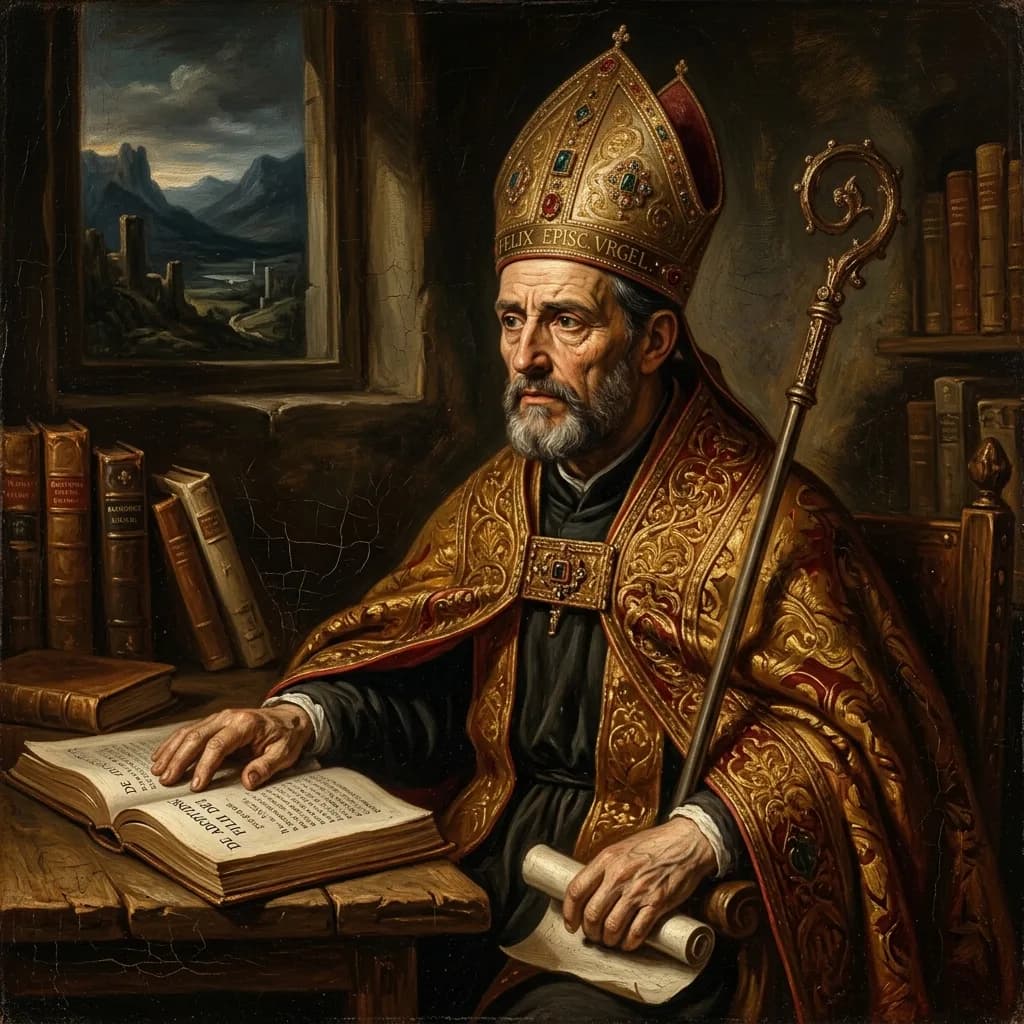
AI-generated illustration
Library
Medieval (9th-15th C) · d. 818 CE · Updated April 9, 2026
Felix of Urgel was a bishop in the Spanish March during the Medieval era, known for his advocacy of Spanish Adoptionism under Carolingian rule. He served as the Bishop of Urgel, a significant position in a region that was a buffer zone between Islamic and Christian territories. His tenure marked him as a key religious figure in a time of intense theological and political maneuvering, as the Carolingian Empire sought to unify its vast territories under a single Christian doctrine.
Felix became a leading proponent of Adoptionism, a belief that Christ, in his human nature, was the adopted Son of God. This doctrine distinguished between two sonships of Christ: one natural and divine, the other adoptive and human. His teachings gained traction, but they eventually faced strong condemnation. The Council of Frankfurt in 794 CE and the Council of Aachen in 799 CE both denounced his views. Despite this ecclesiastical censure, Felix continued to assert his beliefs until his death in 818 CE, remaining a controversial figure in the church.
The era of Felix of Urgel was marked by the Carolingian Empire's efforts to consolidate both religious and political power. Theological debates like Adoptionism emerged as the empire worked to define what constituted orthodox Christian doctrine. Felix's controversy centered on interpretations of Christ's nature, a subject that required balancing the unity of his person with the duality of his divine and human natures. This intellectual and spiritual environment enabled Felix's ideas to gain initial acceptance, even as they later faced rejection. His story reflects the complexities of an empire striving for religious cohesion in a diverse and expanding realm.
Is Christ the natural or adopted Son of God in his humanity — and does distinguishing his two sonships protect or destroy the unity of his person?
Felix of Urgel grappled with the writings of Elipandus of Toledo, who claimed that Christ's human nature was adopted at baptism. Felix saw this as a necessary clarification. He believed it protected the integrity of Christ's full humanity. To him, this view made Christ more accessible and relatable to believers. It provided a model for spiritual growth, suggesting that Christ's human nature, like ours, developed in grace and obedience. Felix's conviction grew from a desire to make Christ's life and struggles understandable to the common believer. He acted from a genuine belief that distinguishing the two sonships of Christ safeguarded the faith from oversimplifying his human experience.
Asserting that Christ's human nature was adopted required a clear division between his divine and human natures. This theological stance aimed to highlight the reality of Christ's human journey. It presented a Savior who experienced life in a way humans could emulate. But this position threatened to split Christ into two separate entities — a divine being and a human being only loosely connected. Such a division risked unraveling the seamless unity of Christ's person, leading to a fragmented understanding of who he was. The cost was high: it could dismantle the foundational belief in a unified Christ, a belief central to Christian identity and worship.
On the flip side, claiming Christ as the natural Son of God in his humanity demanded an intrinsic union from conception. This view championed the seamless unity of Christ's person, affirming that he was both fully divine and fully human. It preserved the traditional doctrine that had guided the church for centuries. It underscored the mystery of the Incarnation — God becoming man without division. But this position obscured the human side of Christ, making him seem distant and less relatable. If Christ's humanity was naturally divine, it minimized the struggles and growth that humans face. The cost was a potential disconnect between Christ and the believer's day-to-day struggles.
The theological impasse lay in the commitment to both Christ's full divinity and full humanity. Neither side could relinquish these core truths without dismantling the faith. The debate was not just for theologians; it shaped how ordinary believers related to Christ. For them, it influenced whether they saw Christ as an accessible figure who shared in their humanity or as a distant deity. It touched their prayers, their understanding of grace, and their hope for salvation. Christ's nature became a reflection of their own relationship with God, affecting how they lived their faith every day.
Felix of Urgel taught that Jesus Christ, in his human nature, was the adopted Son of God. He believed that while Christ's divine sonship was inherent and natural, his human sonship came through grace, specifically at his baptism. This view answered the question of whether Christ's humanity was naturally or adoptively divine by proposing a dual sonship: natural in his divinity, adoptive in his humanity.
Felix grounded his teaching in both logic and scripture. He argued that distinguishing between Christ's divine and human sonships preserved the integrity of both natures without fragmenting his person. By highlighting the grace of adoption, Felix maintained that Christ remained fully human while unified in his divine identity. In his treatise "Libellus de Unitate Trinitatis," Felix cited scriptures like Romans 1:4, Matthew 3:17, and Acts 13:33. He interpreted these verses as affirmations of Christ's adoptive sonship, using them to demonstrate that Christ's divine recognition was not only eternal but also publicly declared through divine action.
This teaching resonated with those who emphasized the humanity of Christ, particularly in regions where theological debates focused on differentiating Christ's dual natures. Felix's idea spread among communities that valued a clear distinction in Christ's personhood, as it offered a relatable and humanized view of Jesus. Despite its appeal, Felix's teaching eventually faced opposition, culminating in his condemnation at the Council of Frankfurt in 794 CE.
Felix of Urgel's teaching fell under scrutiny because he posited two distinct sonships within Christ. Alcuin of York, a prominent theologian and advisor to Charlemagne, took the lead in dismantling Felix's argument. Alcuin contended that claiming a natural sonship (divine) and an adoptive sonship (human) for Christ introduced a dangerous duality. This duality undermined the unity of Christ’s person, a direct challenge to the doctrine of the hypostatic union. According to Alcuin, as articulated in his letters to Felix from 794 to 799 CE, Christ’s sonship is singular and eternal, anchored in his divine nature. Any separation between divine and human sonship suggested a division in Christ, contradicting the belief that he is one person with two natures, both fully divine and fully human.
Felix of Urgel tried to support his view with Scripture, but the orthodox responses exposed weaknesses in his interpretation. In Romans 1:3-4, Felix saw Christ's resurrection as the moment of his adoption by God. The orthodox countered that this passage reveals Christ’s divine sonship, already eternal, now manifested rather than initiated. Likewise, Felix viewed the heavenly voice at Christ’s baptism in Matthew 3:17 as signaling his adoption. The orthodox interpretation corrected this by asserting the voice affirmed what was already true — Christ’s eternal sonship. Hebrews 1:5 was another point of contention, where Felix argued for a temporal sonship. The orthodox response clarified that the passage underscores Christ's unique, eternal sonship, not a chronological adoption. The trap in Felix’s argument lay in its suggestion that Christ’s human nature was not fully integrated with his divine nature, leading to a division that orthodoxy identified as heretical.
While the orthodox rebuttal effectively dismantled Felix's dual sonship theory, it introduced its own challenges. Explaining how Christ's divine and human natures coexist without division, confusion, or change required a nuanced approach. This task of articulating the mystery of the Incarnation remained complex, avoiding the pitfalls of other heresies like Nestorianism, which splits Christ into two persons, and Monophysitism, which blends his natures into one. Despite the clarity provided against Felix, theologians continued to wrestle with expressing the unity of Christ’s natures. The debate highlighted the ongoing challenge of defining The Incarnation, a mystery that has occupied Christian thought for centuries.
In 794 CE, Charlemagne convened the Council of Frankfurt in the heart of the Carolingian Empire. He called upon the bishops to address a theological storm brewing within his realm. The central question was whether Christ was the natural or adopted Son of God. This was not just a theological puzzle; it was a matter that could fracture the religious unity essential to Charlemagne's political ambitions. By asserting his authority over this council, Charlemagne aimed to solidify his control over both the church and his empire. Religious unity was vital for maintaining the stability and cohesion of his vast territories.
At the council, the debate centered around Felix of Urgel's Adoptionism. Felix argued that Christ became the Son of God by grace at his baptism, suggesting an adoptive sonship. Opponents like Alcuin of York defended the idea that Christ was the natural Son of God, emphasizing a union of divine and human natures from conception. The distinction between 'natural' and 'adoptive' sonship was crucial. It shaped the understanding of Christ's dual nature and personhood. The council ultimately condemned Adoptionism as heretical, affirming the natural sonship of Christ. This decision aligned with orthodox teachings and strengthened Charlemagne's position.
Despite the council's condemnation, the Adoptionist controversy did not vanish. Particularly in the Spanish March, where Felix held sway, the debate simmered. Five years later, in 799 CE, the Council of Aachen revisited the issue. Yet, even after this, Adoptionist ideas occasionally resurfaced. The theological tensions lingered, and debates over Christ's nature and sonship continued to evolve. It was not until the later church councils and the solidification of orthodox doctrines that the controversy finally waned, leaving its mark on the theological landscape.
After the Councils of Frankfurt and Aachen condemned Felix of Urgel, his life took a sharp turn. Stripped of influence, he faced exile and pressure from the Carolingian authorities. Under this duress, Felix recanted his views on Adoptionism, a doctrine suggesting that Jesus was adopted as God's son in his humanity. Confined under ecclesiastical supervision, Felix lived out his days away from the public eye. He died in 818 CE, never reclaiming the stature he once held in theological circles. The Carolingian Church, determined to maintain orthodox beliefs, ensured that Felix's influence remained suppressed.
Despite Felix's recantation, his teachings on Adoptionism did not vanish entirely. In the Spanish March, a region on the fringes of the Carolingian Empire, some theologians found the idea intriguing. They were drawn to the notion of clearly distinguishing between Christ's human and divine natures. Although interest lingered among a few, the movement lacked momentum and eventually faded. The Carolingian Church's firm stance on orthodox Christology quashed widespread adoption of Felix's views, relegating them to the periphery of theological exploration.
Today, Felix's brand of Adoptionism rarely surfaces in mainstream theology. Yet, echoes of his ideas occasionally appear among liberal theologians who emphasize Christ's humanity. In some secular circles, interpretations of Jesus as a purely historical figure resonate with the notion of an adopted, non-divine status. This perspective finds a place in discussions that strip away the divine to focus on Jesus as a man of history. While Felix's teachings do not dominate, their subtle influence persists in discussions about the nature of Christ.
Continue reading with a Scholar plan
Upgrade to ScholarAI-generated illustration