Library
Library
Modern (17th C+) · 1628-1688 CE · Updated April 9, 2026
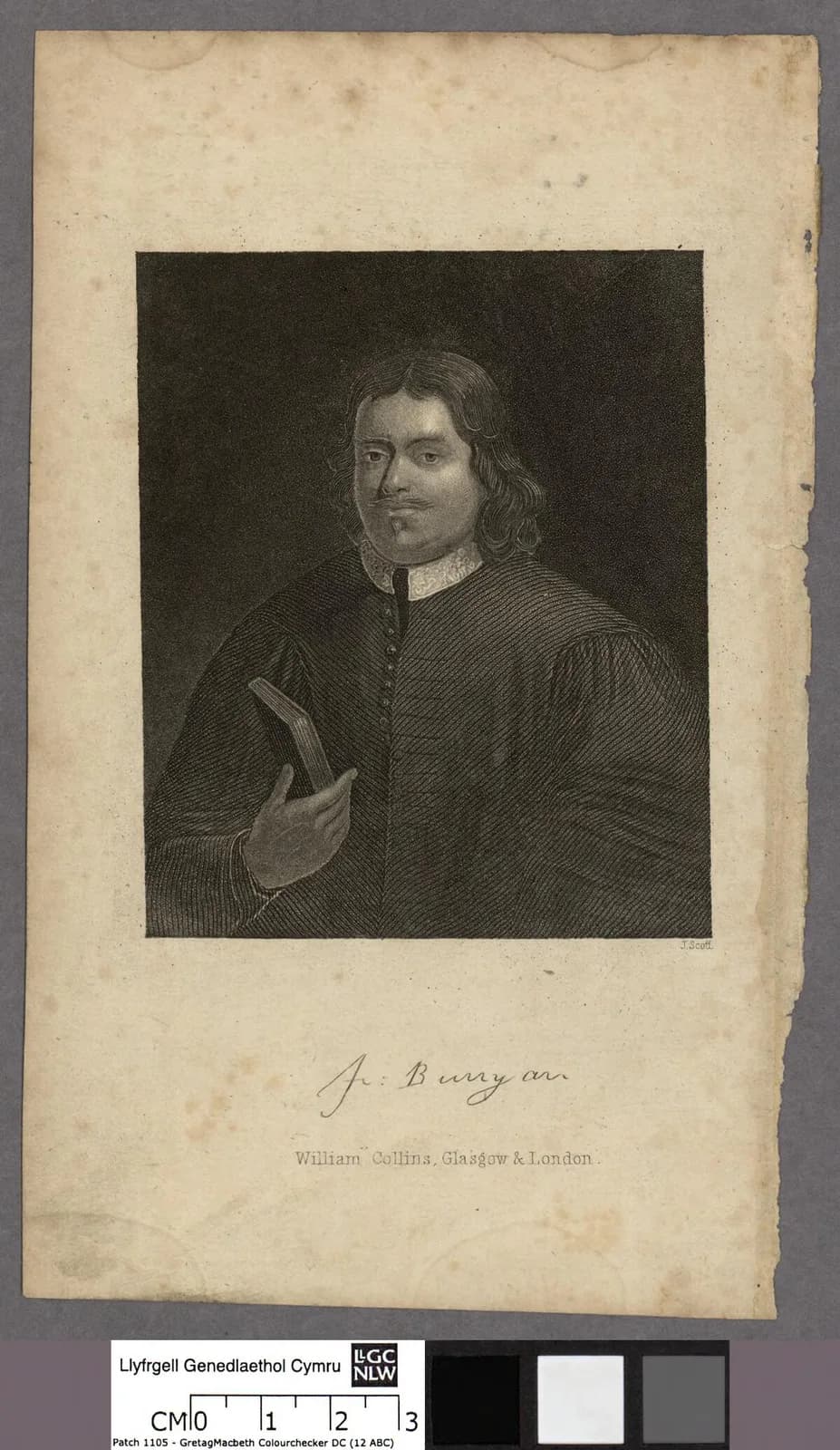
John Bunyan was an English Nonconformist minister and author, active in the 17th century, known for his influential allegorical works and his imprisonment for unlicensed preaching. He spent much of his life in Bedfordshire, where he wrestled with the religious tensions of his time. The English Civil War and the Restoration period shaped his identity and writings, making him a central figure in Protestant devotional literature.
Born in 1628 in Elstow, Bedfordshire, Bunyan grew up amidst the tumult of religious conflict. Largely self-taught, his lack of formal theological education often set him at odds with the educated clergy. Despite this, he became a powerful preacher. When the Clarendon Code enforced conformity to the Church of England, Bunyan faced imprisonment for 12 years due to his refusal to cease unlicensed preaching. During this time, he wrote "The Pilgrim's Progress," published in two parts in 1678 and 1684, which remains a seminal work in Christian literature. His writings often explore themes of Christian pilgrimage and spiritual struggle.
Bunyan lived in a world marked by religious turmoil and intense theological debate. The Clarendon Code targeted Nonconformists like him, spurring a climate of persecution. His works sparked discussions about Calvinist and Arminian interpretations of Christian doctrine, reflecting the broader theological conflicts of the era. Despite the controversies, "The Pilgrim's Progress" endures as a testament to his vision, illustrating the journey of faith amidst adversity.
What does it feel like to live the Christian life — and can an allegory convey the reality of spiritual struggle and hope more honestly than systematic theology?
John Bunyan dedicated his life to tackling the perplexing journey of faith. For him, the Christian life was not a straightforward path but a tumultuous journey fraught with trials, temptations, and inner turmoil. His own life, marked by imprisonment and persecution, mirrored this struggle. Bunyan sought to demystify this spiritual pilgrimage, making it relatable and vivid for ordinary believers who faced similar challenges. He aimed to provide not just a map but a narrative that resonated with the common experience of doubt and hope in the quest for salvation.
Three core ideas dominate Bunyan's theology: the Christian life as a pilgrimage, the ever-present temptations, and justification by faith alone. Bunyan likened the Christian journey to a Pilgrimage toward the Celestial City, full of obstacles and moral tests, a concept driven by his own hardships and the teachings of the Reformation. Vanity Fair and Doubting Castle represent the constant allure of worldly temptations and the crippling burden of doubt, reflecting his personal battles and societal observations. Central to Bunyan's theology is the belief that salvation comes through faith in Christ alone, a stance he shared with Martin Luther and other Protestant reformers. This doctrine offered believers the assurance that their Salvation rested not on their actions but on their faith.
Beyond these core ideas, Bunyan's allegory serves as a powerful tool for theological exploration. His most famous work, "The Pilgrim's Progress," published in 1678, uses vivid characters and settings to illustrate the spiritual journey. Unlike systematic theology, which can be dense and inaccessible, Bunyan's narrative approach brought abstract theological concepts to life. His depiction of the inner struggle between doubt and assurance resonated deeply with readers, offering comfort and clarity to those grappling with their faith. In "Grace Abounding to the Chief of Sinners" (1666), Bunyan shared his own spiritual battles, providing an intimate glimpse into the transformative power of faith.
Bunyan's signature argument lies in his belief that allegory, more than dry systematic theology, could capture the essence of spiritual struggle and hope. By creating relatable characters and engaging narratives, he offered believers a way to see their own experiences within the larger story of Salvation. This approach made complex theological ideas accessible to a wide audience, including those who were illiterate or lacked formal education. Bunyan's work changed how people understood their faith journey, emphasizing that the road to Salvation is an active, ongoing Pilgrimage. His legacy endures as a testament to the power of storytelling in conveying profound spiritual truths.
Before John Bunyan, Christian thought leaned heavily on systematic theology and the authority of the educated clergy. The church insisted on doctrinal correctness and participation in rituals. Christian life revolved around adherence to these structures, leaving personal spiritual experiences in the shadows. The educated clergy held a monopoly on interpreting scripture, often leaving laypeople dependent on their insights. The tension between personal faith and institutional religion simmered beneath the surface, as did the challenge of expressing the inner spiritual struggle in a way that resonated with ordinary believers.
John Bunyan changed everything. He shifted the focus from rigid doctrine to the personal spiritual journey. His allegorical masterpiece, "The Pilgrim's Progress," portrayed Christian life as a challenging journey, rich with personal growth and struggle. This narrative approach made complex theological ideas accessible to everyone, not just the educated elite. Bunyan's self-taught status challenged the clergy's authority, proving that deep theological insight emerged from personal study and reflection. He emphasized grace and justification by faith, illustrating these doctrines through relatable stories of struggle and redemption. His work forced the church to acknowledge the importance of individual experience in faith.
Bunyan's influence paved the way for the rise of evangelicalism, which emphasizes personal conversion and spiritual experience. His use of allegory inspired later Christian writers like C.S. Lewis and J.R.R. Tolkien, who engaged the imagination in spiritual reflection. The nonconformist tradition he embodied contributed to religious pluralism and acceptance of diverse theological perspectives. Without Bunyan, these movements might not have gained the traction they did. His legacy lives on, as "The Pilgrim's Progress" remains one of the most translated books in history, second only to the Bible.
John Bunyan, a towering figure in Christian literature, held views that sparked significant controversy. His strict Calvinist theology, particularly the ideas of predestination and justification by faith alone, alienated many who embraced a more inclusive understanding of Christianity. Arminians and other non-Calvinist theologians criticized him for his exclusionary stance, arguing that it lacked compassion and failed to account for the diversity within the Christian faith. Bunyan also leaned heavily on allegorical storytelling in "The Pilgrim's Progress," which some argued oversimplified complex theological issues. His preference for allegory over a systematic approach left critics questioning its depth. Furthermore, his anti-Catholic rhetoric fueled religious tensions, creating division rather than unity among Christians. His imprisonment for preaching without a license stirred debate about civil disobedience and the relationship between religious practice and state authority.
The most indefensible aspect of Bunyan's legacy lies in his anti-Catholic rhetoric. His writings during a time of intense religious conflict perpetuated intolerance and deepened sectarian divides. Bunyan's harsh depiction of Catholics painted them as enemies of true faith, which only served to entrench negative stereotypes and hinder efforts toward Christian unity. His words contributed to a climate of suspicion and hostility, making reconciliation between different Christian groups more difficult. This legacy of division clashes starkly with the broader Christian ideals of love and unity, leaving a stain on his contributions to religious thought.
While some argue that Bunyan's theology and allegorical style should be viewed within the context of his era, criticisms of his work remain robust. His Calvinist exclusivity and reliance on allegory still face scrutiny for their limitations in addressing the complexities of faith. Although his personal spiritual insights have been celebrated in devotional literature, his divisive rhetoric and theological rigidity endure as contentious points. The impact of his anti-Catholic sentiments is undeniable, reflecting a period when religious discourse often bred division rather than understanding. Bunyan's legacy, while significant, remains marked by these unresolved criticisms.
John Bunyan faced imprisonment for 12 years because he preached without a license, defying the Clarendon Code, which sought to suppress Nonconformist religious practices. Despite this setback, Bunyan's resolve only strengthened. Upon his release, he continued to preach and write, becoming a pillar of the Nonconformist community. His dedication and eloquence earned him respect and followers. Bunyan's death in 1688 marked the end of a life spent championing religious freedom and expressing deep spiritual truths through his writings.
Bunyan's impact didn't fade with his passing. His allegorical style and teachings significantly influenced the Evangelical movement. Protestant denominations, particularly Baptists and Methodists, embraced his work. 'The Pilgrim's Progress' stood out as a seminal text that vividly illustrated the Christian journey. Its appeal transcended English borders, becoming a staple in the libraries of believers worldwide. Bunyan's clear, relatable narrative offered guidance and inspiration, deeply embedding itself in the fabric of Protestant thought and practice.
Today, John Bunyan's legacy thrives, especially through 'The Pilgrim's Progress,' which remains a cornerstone in Evangelical reading lists and Christian educational curricula. His exploration of spiritual struggle and perseverance continues to resonate in modern Christian literature and sermons. The enduring relevance of his themes is evident in how often they appear in contemporary religious discussions. His influence reaches beyond printed pages; Bunyan's life and works still inspire those who seek to understand and navigate the complexities of faith.
Continue reading with a Scholar plan
Upgrade to Scholar