Library
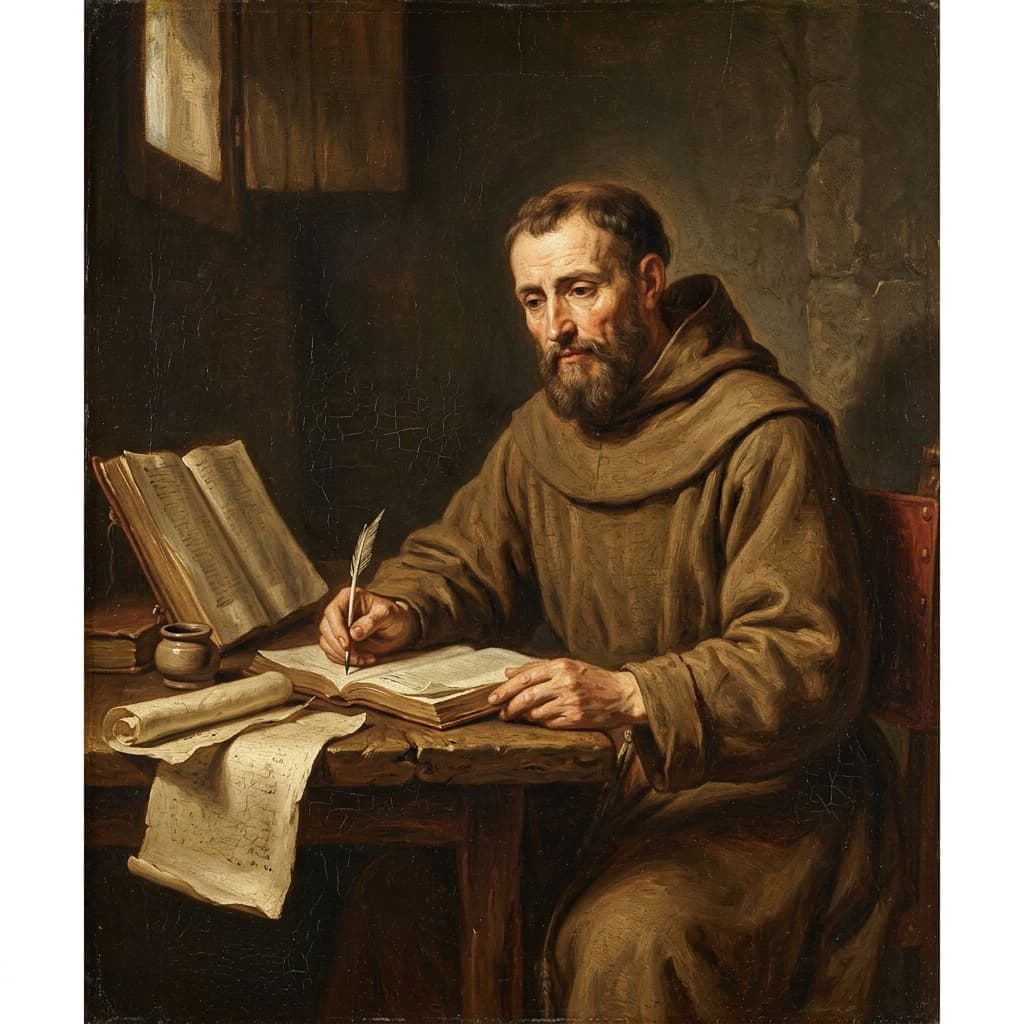
AI-generated illustration
Library
Post-Nicene Patristic (4th-5th C) · c. 360-435 CE · Updated April 9, 2026
John Cassian was a monk, priest, and monastic founder in Gaul during the late 4th and early 5th centuries, known for bringing Eastern desert monasticism to the Western church. He played a pivotal role in shaping Western monastic practices by introducing the ascetic traditions he observed in Egypt. His work laid the foundation for monastic communities that would influence Christian spirituality for centuries.
Born around 360 CE in the region of present-day Romania and Bulgaria, Cassian embarked on a spiritual journey that took him to the deserts of Egypt, where he learned from the desert fathers, revered for their intense ascetic lifestyle. After traveling to Constantinople and Rome, he settled in Gaul. There, in Marseille, he founded the Abbey of Saint-Victor, which became a model for Western monasticism. He penned "Institutes" and "Conferences," capturing his insights and dialogues with Egyptian monks. These works became essential reading for aspiring monks and theologians.
The era in which Cassian lived buzzed with theological debates, especially concerning the nature of grace and free will. Augustine of Hippo championed the idea of divine predestination, while the Pelagians emphasized human free will. Cassian's views, seen as Semi-Pelagian, offered a middle path, suggesting that humans could initiate their salvation with divine help. This stance, articulated in his "Thirteenth Conference," set off a controversy that culminated in its condemnation at the Second Council of Orange in 529 CE. His life and work reflect the vibrant and contentious theological landscape of his time.
In the spiritual life, does the human will take the first step toward God, or is every movement toward God itself a gift of grace — and what is at stake in the difference?
John Cassian grappled with the question of how human effort and divine grace interact in the spiritual journey. Living at a time when Christianity was evolving rapidly, he sought to blend the disciplined practices of Eastern monasticism with the theological frameworks of the Western church. Cassian was deeply concerned with how individuals could draw closer to God. He believed that understanding the role of personal effort and divine assistance was crucial for spiritual development. This inquiry drove his life's work, setting the stage for later debates about free will and Grace.
Cassian identified eight principal sins that block spiritual growth, a concept that later influenced the seven deadly sins. Rooted in the teachings of the Egyptian desert fathers, this framework offered a systematic approach to battling vice. He also developed a structured path of contemplative prayer, guiding individuals from simple prayer to profound union with God. This progression became a cornerstone of Western monastic spirituality, drawing from Eastern traditions but tailored for Western Christians. Cassian emphasized the need for personal experience and spiritual mentorship, arguing that guidance from seasoned spiritual directors was essential for anyone seeking maturity in faith.
Cassian's major works, "The Institutes" and "The Conferences," published in the early 5th century, encapsulated his teachings. These texts provided comprehensive guides for monastic life, detailing both practical advice and deep theological reflection. His influence extended through the centuries, shaping the spiritual practices of monastic communities across Europe. By advocating for a balanced approach to divine grace and human effort, his ideas left a lasting mark on Christian spirituality.
Cassian's signature argument, known as Semi-Pelagianism, posited that while divine grace completes the journey to God, the human will can and should initiate it. This stance challenged Augustine's strict views, which emphasized predestination and the overwhelming necessity of Grace. Cassian's argument was compelling because it acknowledged human agency, allowing believers to feel they played an active role in their salvation. This nuanced view sought to harmonize Eastern and Western theological traditions but eventually led to controversy and condemnation, as later church councils favored Augustine's interpretation. Cassian's attempt to affirm human cooperation with divine grace sparked debates that shaped Christian theology for generations.
Before John Cassian, Christian Monasticism in the West lacked a cohesive framework. The spiritual practices of the Egyptian desert fathers, with their intense asceticism and focus on contemplative prayer, had not yet permeated Western Christianity. The Western church had patchy exposure to these practices, relying more on local traditions and less on a systematic approach to spiritual growth. Furthermore, there was a gap in the understanding of human will's role in salvation, with Augustine's teachings emphasizing the necessity of divine grace and leaving little room for human initiative. Sin was understood in broad terms, but there was no detailed categorization focusing on the root causes of spiritual failings.
John Cassian changed this landscape dramatically. He introduced Eastern monastic practices to the West, emphasizing the importance of asceticism and contemplative prayer. Cassian's works, such as the Institutes, brought structure to Western monastic life by identifying and categorizing the eight principal sins, which he believed were the root of spiritual failings. This categorization later evolved into the seven deadly sins, shaping Christian moral thought. Cassian also proposed a view on Grace and free will that suggested human will could initiate the process of turning toward God, challenging Augustine's dominant view and sparking debate. This perspective, later known as Semi-Pelagianism, forced the church to grapple with the balance between divine grace and human effort.
The influence of John Cassian's work rippled through the centuries. His integration of Eastern practices provided a foundation for Western Monasticism, directly influencing the Rule of Saint Benedict, which became a cornerstone of monastic life in the West. His categorization of sins became embedded in Christian moral theology, guiding spiritual direction for generations. While his views on Grace and free will were condemned at the Second Council of Orange, they continued to provoke theological debate throughout the Middle Ages and beyond. Cassian's legacy endures, with his teachings forming the backbone of Western monastic tradition and Christian ethical thought.
John Cassian, an influential figure in early Christian monasticism, faced significant criticism for several of his ideas. His belief in Semi-Pelagianism suggested that humans could initiate their own salvation without divine intervention, challenging the doctrine of original sin and the necessity of Grace. This belief was seen as a direct threat to foundational Christian teachings, drawing objections from prominent theologians like Augustine. Additionally, Cassian's focus on ascetic practices and spiritual direction was criticized for fostering spiritual elitism, potentially isolating individuals from the broader communal life of the church. His categorization of sins into eight principal ones was later replaced by the more streamlined and widely accepted seven deadly sins, indicating that his framework was perceived as overly complex and less effective.
The most contentious aspect of Cassian's legacy is his Semi-Pelagian views. This theological stance sparked a major controversy, as it appeared to undermine the need for divine grace in salvation. Augustine and his followers argued vehemently against this position, emphasizing humanity's reliance on God's grace. The Second Council of Orange in 529 CE formally condemned Semi-Pelagianism, reinforcing Augustine's doctrine that Grace alone initiates Salvation. This condemnation marked a pivotal moment in church history, showcasing the deep divisions that Cassian's ideas could provoke and solidifying the church's official stance on Grace and human will.
Despite these criticisms, some modern theologians argue that Cassian's emphasis on human cooperation with grace offers valuable insights into free will and responsibility. They suggest that his views were more nuanced than his critics acknowledged. However, the verdict from the Second Council of Orange still stands, and Cassian's Semi-Pelagianism remains condemned as heretical. His legacy is a complex one, marked by both his contributions to monasticism and his contentious theological positions.
John Cassian's teachings were not immediately condemned during his lifetime, allowing him to continue his influential work in monasticism until his death around 435 CE. His writings, particularly on monastic practices and spiritual development, were well-regarded in his time. However, his Semi-Pelagian views, which argued for a middle ground between human free will and divine grace, came under scrutiny after his death. The Second Council of Orange in 529 CE officially condemned these views, but Cassian himself was unaffected by this posthumous judgment.
Despite the condemnation at the council, Cassian's teachings on monastic life and spirituality left a lasting impact, particularly in Gaul. His works, such as "Conferences" and "Institutes," were widely read and respected among Western monastic communities. These writings provided practical guidance on monastic living and spiritual growth, resonating with many who sought a balanced approach to divine grace and human effort. His ideas continued to influence theological discussions on free will and Grace, contributing to ongoing debates within the Christian tradition.
Today, John Cassian's legacy endures, particularly within the Eastern Orthodox Church, which values his contributions to monastic spirituality. His teachings on the human will and Grace continue to be relevant in theological circles, especially in discussions concerning Free Will in Christianity. Moreover, his emphasis on personal effort in spiritual growth has influenced contemporary spiritual practices. A concrete testament to his ongoing influence can be seen in the Rule of Saint Benedict, which, although more widely known, draws significantly from Cassian's earlier work.
Continue reading with a Scholar plan
Upgrade to ScholarAI-generated illustration