Library
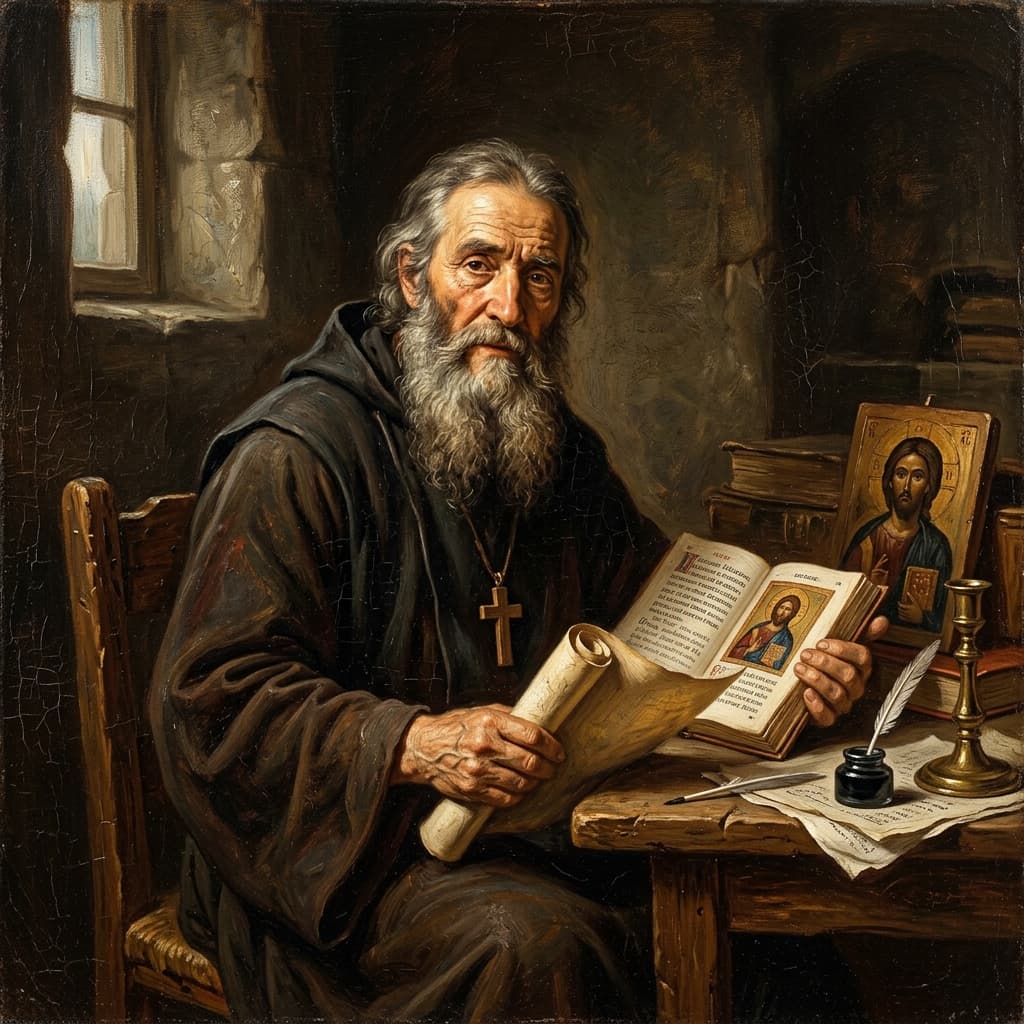
AI-generated illustration
Library
Late Patristic (5th-8th C) · c. 675-749 CE · Updated April 9, 2026
John of Damascus was a Syrian monk and theologian at the monastery of Mar Saba during the Late Patristic era, known for his defense of icon veneration during Byzantine Iconoclasm. Living in the 7th and 8th centuries, he stood at the crossroads of religious and cultural tensions within the Byzantine Empire. His staunch defense of icons made him a key figure in the church's struggle against imperial decrees that sought to ban religious images.
Born around 675 CE in Damascus, John came from a prominent family. He eventually renounced worldly life to become a monk at Mar Saba near Jerusalem. Here, he wrote extensively against the Iconoclasts, who opposed the veneration of religious images. John argued that since Christ took human form, depicting him in art was both permissible and necessary. His writings became crucial for the Second Council of Nicaea in 787 CE, which reaffirmed the use of icons in Christian worship. John died in 749 CE, but his legacy endured, influencing the church's stance on visual representations of the divine.
The Byzantine Iconoclasm erupted from a complex mix of religious, political, and cultural factors. The debate centered around the interpretation of the Second Commandment, which prohibits idolatry, and the theological understanding of Christ's incarnation. The empire saw a clash between the iconoclasts, who viewed images as potential idols, and those who believed that icons were essential for teaching and veneration. The controversy fueled deep divisions between the church and the state. John's defense of icons helped tilt the balance, leading to the restoration of icon veneration at the Second Council of Nicaea.
Does the incarnation of Christ — God taking on visible, material form — mean that Christ can and should be depicted in art, or does depicting him commit the idolatry forbidden in Scripture?
John of Damascus stood firm against the iconoclasts. He saw the emperor's edict banning icons as an affront to the core of Christian theology — the incarnation. For John, the incarnation meant that God entered the material world in the person of Christ. He believed this act validated the use of art to depict the divine. His conviction stemmed from a deep understanding of The Incarnation as a bridge between the divine and the human, making the invisible visible. He argued passionately that icons served as windows to the divine, not idols.
The iconoclasts took a hard line. They saw any depiction of Christ as a violation of the commandment against graven images. To them, icons represented a slippery slope into idolatry. Their stance demanded the wholesale destruction of religious art. This eradication stripped the church of its visual heritage, severing a powerful means for believers to connect with God. The cost was high — it disrupted centuries of tradition and alienated those who found spiritual depth in the beauty of sacred images.
Defenders of icons argued from The Incarnation itself. If God became flesh, then depicting Christ in art was not only permissible but necessary. Icons became essential instruments of worship, deepening the spiritual experience of the faithful. Yet this position risked scandal — accusations of idolatry hovered over their veneration. The church had to walk a fine line, justifying the use of images without crossing into outright worship of the material.
The doctrine of The Incarnation trapped both sides. Denying icons could undermine the profound truth of God made flesh. Embracing them risked charges of idolatry. This theological tension had real-world effects. Ordinary believers faced the potential loss of icons, which were central to their prayer life. The controversy touched the heart of personal devotion and communal worship, making the divine seem both nearer and more distant. For many, icons were not mere art; they were spiritual lifelines.
John of Damascus taught that depicting Christ in art is both permissible and necessary. He believed that the incarnation of Christ, where God took on human form, sanctified the material world. This act made it possible for the divine to be represented in physical form, so depicting Christ in icons does not amount to idolatry. Instead, it serves as a recognition of the divine becoming visible and tangible. By creating images of Christ, believers honor the profound mystery of God becoming flesh.
John used both logic and scripture to support his stance. In his treatise, "Apologia Against Those Who Decry Holy Images," he argued that Christ's incarnation fundamentally altered the relationship between the divine and the material world. He cited passages like John 1:14, which speaks of the Word becoming flesh and dwelling among us, to emphasize that the divine was made visible. Colossians 1:15, which refers to Christ as the image of the invisible God, and Hebrews 1:3, describing Christ as the exact imprint of God's nature, also reinforced his view. These scriptures underscored that Christ's physical form could be represented in art without violating biblical prohibitions against idolatry.
John's teachings resonated with those who valued the tradition of icon veneration within the Christian community. His arguments provided a theological foundation that aligned with the lived experience of worship, making them compelling and influential. The acceptance of his views helped to solidify the role of icons in Eastern Orthodox Christianity. By the time of the Second Council of Nicaea in 787 CE, his position had gained significant traction, leading to the restoration and acceptance of icon veneration within the Church.
John of Damascus made a compelling argument for the use of icons in Christian worship by asserting the sanctity of matter through the incarnation of Christ. In his work "Apologia Against Those Who Decry Holy Images," he stated that he did not worship material objects but rather the Creator who became material for humanity's salvation. His logic was straightforward: if God chose to take on a physical form in Jesus, then representing Christ visually was not only permissible but crucial. This visual representation affirmed the reality of the incarnation, which was central to Christian belief. John argued that denying the depiction of Christ in icons was tantamount to denying Christ's true humanity and, by extension, The Incarnation itself.
John's argument drew heavily on scripture to bolster its foundation. He pointed to John 1:14, which speaks of the Word becoming flesh, to emphasize the physical reality of Christ. Colossians 1:15, describing Christ as the image of the invisible God, supported the idea that Christ could be portrayed in icons, as He made the unseen seen. Hebrews 1:3, which refers to Christ as the exact imprint of God's nature, reinforced the legitimacy of depicting Christ's physical form. By using these texts, John exposed a critical flaw in the iconoclasts' stance. To reject icons was to reject the visible manifestation of God in Jesus, undermining a fundamental tenet of Christian orthodoxy.
Championing this cause came at a significant personal cost for John of Damascus. He faced opposition from the Byzantine authorities who were enforcing iconoclasm. Despite the power of his writings, John lived in relative isolation at the monastery of Mar Saba, away from the centers of ecclesiastical power. His steadfast defense of icons led to his marginalization from the political and religious mainstream. Yet, his arguments endured, and the eventual restoration of icon veneration in the Church testified to the lasting impact of his work.
In 787 CE, Empress Irene convened the Second Council of Nicaea in the city of Nicaea, aiming to address the heated debate over the veneration of icons. Empress Irene, wielding political power, sought to mend the rift that Iconoclasm had created within the Byzantine Empire. This dispute wasn't just about religious doctrine; it was also about political control and the influence of monastic communities. The bishops of the Eastern Orthodox Church, along with papal representatives, gathered to deliberate whether the use of icons in worship was an act of idolatry or a legitimate expression of Christian faith.
The council faced two opposing viewpoints. Iconoclasts claimed that icons violated the biblical commandment against graven images, viewing their use as tantamount to idolatry. Iconodules, led by figures such as John of Damascus, argued that the incarnation of Christ sanctified material representations, thus making the use of icons not only permissible but essential for proper worship. The distinction between "veneration" and "worship" became crucial. The council declared that icons could be venerated, as this reverence directed the faithful toward the divine figures they represented, while worship remained reserved for God alone. With this, the council condemned Iconoclasm as heretical.
Despite the council's decision, the resolution did not end the controversy. Iconoclasm resurfaced under Emperor Leo V in 815 CE, demonstrating that the theological and political stakes remained unresolved. It wasn't until 843 CE, during the reign of Empress Theodora, that the veneration of icons was permanently restored in an event known as the Triumph of Orthodoxy. This marked the end of the iconoclastic debates, settling the issue in favor of those who supported the use of religious images in Eastern Orthodox worship.
After the period of Byzantine Iconoclasm, John of Damascus was not condemned but instead became a key figure in defending the use of icons. Rather than face persecution, John retreated to a monastic life at Mar Saba near Jerusalem. There, he focused on writing and theological study. His works argued for the veneration of icons, emphasizing their role in educating the faithful and serving as windows to the divine. John's writings gained traction and were instrumental during the Second Council of Nicaea in 787 CE, which officially endorsed his views and restored the veneration of icons within the Byzantine Empire.
John's teachings did not fade after his death. They became deeply integrated into the Eastern Orthodox Church. His defense of icons laid the groundwork for a theological understanding that viewed icons as essential to worship and devotion. This perspective spread through regions under Eastern Orthodox influence, including Greece, Russia, and the Balkans. Over time, his ideas shaped the way these communities understood religious art, influencing both clergy and laity. Icon veneration flourished, supported by a robust theological framework that John helped establish and which was later reinforced by church councils and religious leaders.
Today, the legacy of John of Damascus is visible in the continued veneration of icons within the Eastern Orthodox Church, as well as in some Eastern Catholic Churches. These communities maintain the practice of using icons in religious services and personal devotion, adhering to the principles John articulated centuries ago. A visit to any Orthodox church today, whether in Moscow, Athens, or New York, reveals a rich display of icons, each serving as a testament to John's enduring influence. His work continues to shape the discourse on religious art and maintains a vital role in the spiritual lives of millions.
Continue reading with a Scholar plan
Upgrade to ScholarAI-generated illustration