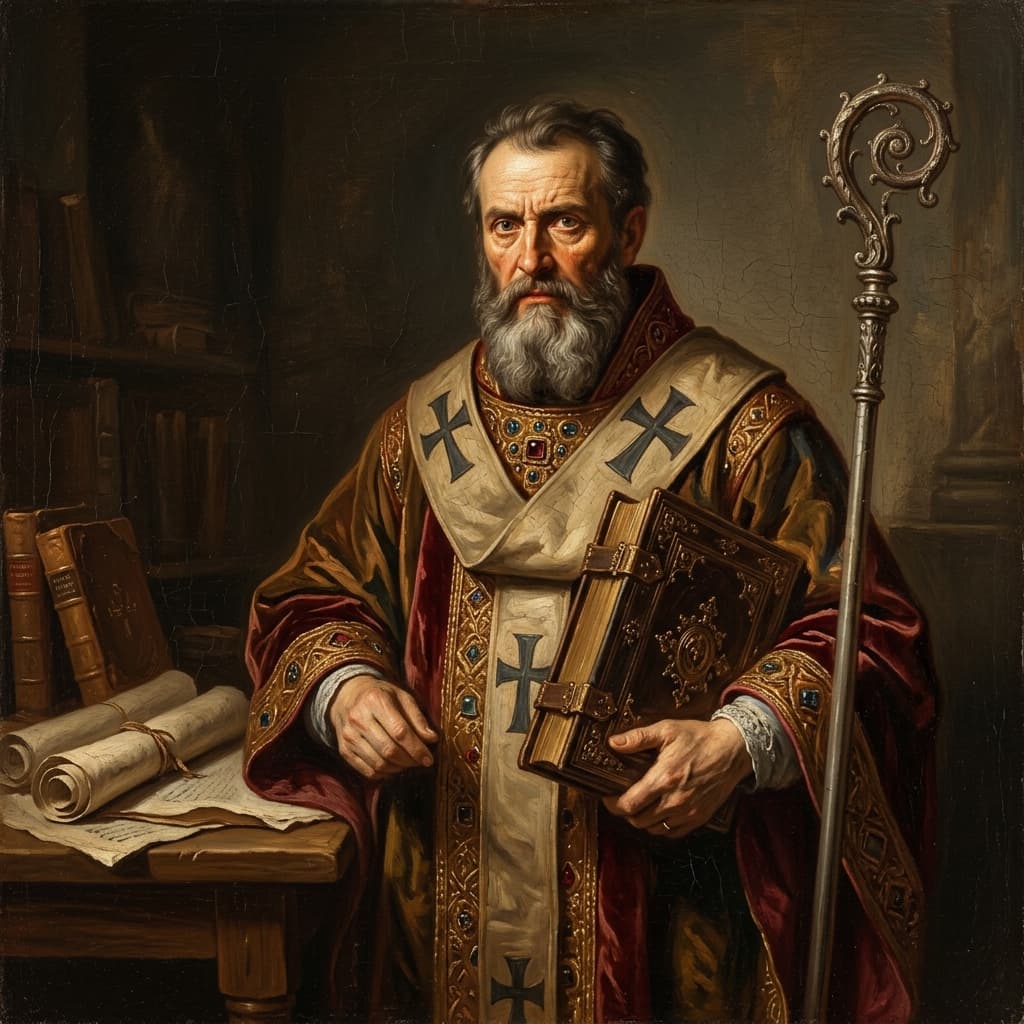
Lucifer of Cagliari
hereticNicene Era (4th C) · d. c. 370-371 CE · Updated April 9, 2026
Biography
Lucifer of Cagliari was a 4th-century bishop in Sardinia known for his extreme rigorist stance against Arianism during the Nicene Era. As the Bishop of Cagliari, he stood firmly against any compromise with Arianism, a belief that challenged the divinity of Christ. His unwavering position made him a notable figure in the battle to uphold the Nicene Creed, which had been established to affirm Jesus as being of the same substance as God the Father.
Throughout his career, Lucifer refused to reconcile with bishops who had accepted Arian doctrines, even temporarily. This refusal led him to break away and form a separate movement known as Luciferianism. The schism gained momentum after the Council of Alexandria in 362 CE, where Lucifer rejected the council's attempt at reconciliation with compromised bishops. Despite his fervent efforts, Lucifer's movement dwindled after his death around 370-371 CE and never received formal condemnation by an ecumenical council.
The 4th century was a time of intense theological debate, with the Arian controversy at its core. The struggle revolved around the nature of Christ and was fueled by political pressures that often swayed church leaders. The Nicene Creed sought to provide clarity, but its enforcement was inconsistent. Lucifer's unyielding rigorism stood out in this volatile period, as he refused to bend under political or ecclesiastical pressure. His defiance underscored the challenges the early church faced in defining orthodoxy amid conflicting influences.
Can clergy who compromised with heresy under pressure be restored to full ministry — or does such compromise permanently disqualify them and corrupt those they serve?
The question
Lucifer of Cagliari watched bishops capitulate to Arian formulas under imperial coercion. He viewed this as a betrayal of Nicene orthodoxy, a core tenet of his faith. This was not a theoretical dispute for him, but a crisis of conscience. He believed unwaveringly in the purity of doctrine, seeing any compromise as a grave sin. Lucifer's convictions were rooted in his understanding that faith was non-negotiable. The widespread acceptance of Arianism among clergy shocked him. He saw it as a surrender to political power rather than a commitment to divine truth. His stance was not just a theological position but a moral imperative.
Demanding permanent disqualification for compromised clergy meant drawing a hard line. It required the church to maintain absolute doctrinal purity. Those who faltered under pressure were seen as irrevocably tainted. This stance created a church divided, unable to reconcile those who had strayed. It led to factions, as seen in the formation of the Luciferian schism. The cost was a fractured community where unity became impossible. The church risked isolating itself, prioritizing purity over the strength found in numbers. Those who stood firm with Lucifer accepted the loneliness of their position as the price for integrity.
Restoring compromised clergy called for forgiveness and reintegration. It required the church to embrace those who had erred under duress. This position allowed for healing and unity but risked diluting the purity of doctrine. It unsettled those who had remained steadfast, questioning the value of their sacrifice. The church risked appearing weak, willing to bend under pressure. Yet, it offered a chance for a unified community, where past mistakes could be forgiven. The faithful were encouraged to look beyond failures, seeing in them the potential for redemption. This approach prioritized the collective health of the church over rigid adherence to purity.
Lucifer was trapped between purity and unity, unable to fully achieve either without sacrificing the other. His commitment to doctrinal purity made compromise seem like a betrayal. Yet the cost of rigidity was division and isolation. For ordinary believers, this was not just a theological debate. It affected their confidence in the legitimacy of their clergy and the sacraments. Their spiritual lives hung in the balance, dependent on the church's ability to guide them in faith. The controversy challenged their trust in the institution meant to uphold divine truth. In trying to protect the integrity of the church, Lucifer inadvertently fractured it, leaving believers to navigate a divided spiritual landscape.
The teaching
Lucifer of Cagliari taught that clergy who compromised with Arianism, even under pressure, were permanently disqualified from ministerial roles. He believed that any concession to heresy corrupted their spiritual integrity and rendered them unfit to serve the Church. Once they aligned with Arian beliefs, Lucifer argued, they could not be trusted to lead the faithful. Their past betrayal of true doctrine showed a lack of steadfastness, and thus, they should not return to positions of authority.
Lucifer based his stance on a combination of logic and scripture. He argued that any association with heresy tainted the clergy's ability to lead. In his treatise "De Athanasio," Lucifer contended that Athanasius's willingness to reconcile with compromised clergy betrayed true faith. He used passages like 2 Corinthians 6:14 to emphasize that light should have no fellowship with darkness, and those who had joined with heretical beliefs could not lead the Church. In "De non conveniendo cum haereticis," he insisted that even peaceful associations with heretics were unacceptable. He cited 1 Timothy 3:2 to argue that clergy must be above reproach, and Galatians 1:8 to highlight the curse upon those who deviate from true doctrine.
Those who valued doctrinal purity found Lucifer's teachings compelling. His rigorous stance attracted followers who feared that leniency toward compromised clergy would weaken the Church's integrity. His influence spread among communities wary of heretical infiltration, particularly in regions where Arianism had gained a foothold. Lucifer's teachings left a lasting mark, as evidenced by the continued debate around the restoration of compromised clergy in subsequent church councils.
The counterargument
The decisive argument against Lucifer of Cagliari centered on the essence of Christian forgiveness, rooted in the possibility of repentance and restoration. Lucifer argued that those who compromised their faith under persecution should remain outside the Church, denying them reconciliation. This stance clashed with the core Christian belief in the transformative power of grace. Athanasius of Alexandria, a staunch defender of Nicene orthodoxy, articulated the counter-argument. He insisted that the Church must embody forgiveness and reconciliation, as demonstrated by Christ. At the Council of Alexandria in 362 CE, Athanasius emphasized the importance of unity and healing, arguing that those who repented should be welcomed back. His reasoning was clear: to deny the possibility of repentance is to deny the very heart of Christian redemption.
Lucifer of Cagliari leaned heavily on certain scriptural passages to support his views. He cited Hebrews 6:4-6 to argue that those who fall away cannot be restored. The orthodox response clarified that this passage warned against apostasy but did not rule out repentance for those who genuinely seek it. Lucifer also used Matthew 10:33, claiming that denying Christ under pressure was unforgivable. The orthodox pointed to Peter's denial and subsequent restoration by Jesus as evidence that such acts could be forgiven upon repentance. Finally, Lucifer referenced 1 John 5:16, suggesting some sins lead to death and cannot be forgiven. The orthodox countered that this referred to persistent, unrepentant sin, not a single lapse under duress. The trap in Lucifer's position was that it contradicted the Church's mission of grace and reconciliation by permanently excluding those who faltered, thus undermining unity.
Addressing Lucifer's argument required the Church to discern genuine repentance, a process fraught with challenges and potential disputes over sincerity. This commitment demanded careful judgment and left open the problem of ensuring reconciliation was just and merciful. While the Church aimed for unity and healing, the subjective nature of repentance posed a new difficulty. Despite these challenges, the Church maintained its mission, exemplifying its commitment to forgiveness by welcoming back those who repented. The Council of Alexandria's decisions remain a testament to the enduring belief in the power of Grace to restore individuals and communities alike.
The resolution
In 362 CE, Athanasius of Alexandria convened the Council of Alexandria, attracting bishops from various regions to address a pressing issue: whether bishops who had compromised with Arianism due to imperial pressure could return to full ministry. Previously, the Roman Emperor Constantius II had supported Arianism, compelling many bishops to conform. But with his death and the rise of Julian the Apostate, who cared little for Christian disputes, the church found itself with a unique opportunity to resolve internal conflicts without external interference. At stake was not only theological purity but the unity and legitimacy of the Church's leadership.
The debate centered on two opposing views. Lucifer of Cagliari insisted that any compromise with Arianism permanently disqualified bishops from ministry, arguing for a strict, unforgiving approach. In contrast, Athanasius advocated for reconciliation and restoration, provided the bishops repented. The language of 'compromise' versus 'repentance and restoration' was crucial. It framed the discussion around forgiveness and the possibility of healing the Church's divisions. Ultimately, the Council endorsed Athanasius's position, allowing repentant bishops to be restored, which helped to unify the church under a more inclusive doctrine.
Despite this resolution, the controversy did not disappear. Lucifer of Cagliari's strict followers, known as Luciferians, rejected the decision and continued to exist as a separate faction. This schism persisted beyond Lucifer's death around 370-371 CE, reflecting ongoing tensions about church discipline. The Luciferians held onto their rigorist stance for some time, though they eventually faded as the broader Church moved towards healing and unity. The Council of Alexandria, while a significant step, left unresolved questions about how to handle clergy who faltered under external pressure, a debate that would echo in later church discussions.
Legacy
After the Council of Alexandria in 362 CE, Lucifer of Cagliari found himself at odds with the broader church. The council aimed to heal divisions caused by Arianism, but Lucifer refused to reconcile with bishops who had once sided with the Arians. He saw any compromise as a betrayal of true faith. Instead of yielding, he led his followers into schism, forming a separate community that held strictly to his principles. He continued this path until his death around 370-371 CE. Despite his fervor, his movement didn't face any formal condemnation from an ecumenical council, which might have solidified his opposition as a permanent faction within Christianity.
The Luciferian movement survived briefly after its founder's death, mainly in Sardinia, where Lucifer had been bishop, and in parts of Italy. His followers were known as Luciferians and adhered to a rigorist interpretation of faith, refusing communion with those they deemed tainted by association with Arianism. Yet, their numbers dwindled as the mainstream church, which sought unity, drew back many of the faithful. The lack of broader support and the church's refusal to see Lucifer's stance as a major threat meant that the movement faded into obscurity. Over time, most of Lucifer's followers were absorbed back into the larger church, leaving little trace of their once-defiant stand.
Today, the echoes of Lucifer's strict stance can still be felt in ongoing debates within some Christian denominations. Questions about whether clergy or leaders who falter under pressure should be reinstated continue to surface, especially in communities that prioritize doctrinal purity. Outside the church, this issue resonates in secular society as well, where public figures often face scrutiny over their integrity after compromising under duress. The long shadow of Lucifer of Cagliari's rigorism remains in these discussions about redemption and the limits of forgiveness, illustrating how historical religious debates can influence modern ethical dilemmas.
Continue reading with a Scholar plan
Upgrade to ScholarCommon questions
- Why was Luciferianism (schism) considered dangerous?
- Luciferianism was considered dangerous because it threatened the unity of the Church by refusing reconciliation with those who had compromised with Arianism. It created a separate schismatic church, undermining the authority of the broader ecclesiastical structure and challenging the decisions made at the Council of Alexandria in 362 CE.
- What exactly did Lucifer of Cagliari teach?
- Lucifer of Cagliari taught that bishops who had subscribed to Arian formulas under imperial pressure were permanently disqualified from ministry. He insisted that these bishops could not be readmitted to the Church, even if they repented, thus rejecting the possibility of reconciliation.
- Why did Luciferianism (schism) spread so widely?
- Luciferianism spread widely because it appealed to those who were disillusioned with the perceived leniency of the Church towards Arianism. The movement resonated with Christians who valued doctrinal purity and were frustrated by the compromises made by some Church leaders under political pressure.
- Who opposed Lucifer of Cagliari, and what was their argument?
- Lucifer of Cagliari was opposed by figures like Athanasius of Alexandria, who argued for the importance of reconciliation and unity within the Church. They believed that those who repented should be allowed back into the Church to maintain ecclesiastical harmony and uphold the decisions of the Council of Alexandria.
- Was Lucifer of Cagliari excommunicated, exiled, or executed?
- Lucifer of Cagliari was not executed, but he was exiled for a time due to his staunch opposition to Arianism and refusal to reconcile with those who had compromised. He was eventually allowed to return to Cagliari, where he continued to lead his followers until his death.
- Which council condemned Luciferianism (schism), and what did it decide?
- Luciferianism was not formally condemned by an ecumenical council. The schism gradually faded after Lucifer's death, as the Church focused on healing divisions and promoting unity rather than issuing formal condemnations.
- Did Lucifer of Cagliari ever recant?
- Lucifer of Cagliari did not recant his views. He remained steadfast in his beliefs until his death, continuing to lead his followers in opposition to any reconciliation with those who had compromised with Arianism.
- What is the difference between Luciferianism (schism) and orthodox Christianity?
- The primary difference is that Luciferianism refused to accept the reconciliation of bishops who had compromised with Arianism, while orthodox Christianity sought to restore unity by allowing repentant bishops back into the Church. Luciferianism prioritized doctrinal purity over ecclesiastical unity.
- Are there modern versions of Luciferianism (schism)?
- There are no direct modern versions of Luciferianism as it existed in the 4th century. However, the issues of doctrinal purity versus ecclesiastical unity continue to be relevant in various Christian denominations today.
- Is there anything Lucifer of Cagliari got right?
- Lucifer of Cagliari was correct in recognizing the dangers of Arianism and the importance of maintaining doctrinal integrity. His commitment to orthodoxy highlighted the need for the Church to address theological compromises seriously.
- Why does Luciferianism (schism) still matter today?
- Luciferianism matters today as a historical example of the challenges the Church faces in balancing doctrinal purity with unity. It serves as a reminder of the complexities involved in reconciling differing theological positions within a religious community.
- Why did Lucifer of Cagliari sincerely believe his position was correct? What was he actually defending — and why did he see the alternatives as worse?
- Lucifer of Cagliari sincerely believed his position was correct because he was defending the purity of Christian doctrine against what he saw as the heretical influence of Arianism. He viewed the alternatives as worse because they involved compromising with those who had betrayed the faith, potentially leading to further doctrinal corruption.