Library
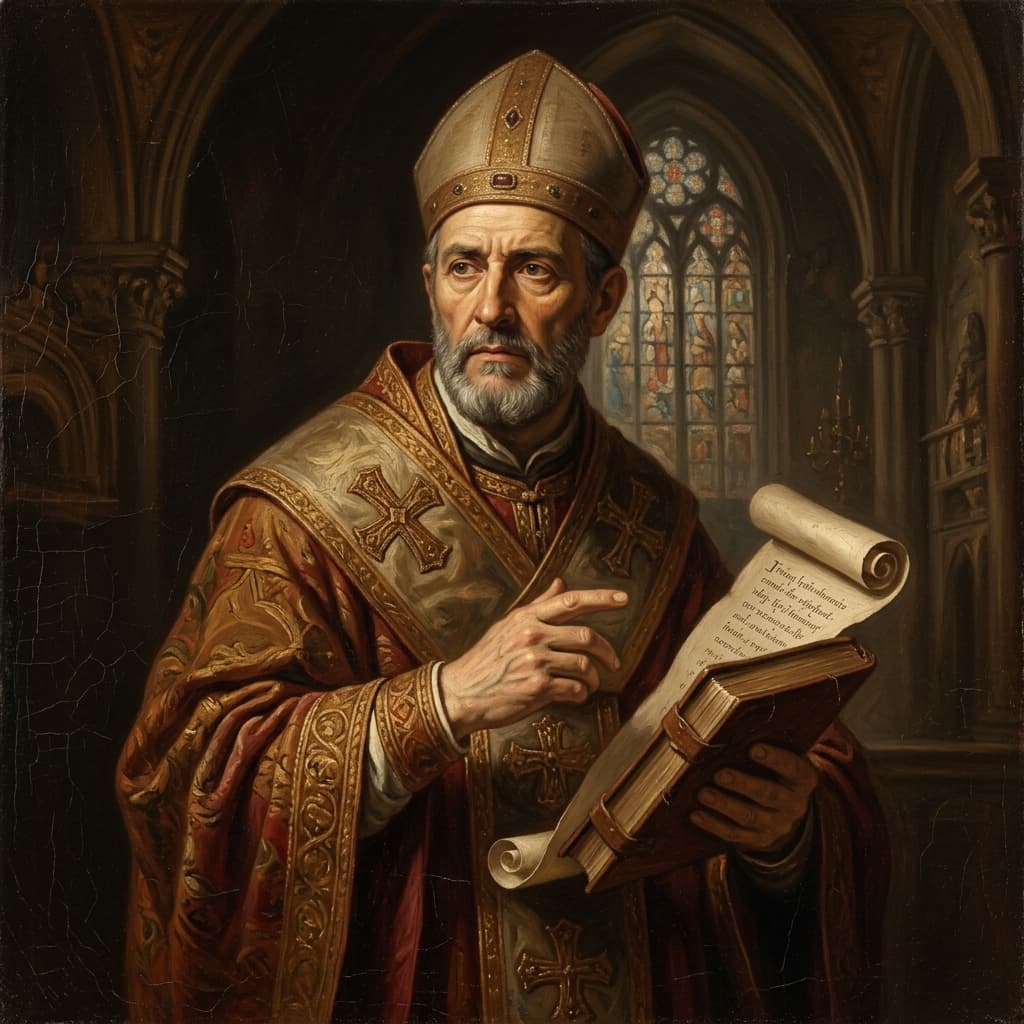
AI-generated illustration
Library
Nicene Era (4th C) · d. c. 362 CE · Updated April 9, 2026
Macedonius I was a bishop of Constantinople during the Nicene Era in the 4th century, known for leading the Semi-Arian Pneumatomachian party. He played a significant role during a period when the Christian Church was embroiled in debates about the nature of the Trinity. Although he accepted the Nicene formula regarding the Son, Macedonius denied the full divinity of the Holy Spirit, aligning himself with a theological stance later condemned as heretical.
Macedonius assumed the role of bishop in the bustling city of Constantinople, a key center of early Christianity. His tenure was marked by theological controversy, particularly his association with the movement that came to be known as Macedonianism. This doctrine, which he championed, contested the divinity of the Holy Spirit, diverging from the emerging orthodox position. Macedonius's influence waned as his views fell out of favor, culminating in the First Council of Constantinople in 381 CE, which officially condemned Macedonianism. He died around 362 CE, leaving behind a complex legacy.
The 4th century was a crucible of theological debate, driven by the need to clarify Christian doctrine after the Nicene Creed of 325 CE. The Church grappled with questions of divine nature, and figures like Macedonius were at the forefront of these discussions. The controversy over the Holy Spirit's divinity reflected broader struggles to define orthodoxy, as the faith spread across diverse cultures and interpretations of scripture varied. The First Council of Constantinople's condemnation of Macedonianism underscored the Church's commitment to a unified doctrine, setting a precedent for future theological resolutions.
Is the Holy Spirit fully God and co-equal with the Father and Son, or a created being subordinate to them — and what is at stake in the answer?
Macedonius I saw the theological debates of his time not as abstract disputes but as essential inquiries into the very nature of God. He believed that the Holy Spirit, while divine, held a subordinate position to the Father and the Son. This conviction was not born out of defiance but from a genuine attempt to understand the nature of divinity through the lens of existing Semi-Arian thought. Macedonius found himself grappling with the writings and teachings that emphasized a hierarchy, a perspective that seemed, to him, consistent with both tradition and reason. For Macedonius, the idea of a subordinate Holy Spirit preserved a sense of order within the divine, aligning with a structured view of the cosmos.
To argue that the Holy Spirit is fully God and co-equal with the Father and the Son requires accepting the Nicene Creed's declaration of unity within the Godhead. This stance demands the rejection of any notion that the Spirit holds a lesser status. It costs the abandonment of deeply ingrained beliefs about hierarchy within the divine, challenging those who saw order as essential to understanding God. This path leads to the affirmation of the Spirit's full divinity, a position solidified by the First Council of Constantinople. The result is a unified vision of God, where the Spirit is not merely an emissary but an integral presence, fully sharing in the divine essence.
The alternative view, embraced by Macedonius, sees the Holy Spirit as a created being, a view that aligns with a tiered understanding of the divine. This position necessitates rejecting the full implications of the Nicene Creed and accepting a division within the Godhead. The cost is significant, as it places Macedonianism at odds with emerging orthodoxy and ultimately leads to its condemnation as heretical. By insisting on the Spirit's subordination, this perspective envisions a Godhead with distinct roles and authority levels, risking fragmentation within the Church itself. This understanding reduces the Spirit to a ministering role, vital yet not equal, a view that the broader Church could not sustain.
The struggle between these positions reflects a deeper tension: how to reconcile a hierarchical understanding of divinity with the emerging consensus of co-equality. Both sides feared losing a coherent vision of God's nature. For ordinary believers, this debate was not merely theological but practical. It influenced their prayers, shaping how they understood God's presence in their lives and their relationship with the divine. The Holy Spirit's role in salvation and sanctification became a personal matter, affecting liturgical practices and the hope placed in the divine. This controversy touched the heart of faith, prompting believers to question and affirm what it means to encounter God in their everyday lives.
Macedonius I taught that the Holy Spirit is not fully God but a created being, subordinate to the Father and the Son. He accepted that the Son was divine, in line with the Nicene Creed, but drew the line at the Holy Spirit. To him, the Spirit was more of a divine agent or messenger, lacking the full divine status of the Father and the Son. Macedonius viewed this hierarchy as essential for maintaining order within the Trinity.
Macedonius used a combination of logic and scripture to support his view. He argued that the roles and functions of the Holy Spirit, as seen in various biblical passages, indicated a subordinate status. In John 16:13, the Spirit is described as a guide who speaks only what he hears, suggesting a role dependent on another's authority. Acts 2:4 and 1 Corinthians 12:11 further depict the Spirit as enabling and distributing gifts, reinforcing the idea of a ministerial, created role. Macedonius articulated these arguments in his "Letter to the Semi-Arians," where he proposed that the Spirit's position as a minister aligns with the view of the Spirit as a created being.
This teaching found an audience among those uncomfortable with the notion of the Holy Spirit as co-equal with the Father and the Son. It appealed especially to Semi-Arians, who already questioned aspects of the Trinity's unity. By accepting the Nicene formula for the Son but not the Spirit, Macedonius offered a theological compromise. His teaching spread among those who favored a clear hierarchy within The Trinity. Despite its appeal, the church ultimately rejected this view, affirming the full divinity of the Holy Spirit in the Council of Constantinople in 381.
The case against Macedonius I hinged on the argument that the Holy Spirit's full divinity is crucial for maintaining the coherence of the Trinity. Without the Spirit being fully divine, the Trinity's unity and co-equality fall apart, creating a hierarchy that clashes with the Nicene concept of one essence shared by the Father, Son, and Holy Spirit. Gregory of Nazianzus, a theologian and Archbishop of Constantinople, spearheaded this intellectual move. In his "Theological Orations," Gregory insisted that the Spirit's divinity is embedded in both the baptismal formula and the Spirit's role in sanctification. He argued that these elements underscore the Spirit's equal standing within The Trinity, thus preserving its oneness.
Macedonius I leaned on specific scripture to support his claims. He cited John 14:28, interpreting it as evidence of a hierarchy within The Trinity, with the Spirit as lesser. The orthodox response clarified that this passage speaks to the roles within the economic Trinity, where function does not indicate inequality of essence. In 1 Corinthians 12:11, Macedonius viewed the Spirit's action as subordinate, while orthodoxy highlighted the Spirit's sovereign will in distributing gifts as a mark of divine authority. Romans 8:27 was taken by Macedonius to imply the Spirit's lack of omniscience. The orthodox answer emphasized the passage's depiction of profound unity and knowledge between the Spirit and God. The trap in Macedonius's position was clear: a creaturely Spirit could not accomplish the divine tasks of sanctification and deification, thereby undermining salvation itself.
Countering Macedonius required a deeper theology of the Holy Spirit, which earlier creeds had not fully developed. This need to articulate the Spirit's distinct personhood while maintaining the Trinity's unity opened new theological challenges. The orthodox stance had to ensure that the Spirit's divinity did not blur with the Father and the Son's roles, demanding precise articulation of the Spirit's unique work. This development was crucial, as it laid the groundwork for the eventual inclusion of the Spirit in the Nicene Creed's final form, ratified in 381 CE at the First Council of Constantinople.
In 381 CE, the First Council of Constantinople gathered at the behest of Emperor Theodosius I, who aimed to unify the Eastern Roman Empire under a single Christian doctrine. The meeting attracted 150 bishops, mostly from the eastern regions of the empire. Theodosius, a staunch supporter of the Nicene Creed, understood that theological unity was essential for political stability. Divisions over the nature of the Holy Spirit threatened to fragment his realm, undermining both religious cohesion and imperial authority. This council presented an opportunity to address these divisions and reinforce the Nicene position as the orthodox teaching.
The heart of the debate lay in the nature of the Holy Spirit. Was the Spirit fully divine and equal to the Father and the Son, or was it a lesser, created being as Macedonianism suggested? The crux of the argument hinged on Greek terms: 'homoousios', meaning "of the same essence", versus 'homoiousios', "of similar essence". Macedonius and his followers contended for the latter, suggesting a hierarchical Trinity. The council rejected this view, declaring the Spirit co-equal with the Father and the Son, and condemned Macedonianism as heretical. They formalized this in the Nicene-Constantinopolitan Creed, affirming the Spirit's divinity and its role within the Trinity.
Despite the council's decisive ruling, the controversy over the Holy Spirit's nature did not vanish. Arian and Semi-Arian factions continued to challenge the Nicene formulation. Regional resistance in parts of the empire persisted, and theological debates over the Spirit's procession eventually culminated in the Filioque controversy. This dispute contributed to the East-West Schism in 1054 CE, demonstrating that the council's resolution, while significant, did not quash all doctrinal conflicts. The question of the Spirit's nature lingered, influencing Christian theology for centuries.
After the First Council of Constantinople in 381 CE condemned Macedonius I's teachings, his influence waned dramatically. Removed from his role as Bishop of Constantinople, he spent his remaining years in obscurity, passing away around 362 CE. The council's decision marked him as a heretic, effectively erasing his theological positions from the official doctrines of the church. His teachings, which questioned the full divinity of the Holy Spirit, were pushed to the fringes of Christian thought.
Despite the official condemnation, Macedonianism didn't disappear overnight. Certain Semi-Arian groups clung to his views, rejecting the full divinity of the Holy Spirit while maintaining a form of Christianity distinct from Nicene orthodoxy. These ideas found pockets of support within the Eastern Roman Empire, particularly among communities resistant to the dominant theological currents. Over time, as Nicene orthodoxy solidified its hold on Christian doctrine, these groups dwindled, but the echoes of Macedonius's ideas lingered.
Today, remnants of Macedonianism appear in some non-trinitarian Christian groups that continue to question the full divinity of the Holy Spirit. This perspective occasionally surfaces in broader secular discussions about divine hierarchies and how religious texts interpret the nature of God. For instance, some modern religious thinkers explore the concept of a subordinate Holy Spirit when debating the structure of divine authority. These discussions show that Macedonius's legacy, though diminished, still sparks dialogue on the complexities of faith.
Continue reading with a Scholar plan
Upgrade to ScholarAI-generated illustration