The Great Schism
Church history · Updated August 15, 2026
Overview
The Great Schism, the monumental division between the Roman Catholic Church and the Eastern Orthodox Church, arose partly from a disagreement over a single word in the Nicene Creed. "Filioque," meaning "and the Son," was added by the Western Church to the description of the Holy Spirit's procession. Originally, the Creed stated that the Holy Spirit proceeds from the Father, a statement accepted by both the Western and Eastern branches of Christianity. However, the Western Church's addition suggested that the Holy Spirit proceeds from both the Father and the Son, a minor theological tweak that ignited deep-seated tensions between the two sides.
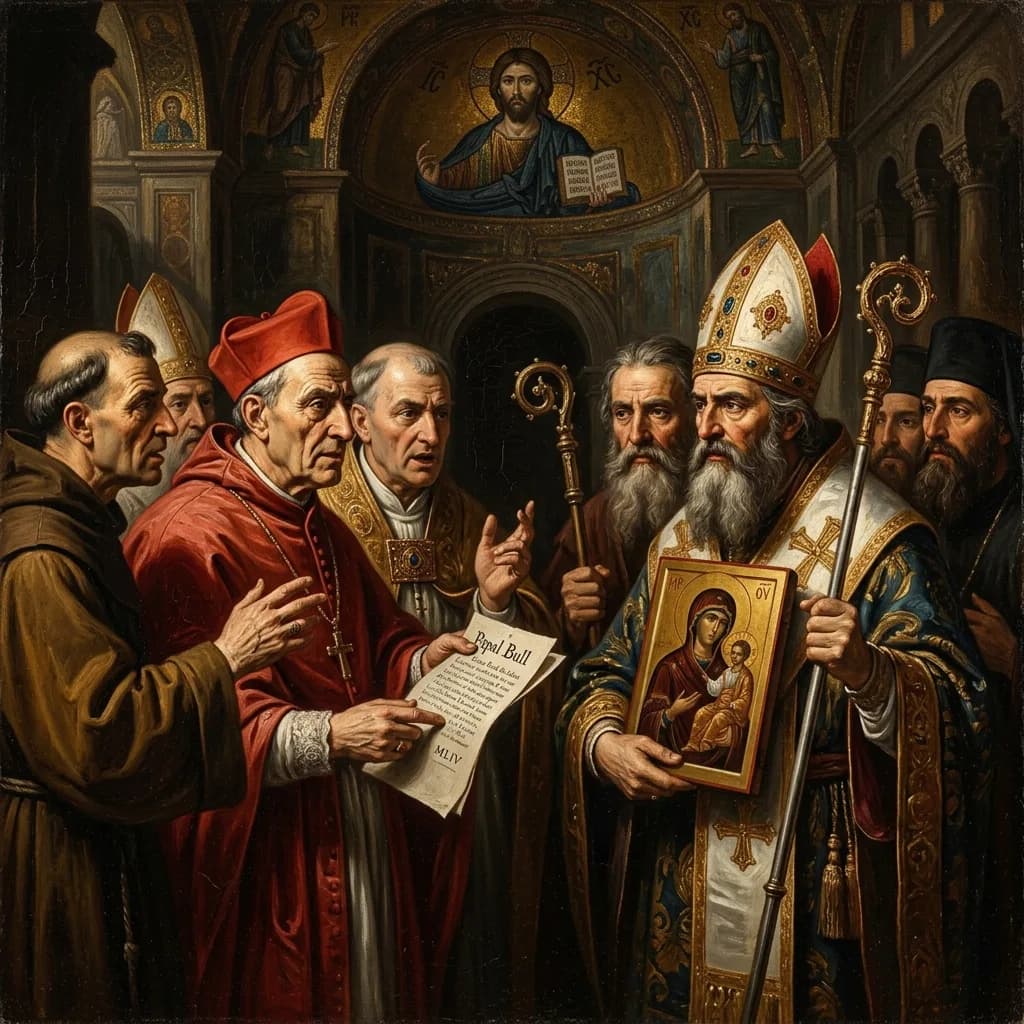
In 1054, the Schism officially took shape, with Pope Leo IX and Patriarch Michael I Cerularius at the epicenter of the conflict. Theological disagreements, cultural differences, and political rivalries between the Latin-speaking West and the Greek-speaking East had strained relations between the two branches. Amidst this charged atmosphere, the dispute over "Filioque" became a lightning rod. Pope Leo IX sent a delegation to Constantinople to assert Roman authority, and Patriarch Michael I Cerularius responded by closing Latin churches in his region. Mutual excommunications were declared, with each side effectively cutting the other off from the Christian community.
Today, the division initiated by the Great Schism remains, with the Roman Catholic Church and the Eastern Orthodox Church still distinct entities. While efforts have been made to bridge this ecclesiastical divide, the two traditions continue to differ on key theological and liturgical issues. Despite these differences, both churches maintain a shared heritage rooted in early Christianity, and dialogues continue in pursuit of greater understanding and unity.
The Great Schism was partly fueled by a disagreement over a single word in the Nicene Creed.
Why Fighting Over The Great Schism Was a Big Deal
The Great Schism was not just a theological debate over a single word in a creed; it was a power struggle over who held the reins of ecclesiastical authority. The real issue at stake was whether the Pope in Rome or the patriarchs of the Eastern Church had the power to define Christian doctrine and practice. Both sides were fighting for supremacy in the Christian world. The Western Church, under Pope Leo IX, sought to centralize control by asserting the Pope's authority over all of Christendom. Meanwhile, the Eastern Orthodox Church, led by Patriarch Michael I Cerularius, aimed to maintain the autonomy of its regional leaders, resisting any attempts to subsume their traditions under Roman rule. This was not just a matter of belief, but of control over the religious and cultural landscape of Europe and the Near East.
The struggle reached a boiling point on July 16, 1054. Cardinal Humbert of Silva Candida, representing Pope Leo IX, marched into the Hagia Sophia and placed a decree of excommunication on the altar, targeting Patriarch Michael I Cerularius. In retaliation, Cerularius excommunicated Humbert and his delegation. This mutual excommunication was a declaration of independence and rejection of Roman authority by the Eastern Church. For the Roman Catholic Church, winning meant consolidating power under the Pope, which would strengthen their influence across Christian territories. The Eastern Orthodox Church, on the other hand, had to resist this to preserve its regional independence, traditions, and authority. Each side believed that its vision of Christianity was at stake.
This conflict has never been resolved due to theological, cultural, and political differences that have persisted for centuries. The schism was compounded by subsequent historical events, such as the Crusades and the rise of national churches, which further entrenched the division between the two branches. The cultural divide between the Latin-speaking West and the Greek-speaking East only widened over time, complicating any attempts at reconciliation. To this day, the Roman Catholic and Eastern Orthodox Churches remain distinct entities, each holding firm to its traditions and interpretations of Christianity. These differences have shaped the history of Christianity, and the schism continues to influence religious relations in the present day.
Continue reading with a Scholar plan
Upgrade to ScholarCommon questions
- What caused the Great Schism?
- The Great Schism was caused by theological disagreements, particularly over the 'Filioque' clause in the Nicene Creed, and power struggles over ecclesiastical authority between the Pope in Rome and the patriarchs of the Eastern Church.
- How did the Great Schism affect Christianity?
- The Great Schism resulted in the permanent division of Christianity into the Roman Catholic Church in the West and the Eastern Orthodox Church in the East, each developing distinct theological and liturgical traditions.
- Who was involved in the Great Schism?
- Key figures in the Great Schism included Pope Leo IX and Patriarch Michael I Cerularius, along with Cardinal Humbert of Silva Candida, who played a significant role in the mutual excommunications of 1054.
- What role did the Filioque controversy play in the Great Schism?
- The 'Filioque' controversy, involving the addition of 'and the Son' to the Nicene Creed by the Western Church, was a major theological dispute that fueled tensions and contributed to the division between the Eastern and Western Churches.
- How did the Great Schism change the structure of the Church?
- The Great Schism led to the formal separation of the Christian Church into two distinct entities: the Roman Catholic Church in the West and the Eastern Orthodox Church in the East, each with its own hierarchy and traditions.
- What are the theological differences between the Eastern and Western Churches?
- Theological differences include the 'Filioque' clause, the nature of the Holy Spirit's procession, and views on papal authority, with the Western Church emphasizing the Pope's supremacy and the Eastern Church advocating for a more conciliar approach.
- Why did the Eastern Orthodox Church split from the Roman Catholic Church?
- The Eastern Orthodox Church split from the Roman Catholic Church due to theological disagreements, cultural differences, and a rejection of the Pope's attempts to assert authority over the Eastern patriarchs.
- How did the Great Schism impact the political landscape of Europe?
- The Great Schism deepened the cultural and political divide between the Latin-speaking West and the Greek-speaking East, influencing alliances and conflicts in Europe and contributing to the distinct development of Western and Eastern Christian societies.
- What attempts have been made to reconcile the Eastern Orthodox and Roman Catholic Churches?
- Various attempts at reconciliation have been made, including dialogues and meetings between church leaders, such as the Second Vatican Council and the Joint International Commission for Theological Dialogue, but significant theological and cultural differences remain.
- What was the significance of the mutual excommunications in the Great Schism?
- The mutual excommunications in 1054 symbolized the formal break between the Roman Catholic and Eastern Orthodox Churches, marking a definitive split and asserting independence from each other's authority.
- How is the Great Schism viewed by the Eastern Orthodox Church today?
- The Eastern Orthodox Church views the Great Schism as a historical event that solidified its independence and distinct traditions, while continuing to engage in dialogues aimed at fostering understanding with the Roman Catholic Church.
- What events led up to the Great Schism?
- Events leading up to the Great Schism included long-standing theological disputes, cultural and linguistic differences, and political tensions between the Latin-speaking West and Greek-speaking East, culminating in the mutual excommunications of 1054.
- What are the long-term effects of the Great Schism on global Christianity?
- The long-term effects of the Great Schism include the continued existence of two major branches of Christianity with distinct traditions, influencing religious, cultural, and political developments globally and shaping Christian ecumenical efforts.