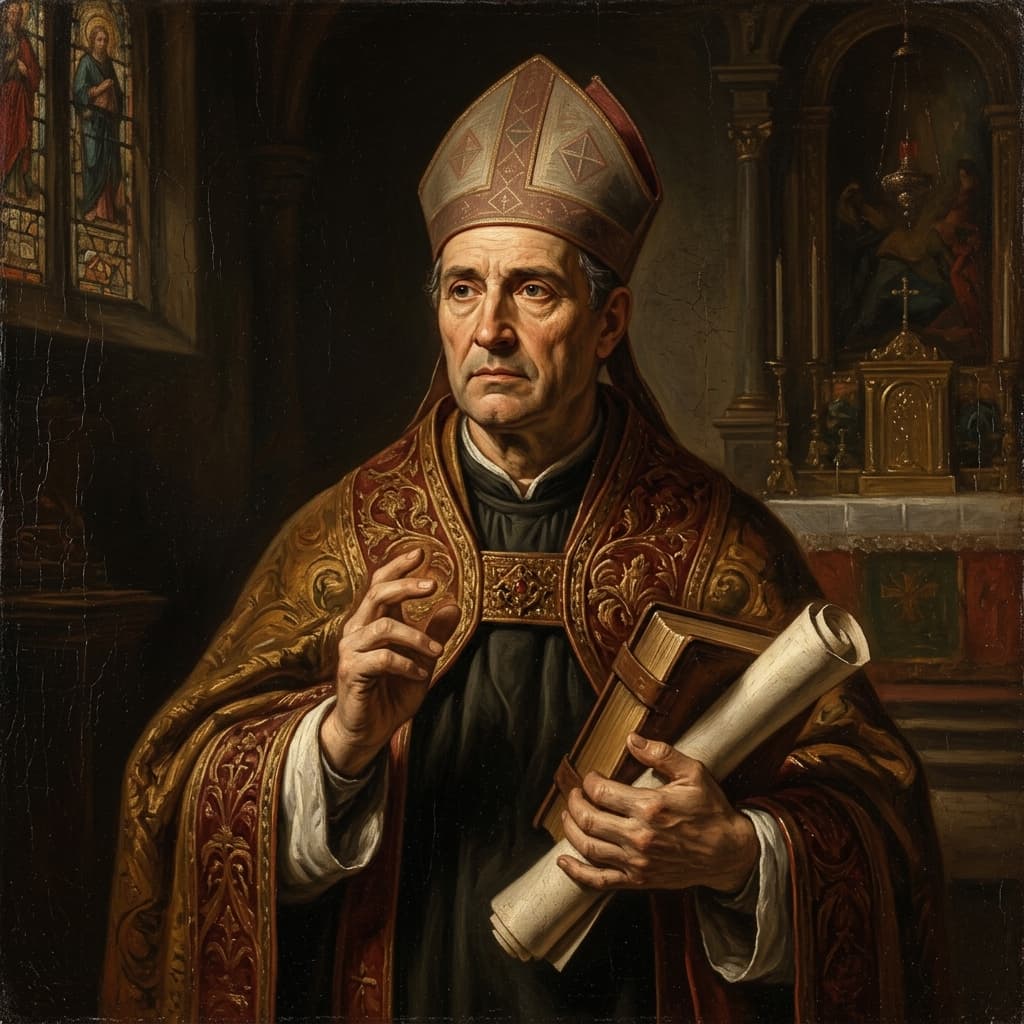
Marcellus of Ancyra
hereticNicene Era (4th C) · c. 280-374 CE · Updated April 9, 2026
Biography
Marcellus of Ancyra was a 4th-century bishop from Ancyra, known for his opposition to Arianism and his controversial theological views during the Nicene Era. He played a significant role in the early Christian church's efforts to combat Arianism, a belief that denied the full divinity of the Son. His tenure as bishop placed him at the heart of the theological battles that defined early Christian orthodoxy.
Born around 280 CE, Marcellus rose to prominence as the Bishop of Ancyra, a central position in the Christian world. His career was marked by both his alliance with Athanasius in opposing Arianism and the controversies his own teachings stirred. Marcellus developed a theological perspective, later dubbed Marcellanism, which argued that the Son and Spirit were temporary manifestations of the divine. This view brought him under scrutiny and led to his condemnation at the Council of Constantinople in 336 CE. His teachings resulted in two exiles, reflecting the intense backlash from church authorities.
The 4th century was a turbulent period for theological debate within Christianity. The church was embroiled in defining the nature of the Trinity and addressing differing views like Arianism. Marcellus’s ideas challenged the emerging consensus by suggesting that the Son and Spirit were not eternal. This put him at odds with the orthodoxy that was forming in the wake of the Council of Nicaea. The controversy surrounding Marcellus illustrates the fierce struggle to establish clear doctrinal boundaries during this era of religious evolution. His condemnation at the Council of Constantinople marks a pivotal moment in the church's journey toward defining its core beliefs.
Does the Son have eternal, personal existence distinct from the Father — or does he exist only in relation to creation and redemption, and will he ultimately be reabsorbed into the divine unity?
The question
Marcellus of Ancyra found himself at the heart of a theological storm, driven by his deep engagement with the works of Origen and the Arian controversy. Origen's writings had laid seeds of thought that emphasized the distinct existence of the Son, while the Arian debates highlighted the dangers of diminishing the Son's divinity. Marcellus, committed to preserving the unity of God, saw no path but to argue that the Son did not have an eternal, personal existence distinct from the Father. To him, any suggestion otherwise risked fragmenting the divine essence. He believed that the Son's manifestation was tied to creation and redemption, a temporary role that would ultimately merge back into the divine unity. This stance, he thought, was the only way to protect the core of monotheism.
If the Son has eternal, personal existence distinct from the Father, it requires accepting a plurality within the Godhead. This notion fractures the strict monotheism central to Christian doctrine. It introduces a hierarchy where the Son becomes a lesser deity, skewing the equality within the Godhead. A divided understanding of God emerges, complicating worship. The unity of divine essence becomes a casualty, and the foundational belief in one God faces erosion. Such division confounds the believer, leading to potential polytheism. Marcellus saw this as an untenable risk, a path that led away from true faith.
Conversely, if the Son exists only in relation to creation and redemption, and will ultimately be reabsorbed into the divine unity, the Son's role shrinks. He becomes a temporary figure, not a co-eternal divine person. The Incarnation loses weight, and Redemption becomes transient rather than eternal. This view challenges the permanence of the Son's divinity. It erodes the ongoing intercessory role of the Son, leaving the faithful with a diminished hope. Marcellus's critics saw this as undermining the eternal nature of the Son's existence, a view that stripped the divine narrative of its power and promise.
The tension between maintaining God's unity and affirming the Son's distinct personhood was inescapable. Neither side could afford to abandon their core commitments without unraveling the fabric of their beliefs. For ordinary believers, this debate shaped their perception of Christ and the divine relationship. It influenced how they prayed and understood divine intervention. The presence of the Son in their spiritual lives was not just a theological abstraction but a source of hope and comfort. The stakes were high. The struggle to define the Son's nature was not just a battle of ideas but a quest to preserve the heart of Christian faith.
The teaching
Marcellus of Ancyra taught that the Son and the Spirit do not possess eternal, separate existence from the Father. Instead, he saw them as temporary expressions of the single divine being, existing solely for the tasks of creation and redemption. Marcellus believed that once these tasks were completed, the Son and the Spirit would be reabsorbed back into the Father, restoring the divine unity.
Marcellus based his views on a desire to preserve the unity of God. He argued that recognizing the Son and Spirit as eternal and separate would fracture that unity. In his treatise "Against Asterius," Marcellus countered the idea that the Son was subordinate to the Father. He used scriptures like 1 Corinthians 15:28 to show that the Son's role is temporary, destined to fold back into the Father. John 10:30 supported his belief in a singular divine essence, and Hebrews 1:3 illustrated the Son as an extension of God's power, not an independent figure.
Marcellus's teachings resonated with those who wanted to avoid any hint of polytheism in Christianity. His ideas found traction among believers who valued a cohesive, singular divine essence over the complexities of distinct divine persons. While his views never matched the widespread acceptance of mainstream Trinitarian doctrine, they stirred significant debate and concern among early church leaders. By the mid-4th century, his ideas were influential enough to prompt fierce theological discussions, illustrating their impact on the shaping of early Christian doctrine.
The counterargument
The central argument against Marcellus of Ancyra rested on the claim that his views dismantled the eternal distinction within the Trinity, essential for its coherence. Eusebius of Caesarea led this charge, arguing that Marcellus's teachings effectively denied the eternal generation of the Son and the procession of the Spirit. Eusebius contended that without eternal distinctions, the Trinity collapses into a temporary event, undermining its foundational scriptural basis. He laid out this critique in his work "Against Marcellus," asserting that Marcellus's view reduced the Godhead to a mutable state, contradicting the everlasting interrelations between the Father, Son, and Holy Spirit.
Marcellus used several scriptural passages to support his claims, but each was systematically countered by orthodox thinkers. He interpreted 1 Corinthians 15:28 as signifying the Son's reabsorption into the Father, but the orthodox response clarified that this verse referred to the completion of the Son's mediatorial role, not the dissolution of his distinct personhood. In John 10:30, Marcellus saw unity of essence as negating personal distinction, yet the orthodox position highlighted that the unity spoken of did not eliminate the distinct roles within The Trinity. Lastly, he viewed John 14:28 as supporting temporary subordination, which was refuted by explaining it as reflecting the Son's role during the incarnation, not a permanent hierarchical structure. The trap in Marcellus's argument was its implication that the divine nature was changeable, contradicting God's immutability and undermining the reliability of divine revelation.
The orthodox counter-argument demanded a refined understanding of the relational distinctions within The Trinity, spurring deeper theological exploration. This required clarifying how the eternal generation of the Son and the procession of the Spirit maintained personal distinctions without compromising unity. These explorations opened complex discussions on divine relations and the language used to describe them, necessitating a more nuanced theological vocabulary. This pursuit of clarity contributed to the development of creeds and doctrines that further articulated the nature of The Trinity, culminating in the Nicene Creed's affirmation of the eternal coexistence of the Father, Son, and Holy Spirit.
The resolution
In 336 CE, Emperor Constantine I convened the Council of Constantinople in the heart of the Eastern Roman Empire. The gathering was more than a theological debate; it was a critical moment for the empire's unity. Bishops and theologians from across the region assembled to address the contentious issue of the Trinity's nature. Constantine's primary concern was political stability. He feared that unresolved theological divisions, particularly those stirred by Marcellus of Ancyra, could fracture the empire. Marcellus proposed that the Son and the Spirit were not distinct from the Father but temporary projections of the divine. This view threatened to disrupt the fragile religious cohesion Constantine had fought to preserve.
At the council, Marcellus's ideas faced strong opposition. His critics, many influenced by Arianism, argued that the Son and the Spirit possessed distinct, eternal existence separate from the Father. The debate hinged on precise language: were the Son and Spirit of the "same substance" or merely "similar substance" to the Father? This distinction carried immense weight, with implications for understanding the divine relationship. The council ultimately condemned Marcellus's teachings as heretical, reinforcing the Nicene Creed's stance that the Son's existence remained eternally distinct from the Father.
Despite the council's resolution, the controversy over the Trinity's nature did not end. The church continued to grapple with these theological issues. Arianism and other interpretations persisted, challenging the council's conclusions. Figures like Eusebius of Caesarea kept the debate alive, leading to further disputes and the need for additional councils. The First Council of Constantinople in 381 CE revisited these issues, attempting to bring greater clarity and unity. The resolution of 336 CE, while significant, was not the final word. The debate over The Trinity's nature continued to shape Christian doctrine for centuries.
Legacy
After the Council of Constantinople in 336 CE condemned Marcellus of Ancyra, his life took a tumultuous turn. Exiled due to his controversial views on the nature of Christ, Marcellus found temporary reprieve under Emperor Constantius II, who allowed him to return to his position as bishop. Yet, his return was short-lived. As theological opposition mounted, Marcellus faced deposition once more and lived out his remaining years on the fringes of the church, passing away around 374 CE. His marginalization marked a significant fall from his earlier influence within the Christian community.
Despite his personal downfall, Marcellus's teachings did not vanish overnight. His followers, known as Marcellians, continued to advocate for his perspectives, particularly his understanding of the Son and the Spirit. Though their movement never reached the prominence of other Christian factions, they left an imprint on theological discourse. As the Nicene Creed gained wider acceptance, the Marcellians struggled to maintain their foothold. Nevertheless, traces of their thought lingered, subtly influencing later debates on the nature of the Trinity and the relationship between its persons.
Today, echoes of Marcellus's ideas appear in modern Unitarian and non-Trinitarian Christian groups. These groups often emphasize the oneness of God, a principle central to Marcellus's teachings, over the distinct personhood emphasized in traditional Trinitarian doctrine. His emphasis on divine unity aligns with certain philosophical views that prioritize a singular divine essence. This legacy remains tangible, as seen in the ongoing conversations about the nature of God within these communities, demonstrating that Marcellus's theological impact, though diminished, has not entirely faded from the Christian landscape.
Continue reading with a Scholar plan
Upgrade to Scholar