Library
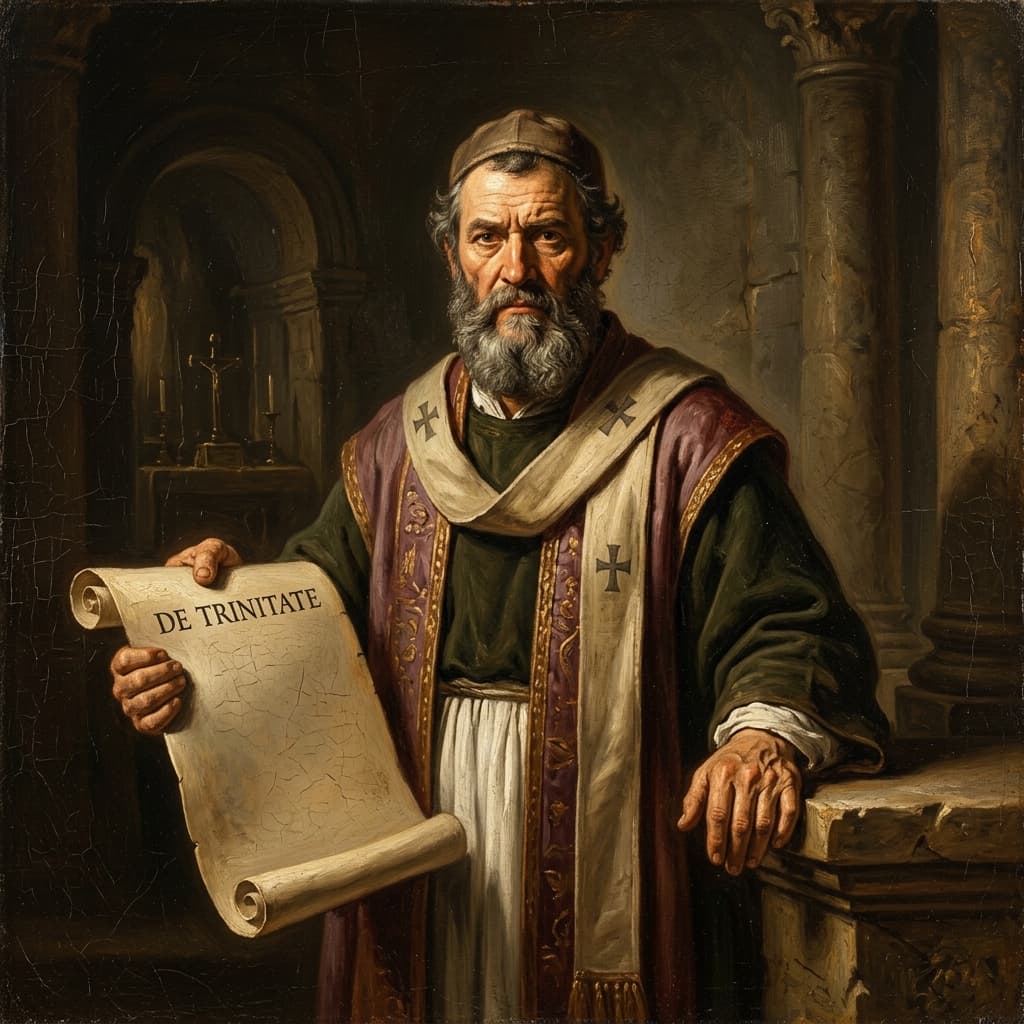
AI-generated illustration
Library
Early Church (2nd-3rd C) · c. 200-258 CE · Updated April 9, 2026
Novatian was a Roman presbyter and theologian in the Early Church era, known for being the first significant Latin theologian and a rival bishop of Rome after Cornelius. His influence and writings marked him as a pivotal figure in the theological debates of his time. He emerged as a staunch advocate for strict adherence to Christian purity, making him a contentious figure in the church's history.
Novatian's life unfolded during a tumultuous period in the third century. In 251 CE, a synod at Rome condemned him for his rigid stance on the lapsi — Christians who had renounced their faith during the Decian persecution. Novatian insisted that these apostates could not be readmitted to the church, which led to his schism with Cornelius, the bishop of Rome. Declaring himself a rival bishop, Novatian gathered followers who shared his vision of a "community of the pure." His congregations, though condemned, persisted for two centuries, illustrating the enduring appeal of his uncompromising ideals.
The backdrop of Novatian's controversy was the Decian persecution, a time when Christians across the Roman Empire faced severe pressure to abandon their faith. The crisis over the lapsi challenged the church's understanding of forgiveness and ecclesiastical authority. Could the church forgive grave sin? Novatian's firm "no" divided believers and questioned the church's role in forgiving and reintegrating those who faltered. Despite his eventual condemnation, Novatian's challenge to the church's authority and his demand for purity left a lasting impact, as his congregations continued to thrive long after his death.
Can the church forgive and restore those who denied the faith under persecution — or does such apostasy permanently exclude a Christian from the body of Christ?
Novatian, a man deeply scarred by the Decian persecution, witnessed the faith of many crumble under the threat of death. He saw Christians, once stalwart in their beliefs, renounce their faith to escape execution. For Novatian, this apostasy was more than a personal failing; it was a betrayal of the entire community. He believed that the church could only preserve its sanctity by upholding strict moral and doctrinal purity. Those who denied their faith had severed their connection to the body of Christ. To readmit them would be to compromise the church's integrity, a step Novatian found unthinkable. His stance emerged from a place of genuine conviction, driven by the need to protect the church from internal decay.
The first horn demands unyielding adherence to purity, excluding any who faltered. This position insists that the church must be a bastion of unwavering faith, even if it means becoming a smaller, more rigid community. By refusing to forgive apostates, the church loses potential members and faces the reality of a faith that offers no second chances. This approach permanently bars those who denied the faith from returning, leaving them in a state of spiritual exile. It creates a community that prioritizes doctrinal integrity over compassion, drawing a clear line between the faithful and those deemed unworthy.
Conversely, the second horn embraces mercy and redemption, acknowledging human weakness. This stance allows the church to open its doors to those who have stumbled, offering them a path back through repentance. It recognizes that the essence of the faith lies in forgiveness and transformation. Yet, it comes at the cost of the church's claim to absolute purity. By welcoming back apostates, the church risks internal tensions and the dilution of its doctrinal standards. It becomes a community defined by its willingness to forgive, even when it challenges the boundaries of traditional orthodoxy.
Caught between these horns, the church faced an impossible choice. It struggled to balance the need for doctrinal integrity with the call to embody Christ's forgiving nature. For ordinary people, this was not an abstract theological debate; it was a question of survival and hope. Could they find forgiveness after their moment of weakness? Could they rejoin the community, participate in worship, and seek salvation? The stakes were deeply personal, affecting their spiritual lives and their place in the community. The controversy left the church grappling with its identity and its mission, torn between purity and mercy.
Novatian taught that Christians who denied their faith during times of persecution could not be welcomed back into the church. He believed that such apostasy caused a permanent break with the Christian community. In his view, the church should remain a gathering of the pure, and those who lapsed in their faith had chosen to exclude themselves forever from the body of Christ.
Novatian's reasoning hinged on the idea that the church's purity and sanctity were paramount. He argued that allowing apostates back would tarnish the church's holiness. In his treatise "De Trinitate," he insisted that true repentance was impossible for those who had denied the faith. He leaned on scriptures like Hebrews 6:4-6, which speaks of the impossibility of restoring those who have fallen away, and Matthew 10:33, where denying Christ means Christ will deny them. He also referenced 1 Corinthians 5:11, interpreting it as a call to exclude those guilty of grave sins to preserve the church's integrity.
Novatian's teaching appealed to Christians who prioritized moral and doctrinal purity. His strict stance resonated with those who feared that leniency would weaken the church's foundations. This teaching gained traction among communities that valued a disciplined and uncompromising approach to faith. The Novatianist movement spread throughout the Roman Empire, establishing itself in places like Carthage and Rome, where its followers formed separate congregations dedicated to maintaining what they saw as the true essence of Christian purity.
The decisive argument against Novatian centered on the church's role as a vessel of forgiveness and mercy, mirroring the compassion of Christ. Cornelius, the Bishop of Rome, articulated this position in his Letter to Fabius of Antioch in 251 CE. Cornelius argued that the church, empowered by the Holy Spirit, possessed the authority to forgive even the gravest sins, including apostasy. By doing so, the church maintained its unity and inclusivity, offering reconciliation and a path back for those who had faltered. Novatian's rigid stance, which denied the possibility of reinstating the lapsi — those who had renounced their faith under persecution — clashed with this vision of the church as a community of healing and redemption.
Novatian supported his strict views with specific scripture passages, but the orthodox camp systematically dismantled these interpretations. He cited Hebrews 6:4-6 as evidence that apostates could not be restored, yet the orthodox response clarified that the passage warned against apostasy without eliminating the possibility of repentance. Novatian's reading of Matthew 10:33 suggested permanent exclusion for those who denied Christ, but the orthodox interpretation emphasized the church's mission to reconcile, as seen in Christ's forgiveness of Peter. Lastly, Novatian interpreted 1 John 3:9 to mean true Christians do not sin, thus excluding apostates from redemption. The orthodox rebuttal highlighted that the passage spoke to the transformative power of divine grace, allowing for repentance rather than condemning sinners to a static state. Novatian's insistence on a pure church without a path to forgiveness contradicted the New Testament's teachings on grace, ultimately undermining his own argument.
The orthodox counter-argument, while prevailing, required the church to forge a robust theology of penance and reconciliation. This development raised complex issues about the boundaries of forgiveness and the process of reintegrating those who had lapsed. The church had to delineate its authority to bind and loose sins, a task that would shape its future doctrine and practices. The debate against Novatian thus spurred the church to clarify its role as a merciful body, committed to offering salvation even to those who had strayed. In doing so, the church reinforced its mission to embody the Grace and forgiveness that Christ himself exemplified.
In 251 CE, the Synod at Rome convened under the leadership of Bishop Cornelius to address a crisis that had shaken the Christian community. The Decian persecution had forced many Christians to renounce their faith, creating a group known as the 'lapsi'. With the death of Emperor Decius, the Roman Empire’s political landscape was turbulent, allowing the church to handle the issue without imperial interference. The bishops and clergy loyal to Cornelius gathered to decide if these lapsed Christians could be re-admitted to the church. The stakes were high. Beyond theological implications, the decision would shape the church's identity and determine its approach to inclusion and forgiveness.
The synod faced two opposing views. Novatian, a presbyter in Rome, argued for the exclusion of the lapsi, advocating for a church defined by purity and rigidity. He saw apostasy as an unforgivable breach. Cornelius and his supporters, however, championed mercy and the possibility of redemption. They believed that through sincere repentance, the lapsi could be reintegrated into the church. The language of 'purity' versus 'forgiveness' was not just a theological debate but a battle over what the church should represent. The synod's decision condemned Novatian and his teachings, branding Novatianism as heretical. It affirmed the church’s commitment to forgiveness and reinstated Cornelius as the rightful Bishop of Rome.
Despite the synod's resolution, the controversy did not end. Novatian and his followers refused to accept the decision, forming separate congregations that upheld a strict view on purity. These communities, known as Novatianists, persisted for two centuries, maintaining their stance against reconciliation with the lapsi. This schism highlighted ongoing tensions between strict and lenient interpretations of Christian doctrine. Novatianism gradually faded, but the issues it raised about church boundaries and forgiveness continued to echo in theological debates. The church formally addressed these tensions at the First Council of Nicaea in 325 CE, where broader issues of doctrine and unity took center stage, finally closing the chapter on the Novatianist controversy.
After the synod in Rome condemned Novatian in 251 CE, he found himself driven from the mainstream church. Rather than retreat, he established a separate community that embraced his uncompromising stance on apostasy. Novatian's group rejected the possibility of forgiveness for those who had renounced their faith under persecution, a stance that led to his excommunication. Despite his efforts to uphold a stringent moral code, Novatian's life ended violently. He became a martyr during the Valerian persecution around 258 CE, sealing his legacy with his blood.
Novatian's influence did not die with him. His followers, known as the Novatianists, spread his teachings across the Roman Empire. They flourished particularly in North Africa and Asia Minor, regions where his doctrine of a pure church resonated. The group rejected the sacraments administered by those deemed unworthy, such as the traditors who had betrayed their faith. For nearly two centuries, Novatianists maintained their separate identity within Christianity, steadfast in their belief that the church must consist only of those who remained untainted by sin.
Today, echoes of Novatian's rigid principles linger in some conservative Christian denominations that prioritize doctrinal purity and moral rectitude. These groups often stress the importance of maintaining a church free from perceived corruption. Beyond religious circles, the concept of unforgivable actions, akin to Novatian's view on apostasy, appears in secular debates about loyalty and integrity. Certain breaches of trust remain, in many eyes, beyond redemption. This enduring notion reflects a legacy that has transcended its original theological setting and entered broader cultural discussions.
Continue reading with a Scholar plan
Upgrade to ScholarAI-generated illustration